



Hey Adopter,
Your support team already knows how to resolve most tickets. The problem is that knowledge lives inside three or four people’s heads, and when they’re off sick or swamped, your queue turns into a guessing game.
Most companies try to fix this by buying an AI chatbot, plugging it into their help desk, and hoping it figures things out. It won’t. An AI with no decision logic, no knowledge base, and no guardrails is just a very expensive way to annoy your customers faster.
The real fix works in the opposite direction. You document the escalation logic your best agents already follow, map the knowledge they rely on, feed the AI real conversations so it learns how messy inputs become clean decisions, then define exactly where it must stop and hand off to a human.
Six steps. Three hours of focused work. The output is a complete AI support agent with decision trees, a structured knowledge base, trained conversation patterns, and hard guardrails that prevent it from touching anything dangerous.
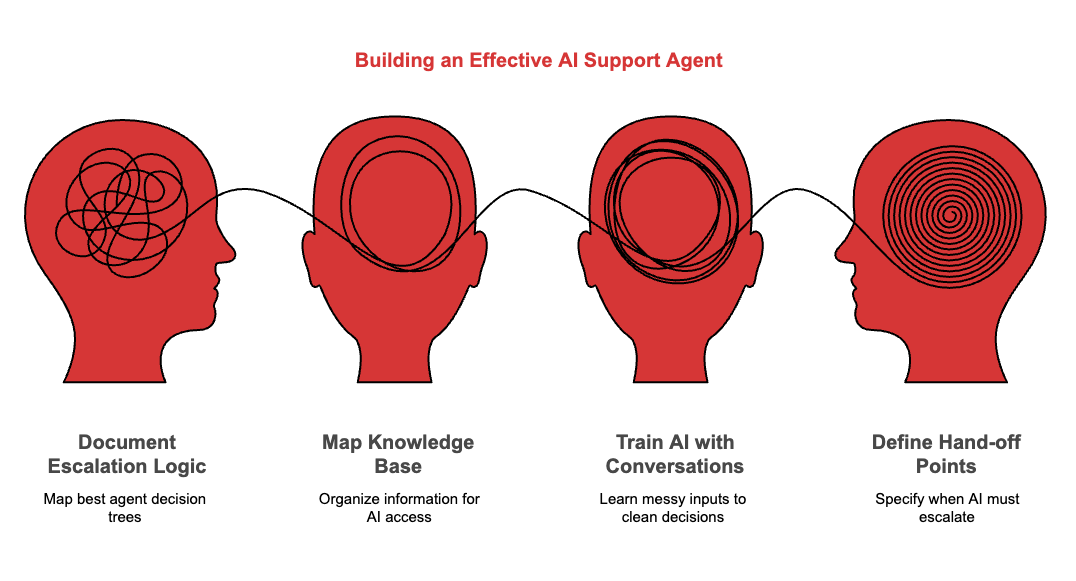
But here’s the part that matters even if you never build the AI agent: Steps 1 to 3 produce a documented escalation playbook your human team can use immediately. New hires follow it on day one. Senior agents stop getting pulled into tickets they shouldn’t be handling. The AI layer is a bonus, not a prerequisite.
The difference between support teams that automate well and those that waste money on chatbots comes down to one thing: whether they documented the logic before they deployed the technology.
Let me show you the exact workflow.
Your coworkers are using the same free prompts as everyone else. Premium members get the workflows that create separation.
Part one builds the human playbook
Before any AI touches a ticket, you need three things: a map of your support operation, decision trees for your highest-impact issue types, and an operational kit with handoff protocols and scripts.
Map first, build second
Step 1 asks you to describe your support operation in plain language. No forms, no placeholder brackets, just a few honest sentences about your team, your tools, and what breaks most often. The AI reads your description and produces a proposed tier structure, a ranked list of your top issue types by escalation frequency and customer impact, and its best guess at where tickets get stuck.
Then it asks you 3 to 5 targeted questions to fill gaps. Yes/no or one-sentence answers. You correct anything it got wrong, confirm the rest, and walk away with a validated support map.
This map alone is worth the exercise. Most support managers have never seen their operation laid out this cleanly.


