


Hi Adopter,
Everyone is sick of AI right now, and they are not wrong to be. The frustration is real, the mandates are real, and a wave of new data backs all of it. But the conclusion underneath the noise, that AI itself is the problem, is wrong, and getting it wrong is about to be expensive. Read to the end and you will have one clean test for whether AI is making you sharper or quietly making you replaceable, and you will know which side of the split now forming you want to be standing on.
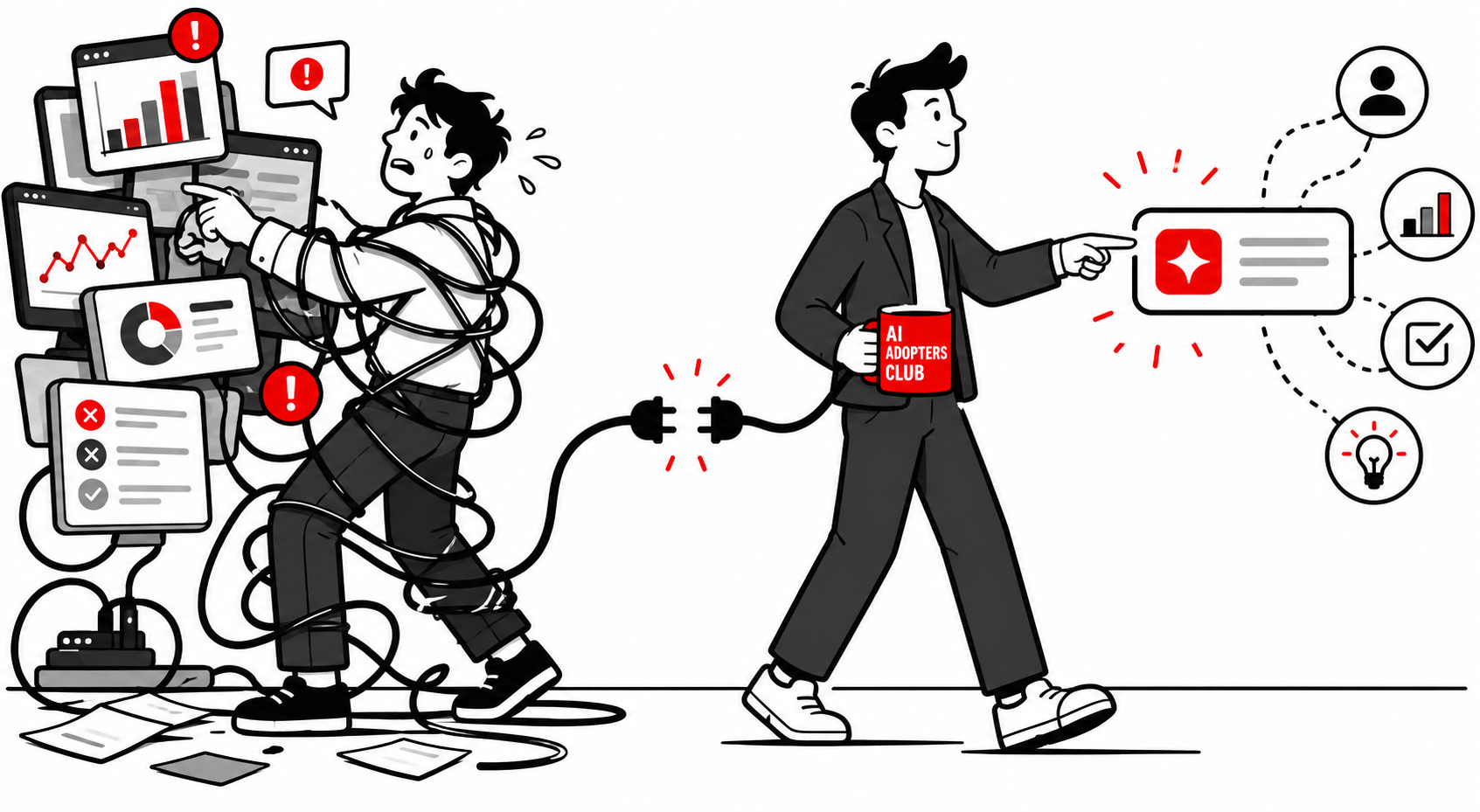
“Nobody actually wants AI anymore.” That video, and the forty like it, are pulling millions of views this month. The hotel bot with the fake Southern charm that swears it is human, then transfers you to another bot. Amazon’s Rufus introducing itself with a disclaimer that it might get things wrong. The “leverage AI to complete this task” email that lands like an insult to anyone who spent years learning their craft.
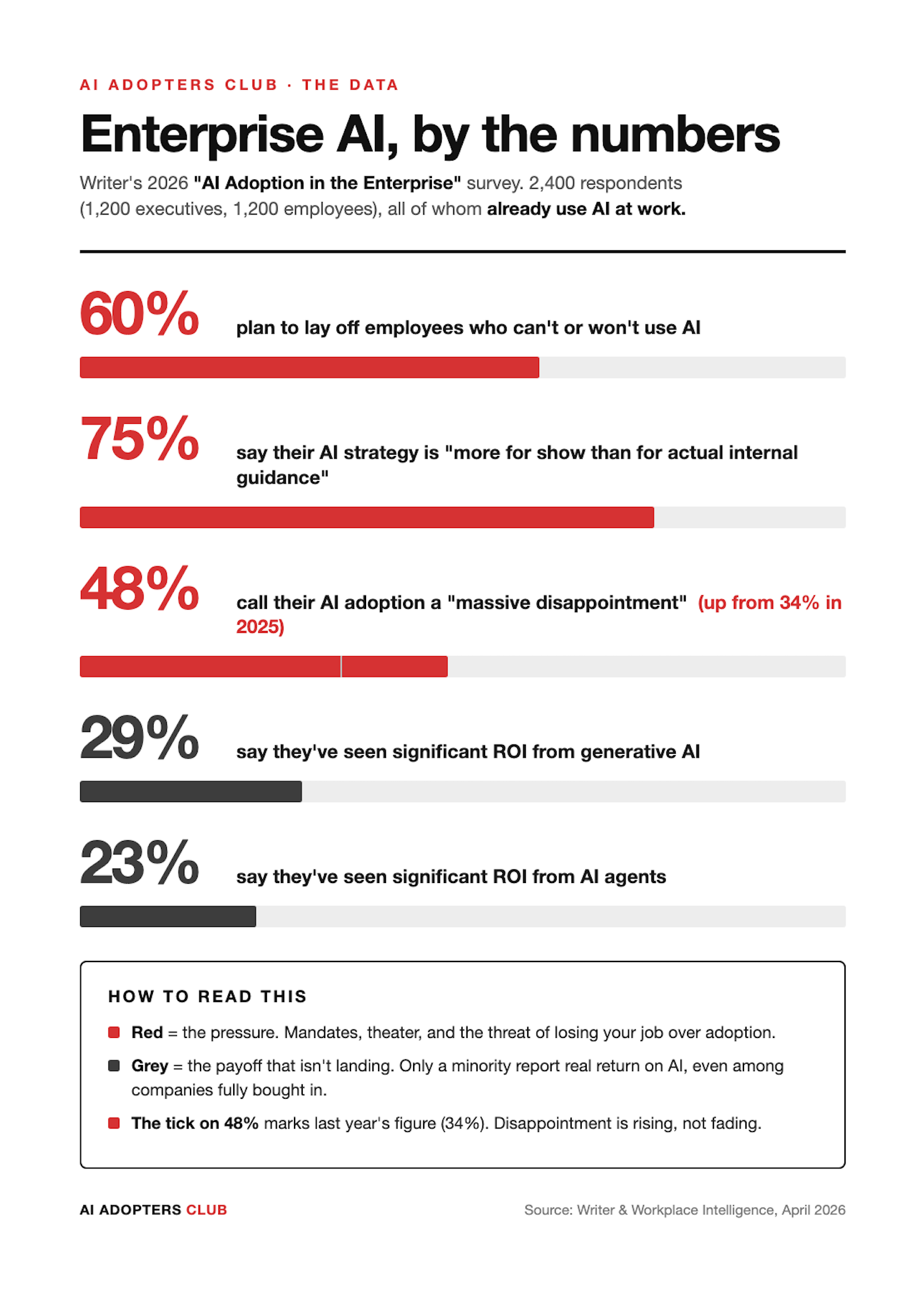
The frustration is real, and the data backs it. Writer’s 2026 enterprise survey asked 2,400 people who already use AI at work. Forty-eight percent of leaders now call their company’s AI adoption a “massive disappointment,” up from 34% a year earlier. Only 29% report meaningful return from generative AI, 23% from agents. Three in four executives admit their AI strategy is “more for show than for actual internal guidance.” And 60% say they plan to lay off employees who can’t or won’t use it.
Tools that mostly do not pay off, mandated by people who admit it is theater, enforced with your job. The anger is earned. Anyone telling you to just be more positive has not read the room.
And it is not only the bots. This May, former Google CEO Eric Schmidt stood in front of ten thousand University of Arizona graduates, told them AI would shape their world, and said that when someone offers you a seat on the rocket ship you do not ask which seat, you just get on. A good part of the stadium booed him. Some of that was organized, and it was not only about AI. But the nerve it hit was real: nobody wants to be handed the future by the people who already cashed out of the present.
But the video makes one move that will cost you if you accept it: it aims all that justified anger at a single target. AI itself. The tool.
Look at what is underneath the complaints and you find two different things wearing the same word. There is AI as theater: the usage dashboards, the slop, the mandate, the budget somebody upstairs has to justify. And there is AI as leverage. The same month those videos went viral, Uber’s engineers tore through a full year’s AI-tools budget in four months. Nobody forced them. Seventy percent of their code commits now involve AI. ChatGPT crossed 900 million weekly users. That is not compliance. That is pull.
The backlash is not a referendum on whether AI is useful. It is the sound of those two things separating, and the fatigue is what it feels like to be handed the theater version and told it is the leverage version.
Here is the part nobody quoting the scary research mentions. The most-cited study on AI making people worse, a five-university trial this spring, found the damage was real but concentrated entirely in people who used AI to get direct answers. The people who used it for hints and kept thinking showed no measurable decline. The same study being passed around to prove AI rots your brain proves something narrower and far more useful.
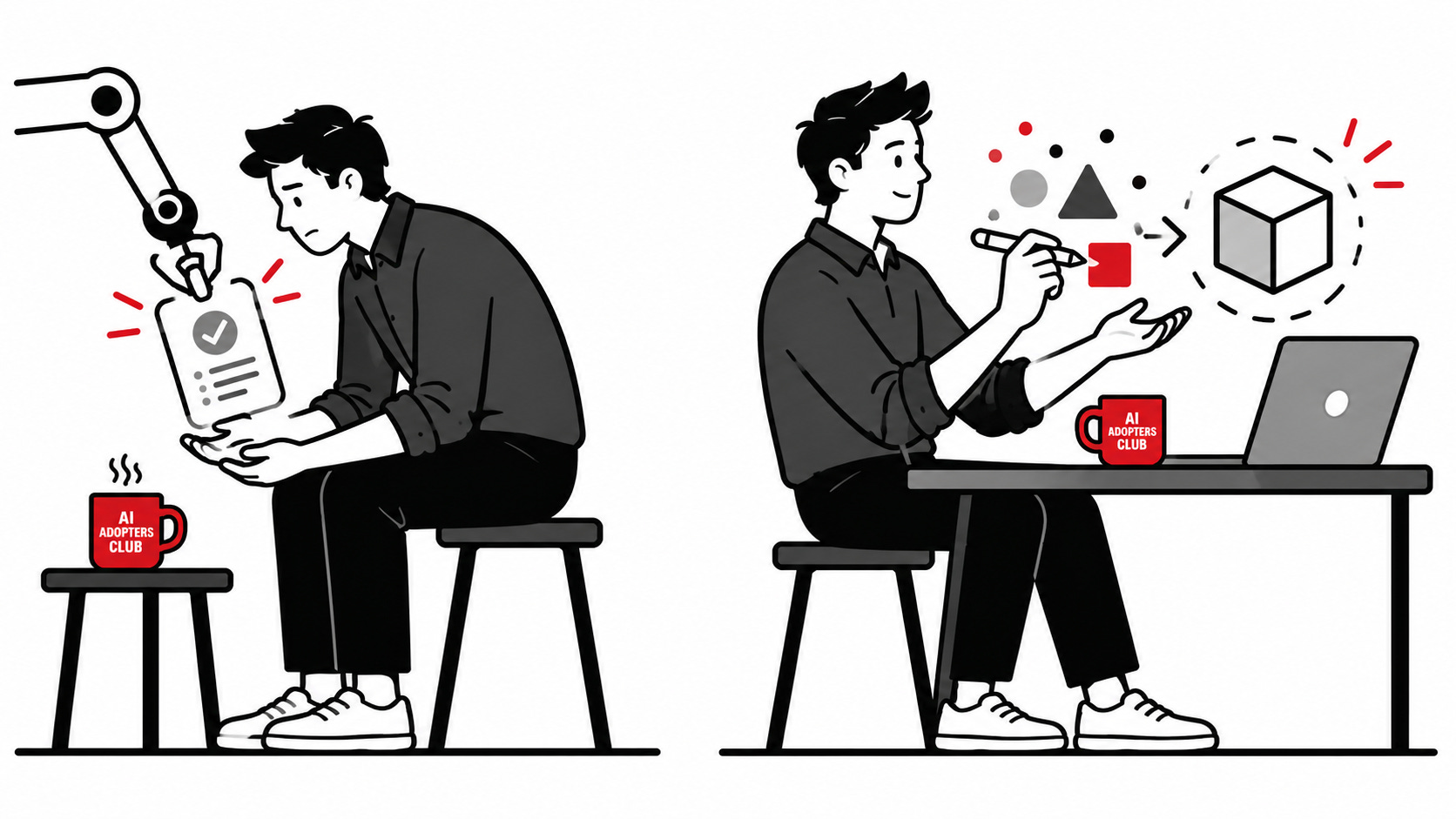
The villain was never the tool. It was the posture.
Which makes the backlash the best news an adopter has gotten all year, if you can read it. The market is sorting people into two piles right now, and you can tell which one you are landing in with a single question: is the tool making your judgment sharper, or replacing it?
Stay on the right side of that line.
Refuse oracle mode. Use AI for the messy middle: drafts, options, pressure-testing your own thinking. Never the final call. The moment you stop checking its work is the moment you join the pile that atrophies.
Build a loop, not a habit. A repeatable workflow with a verification step beats scattered prompting. Those enterprise disappointment numbers come from companies that bought tools and skipped the redesign. Do not make the same mistake at the scale of one.
Watch your own load. The “brain fry” study everyone cites (BCG, 1,488 workers) found productivity rising as people went from one tool to three, then falling at four or more. More agents is not more leverage. Mastery is.
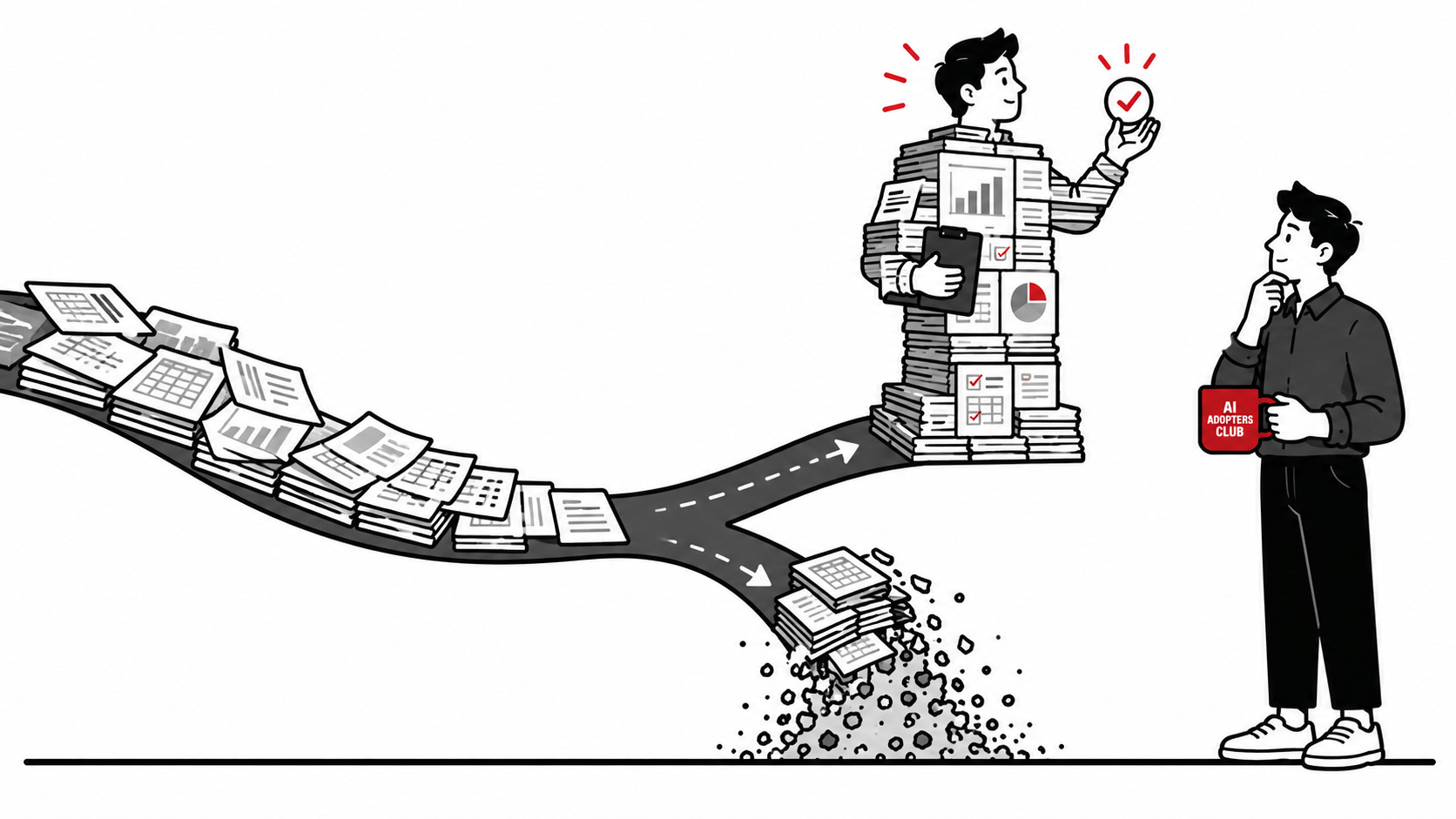
The last time a tool sorted a profession this hard, it was the spreadsheet. (VisiCalc, the first one, shipped in 1979 and turned the personal computer from a hobbyist toy into a serious business machine almost overnight.) Bookkeeping roles fell by about a third over the following decades. The people who moved up into analysis and judgment became more valuable, not less. The difference this time is the mandate bolted on top, and that mandate is exactly what people are revolting against. Fair enough. But VisiCalc never waited for anyone’s permission, and neither will this.
Nobody is coming to sort it for you. That is not the threat the video thinks it is. It is the opening. If this reached you because someone forwarded it, they were telling you something: you are probably already the kind of person who can tell theater from leverage. The people who can, and who keep their own judgment in the loop, are about to be worth a great deal. Everyone else is waiting for a rescue that was never on the schedule.
Adapt & Create,
Kamil
Go deeper. Everything above traces to a primary source:
The video that started it: “Nobody Actually Wants AI Anymore”
The commencement that went viral: Eric Schmidt booed at the University of Arizona, May 2026 (press coverage)
The enterprise data: Writer, “AI Adoption in the Enterprise,” 2026
The persistence study: Liu et al., “AI Assistance Reduces Persistence and Hurts Independent Performance,” 2026
The cognitive-load study: BCG / HBR, “When Using AI Leads to Brain Fry,” March 2026
The Uber numbers: Uber’s Anthropic push, via Yahoo Finance
The usage figure: OpenAI, “Scaling AI for everyone,” Feb 2026


