Hey Adopter,
The greeting card industry should be dead. WhatsApp is free. iMessage takes three seconds. Yet Hallmark still moves 6 billion cards a year.
Generative AI should have been the final nail. Tools that write poems in milliseconds obliterate the “effort premium” that makes a $6 card worth buying. But Hallmark looked at the same tools everyone else was racing to deploy and made a different bet entirely.
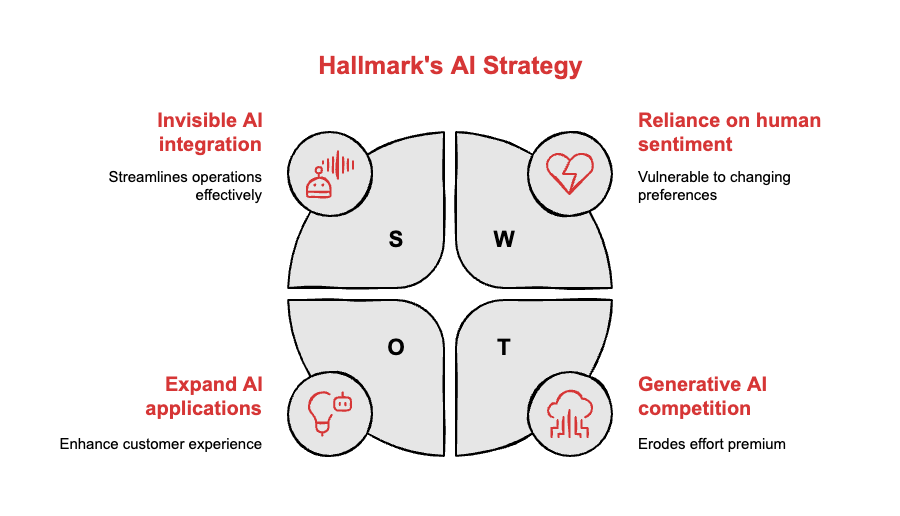
They decided AI should be invisible.
While competitors like Moonpig now use AI to write your messages for you, Hallmark pointed their algorithms at everything except the words on the card. Supply chains. Inventory. Workflow. The operational scaffolding that gets human sentiment from your hand to someone’s mailbox.
The result is a masterclass in knowing what AI should touch, and what it should leave alone
.
The strategy that flips common wisdom on its head
Most AI adoption stories follow a predictable arc. Company launches chatbot. Company launches AI writing assistant. Company announces they are “reimagining” their product with generative tools.
Hallmark’s playbook is the opposite. Their leadership calls it “Preservationist Innovation”, a framework that uses machine learning to protect the human core of the product rather than replace it.
Think about that for a moment. A century-old card company has built a more coherent AI strategy than most tech firms.
The full case study breaks down exactly how they did it, and why smaller operators can steal the same approach without Hallmark’s budget.
Download the full report to get:
The “Recipient Graph” architecture that outperforms standard recommendation engines by tracking relationship history, not purchase history
The exact infrastructure stack that cut total cost of ownership by 60% while funding AI experimentation
A side-by-side analysis of Hallmark vs Moonpig vs Shutterfly, showing three distinct AI philosophies in the same market
The “Sign & Send” product design that succeeded by making AI invisible, next to the “Video Greetings” failure that proved adding friction kills adoption
A framework for “Human-in-the-Loop” creative workflows that protect brand quality without slowing output
The economics of “invisible” over “impressive”
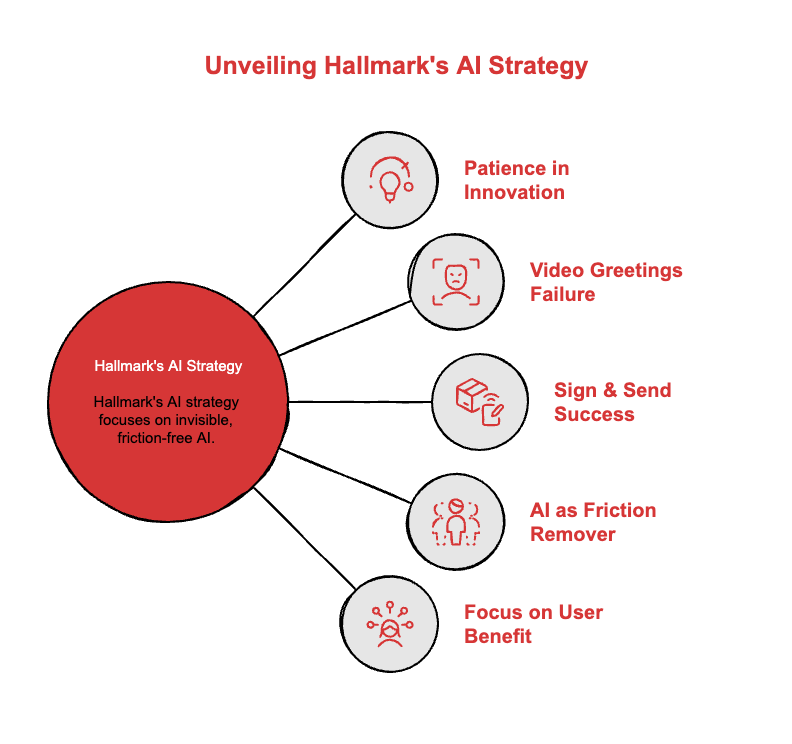
Hallmark’s private ownership gives them something public companies cannot afford: patience. While listed firms scrambled to announce GenAI features to satisfy Wall Street, Hallmark could quietly kill failed experiments without tanking their stock.
Their Video Greetings product, a high-profile initiative that let recipients scan QR codes to watch personalized video montages, was discontinued by 2025. The friction was too high. Scanning a code interrupts the emotional moment. Users already have better, free tools for sending videos.
The lesson Hallmark took from this failure is worth more than most AI strategy decks: AI should remove friction, not add it.
Sign & Send, by contrast, works precisely because users do not feel like they are using AI. You photograph your handwritten message. The app uses computer vision to extract it. Hallmark prints it on a physical card and mails it for you. The customer experiences convenience. The AI stays in the background.
For SMB operators watching larger competitors announce flashy AI features, this is the counterargument. The question is not “how do we use AI that customers notice?” It is “how do we use AI that customers benefit from without ever thinking about?
”
Why recommendation engines failed them, and what they built instead
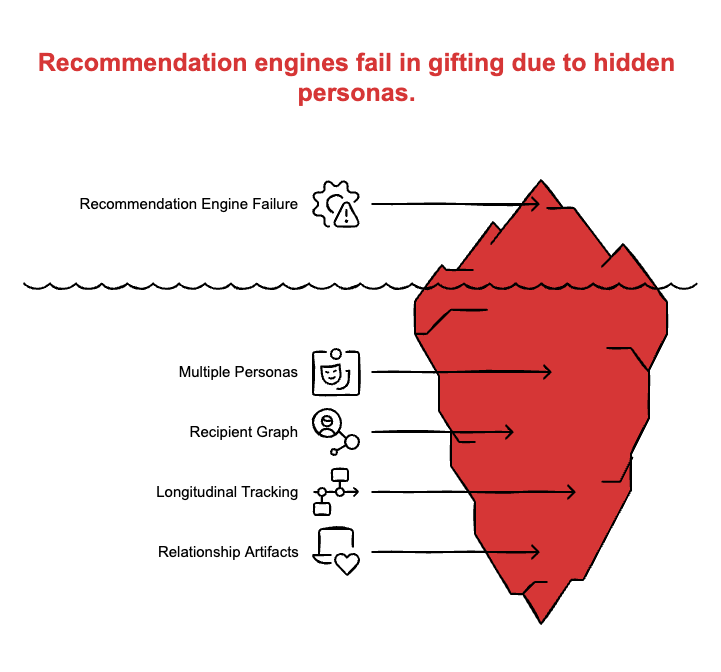
E-commerce recommendation logic breaks in the gifting industry. Standard collaborative filtering says “users who bought X also bought Y.” Works fine for camping gear.
It fails catastrophically for greeting cards.
A single buyer acts as multiple personas. The same 35-year-old woman is a daughter buying for her mother, a wife buying for her husband, and a manager buying for an employee. Recommending a romantic Valentine’s card because she previously bought a romantic anniversary card is a disaster if her current search is for a sympathy card.
Hallmark’s data team, led by executives like Chai Pallapothula, built a custom “Recipient Graph” that creates shadow profiles for the people you buy cards for, not for you. When you log in, the system asks “who is this person buying for today?” not “what does this person buy?”
If the system detects you purchase a card for “Mom” every May and every October, it builds a profile for your mother. The next Mother’s Day, it recommends cards that match the tone of the birthday card you bought in October.
This longitudinal relationship tracking is their moat. Amazon sells cards as commodities. Hallmark sells them as artifacts of tracked relationship history.
For any business selling products that are purchased for others rather than the buyer, this distinction matters enormously.