


No time to read?
Just drop this TL;DR prompt into your AI and have a conversation.
Hi Adopter,
A customer calls after hours with no heat. The office is closed, the technician schedule is changing, and the decision lands back with the owner.
Repeat that every evening, then add pricing, complaints, scheduling, and staff questions. One important process still depends too much on you.
Rescue Air & Plumbing offers a useful case. According to Avoca’s Rescue account, its AI customer service representative answers inbound calls and books appointments in the company’s CRM. Avoca also says its Coach product scores conversations against Rescue’s service rules, and that two customer service representatives moved into management without replacements being hired for their old jobs.

Those are vendor and operator reports, not audited results. The Boxwood deal record separately documents Rescue’s majority sale in December 2023. A Boxwood transaction roundup names HomeTown Services as the buyer, and HomeTown’s brand list includes Rescue. In an Avoca founder interview, Rescue’s founders said buyers were interested in their AI tools. No public source gives the price, a buyer statement about AI, or proof of an AI premium. Today’s named products and results also can’t be projected backward to the sale.
Still, the operating lesson matters. Focus on one customer call becoming a correct appointment, a useful record, and a clear next action without dragging the owner back in. The published account doesn’t measure total human checking time. That’s something I’d test, not assume.
CRM, in plain English: the system holding customer and job records. A booking only helps if the right details reach the team doing the work.
Start with the interruption
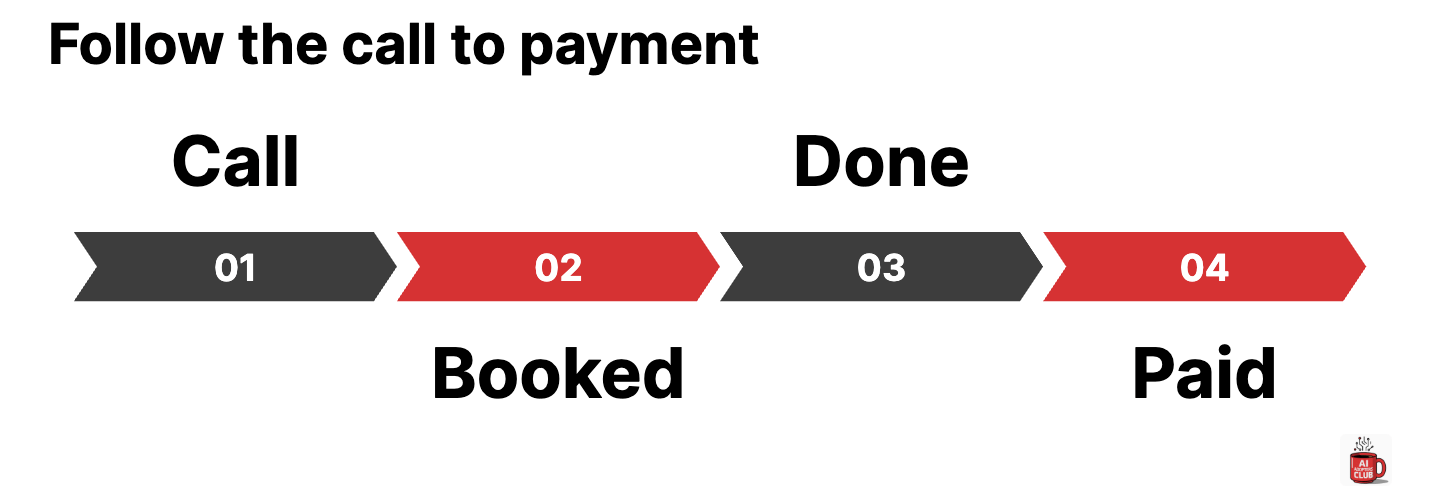
Write down every time someone needed you last week. Pick one repeated task with rules you can explain. For phone intake, separate an answered call from a correct booking, a completed job, and collected payment. Those are four different results.
Count the time spent checking and correcting calls, including those that never become bookings. Add exception handling and upkeep across the whole team, not only the owner. Moving the interruption from your phone to someone else’s review queue hasn’t necessarily improved the process. Track setup time separately, then compare ongoing human minutes per correct booking without lowering the quality bar.
You also need intelligence independence. Keep your own booking rules, escalation instructions, examples, and performance records. If the vendor changes, you should still understand how the work gets done.
Below, I’ve laid out a 30-day test, the owners and safety fallback, a financial worksheet, and the continue, change, or stop decision. The premium case study adds the evidence review and four fillable worksheets for your team.
The 15-page Rescue Air case study contains the full evidence review and four fillable worksheets for your team.

Design the handoff before you automate it
Here’s the phone workflow I’d test. This is our proposed design, not a verified map of Rescue’s architecture.
The AI interprets why the customer is calling and captures the details.
Ordinary software checks the service area, service type, technician capacity, and real calendar availability.
A named person handles exceptions, including complaints, safety concerns, unavailable appointments, out-of-area requests, and callers who want a human.
The integration confirms the appointment was saved in the job system before the customer is told it’s booked.
That last check matters. A confident voice saying “you’re all set” is not a booking if nothing reached the calendar.
Run one 30-day test
Choose after-hours or overflow calls, not every call. Name one owner for intake, one for technician capacity, and one for emergency routing and the human fallback.
For days 1–5, record the current numbers: eligible calls, correct bookings, cancellations, completed jobs, collected revenue, staff minutes, and errors. For days 6–10, write the booking rules and test awkward cases, including an unavailable appointment, a repeat caller, a complaint, an out-of-area request, a caller asking for a person, and a safety-critical problem.
For days 11–25, run the limited workflow with a person ready to take over. Review every booking at first, including routine ones that appear correct. For days 26–30, compare results and calculate contribution. Stop immediately if emergency routing fails, required human help is unavailable, or customer information reaches an unapproved system.
Intense review at the start is normal. It should not become a growing job supervising the AI. Reduce review only after the workflow demonstrates reliable performance, and only where the risk allows it. Keep human judgment on safety, complaints, unusual requests, and policy changes. Keep sampling ordinary bookings too. If errors rise, return to the previous review level.
Eval*: testing the workflow against agreed examples and rules. “The demo sounded good” doesn’t count.
Do the math without fooling yourself
Here’s invented arithmetic to show the method. It is not a Rescue result.
Say 100 eligible after-hours calls produced 10 bookings before the test and 30 during it. If 80% of bookings become completed, paid jobs, the increase is 16 jobs. At $180 contribution per job, that’s $2,880.
Now subtract $900 for software, $600 for staff review, and $200 for errors and rework. The illustrative monthly operating contribution is $1,180.
Contribution*: collected revenue minus the cost of delivering the job. Revenue alone doesn’t tell you whether extra bookings helped.
Don’t count saved hours as cash unless they reduce overtime or support measured additional work. Don’t count the same staff capacity once as labor savings and again as new revenue. And don’t compare a busy month with a quiet one and hand the difference to AI.
Decide what happens next
Continue when safety and service checks pass, completed paid work increases, ongoing human effort per correct booking falls, and conservative contribution stays positive after review and rework.
Change when calls are recovered but scheduling, service quality, or staff workload gets worse. Narrow the hours, rewrite the rules, or improve the fallback, then test again.
Stop when safety escalation fails, errors stay above your agreed limit, or the benefit disappears after the real costs are included.
The Top Flight Electric account reports relief from night and weekend calls, but its revenue figures conflict and aren’t independently audited. The Apollo Home account reports using recorded field conversations to coach more technicians. Both illustrate a specific task with a human owner. Measure finished work in your own test.
Keep your instructions, accepted examples, records, exports, and fallback procedure. Check local recording and disclosure requirements, who owns recordings, whether data trains models, and what happens if the vendor fails. Intelligence independence matters when the process touches customers.
If you’re following this idea, start with AI babysitting to spot the hidden cleanup. Read accepted work to measure the whole team’s effort. Then try the Toyota case study, which looks at making specialist knowledge easier to reach without constantly asking the same experienced person. The first two are free. Toyota has a free preview and a premium implementation section.
Want help with the first test?
If you want help choosing and testing one task, take a look at my one-to-one AI coaching. We’ll start with one bottleneck in your business and build from there.
What’s the one interruption you’d stop carrying first?
Adapt and Create, Kamil