


Hi Adopter,
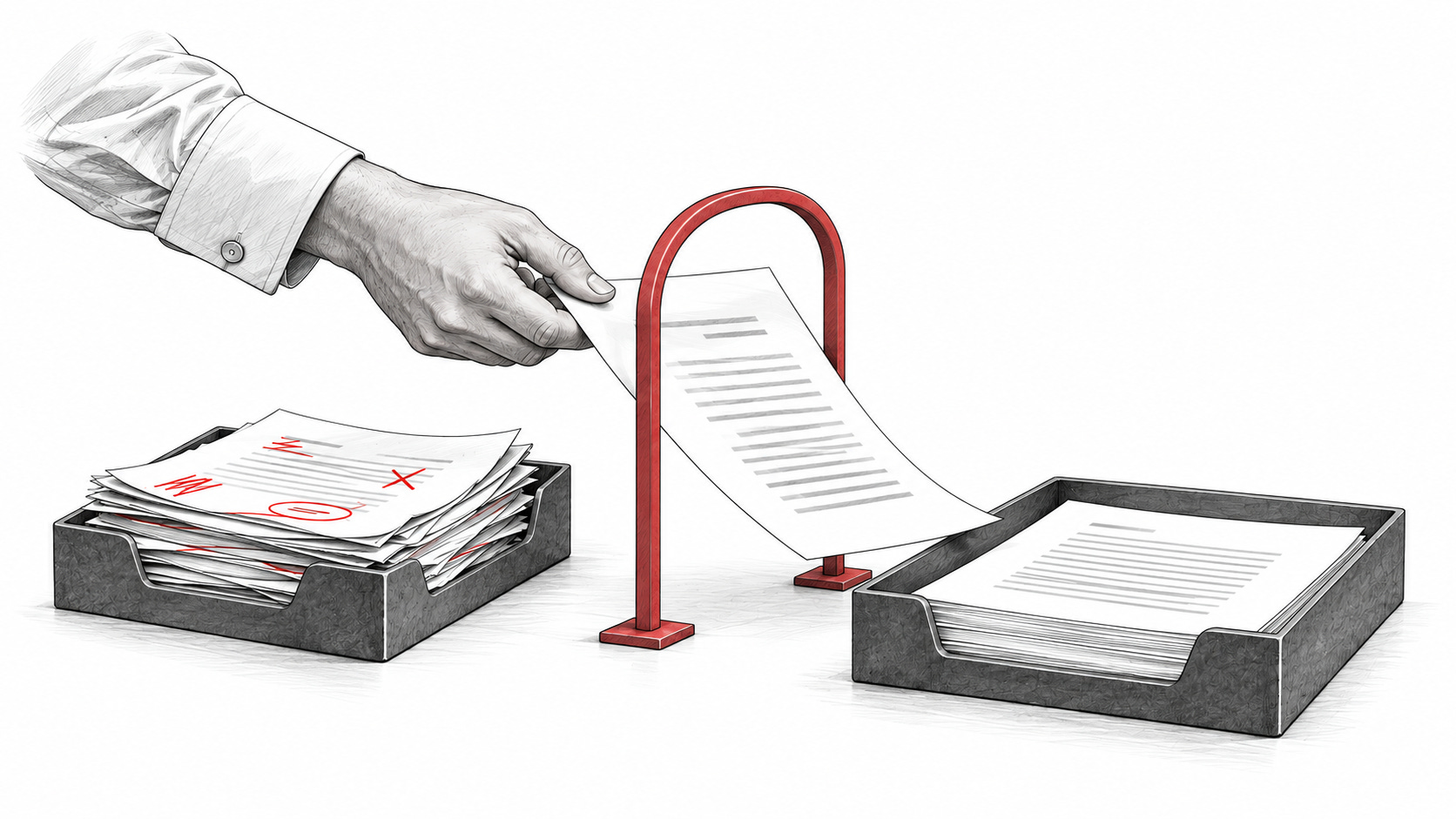
Your team uses AI to finish a proposal faster. Someone else checks the pricing, rewrites the recommendation, and asks where the customer quote came from. Before you count the time saved, count their time too.
That’s why I’d put this question in your next leadership meeting: How much accepted work are we producing per unit of human attention?
You can start answering it with one recurring workflow and the tracker you already use. The useful result is a proposal someone can send, a support case resolved, or a change ready to deploy. A pile of drafts doesn’t count.
Make the question measurable
Agree on two definitions before you change anything.
Accepted work means a complete business task that meets checks agreed with the person receiving it. For a sales proposal, that might mean approved pricing, requirements tied to discovery notes, and delivery promises the delivery team has signed off on. Count the whole proposal once, not every section AI helped write.
Human attention needs a practical proxy. Start with active human hours spent preparing, producing, checking, and correcting the output through acceptance. Include the recipient’s review and handling, but exclude the ordinary business activity that follows accepted work. Hours won’t capture every difference in cognitive effort, so keep specialist review bottlenecks visible too.
Your starting measure is:
Accepted jobs ÷ total human hours spent on all attempted jobs.
Here’s an illustrative comparison. Your team attempts ten comparable proposals. Eight are accepted, and the whole batch takes ten human hours. That’s 0.8 accepted proposals per hour. A later batch produces nine accepted proposals in nine hours. That’s 1 per hour, provided the scope and quality standard are the same.
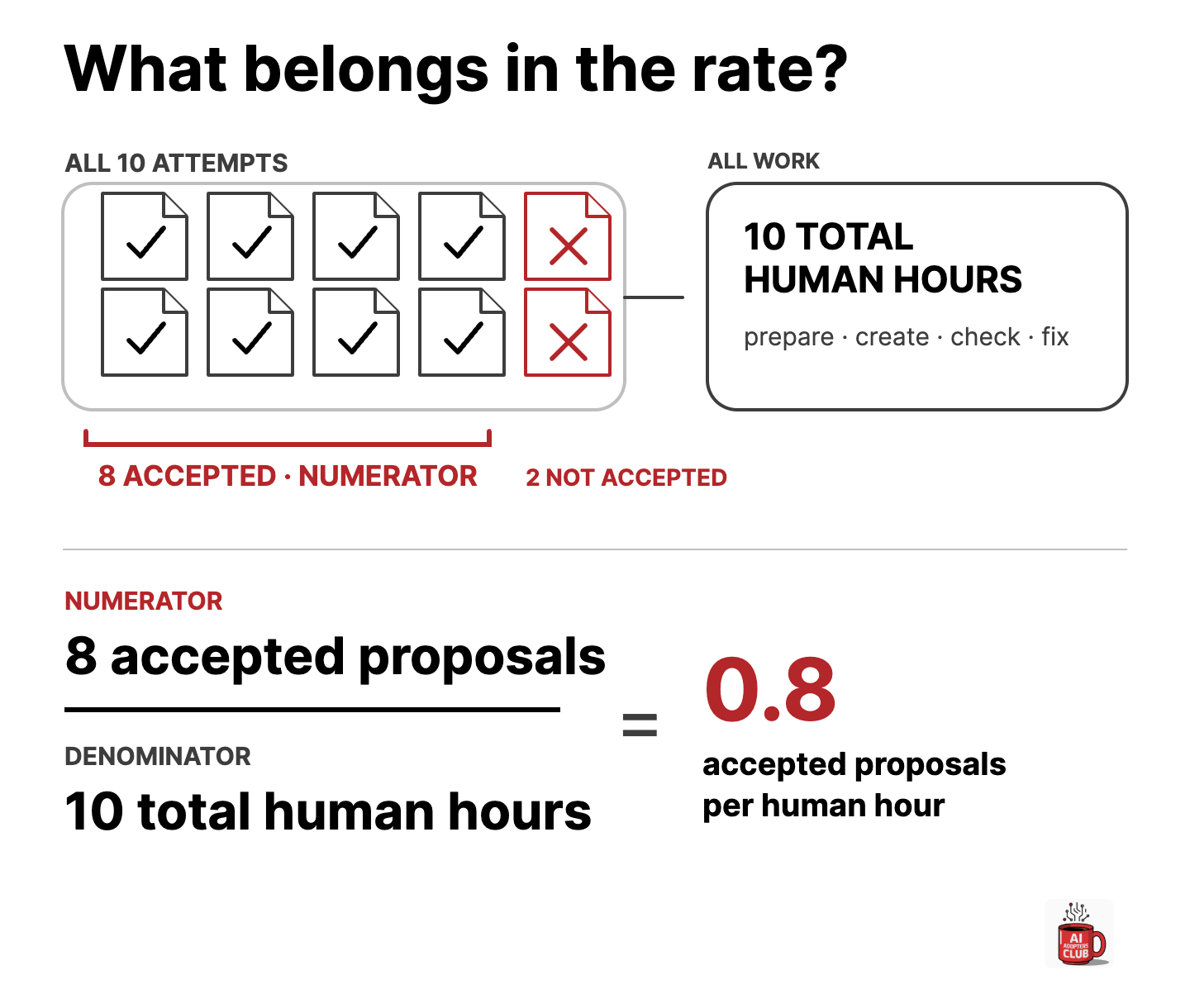
Keep the time spent on rejected work in the denominator. Otherwise, the dashboard quietly deletes the failures. Track turnaround time separately, because ten minutes of approval can still hold up a deal for three days.
Improve the ratio without lowering the standard
There’s evidence for measuring beyond the first draft. In a September 2025 BetterUp Labs and Stanford Social Media Lab survey of 1,150 full-time U.S. desk workers, 40% reported receiving “workslop” in the previous month. Recipients estimated about two hours to resolve an incident. Those are self-reported experiences, not measured company-wide productivity losses.
AI’s value also varies by task. A randomized experiment with 758 BCG consultants using GPT-4, first reported in 2023, found better performance within the model’s capabilities and worse correctness on a task outside them.
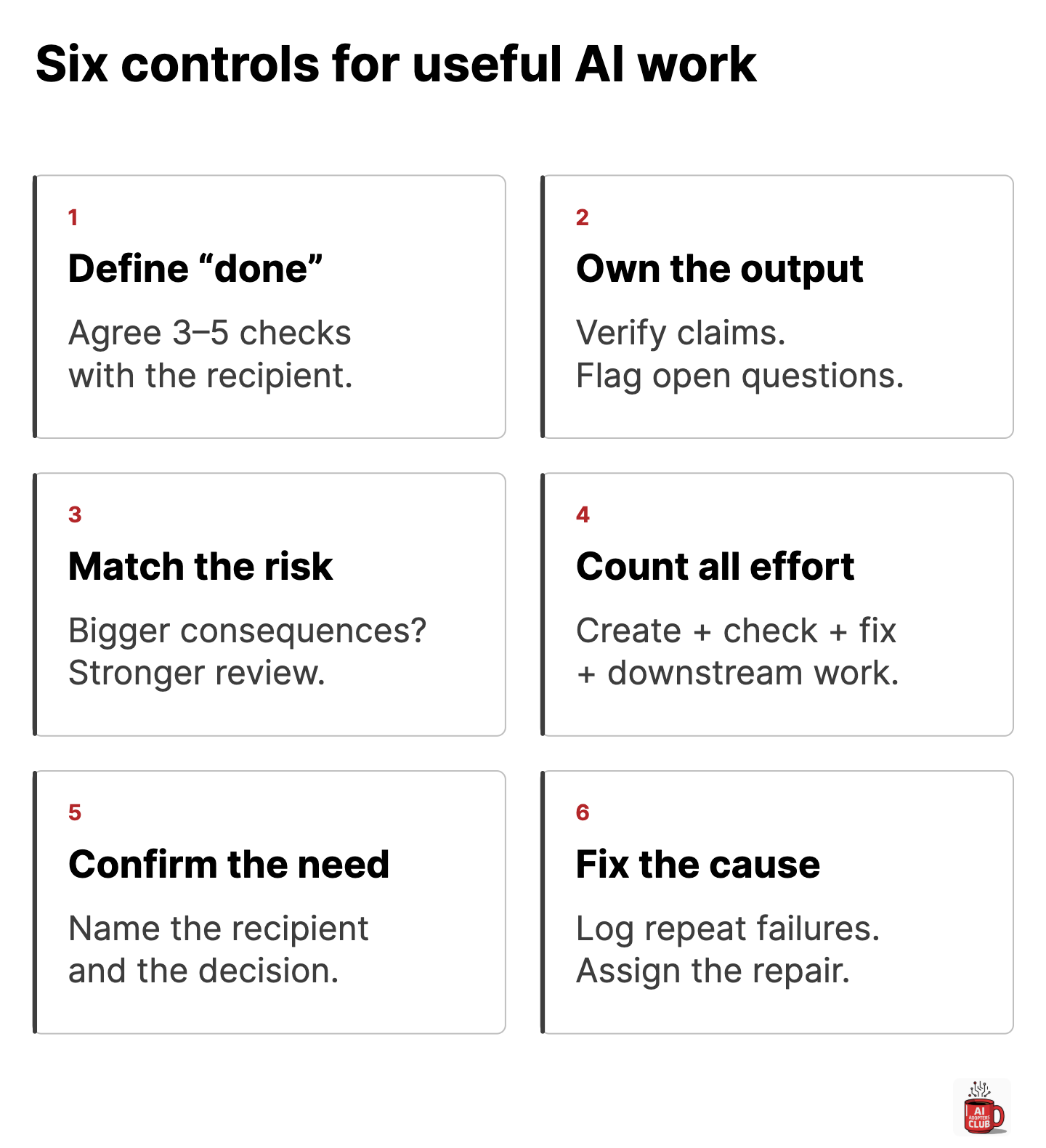
I’d use six controls to find out what improves your own workflow.
1. Agree on acceptance before generating. Write three to five checks with the recipient. Specify the permitted tools, data, and source material. The checks should describe usable work, not whether someone followed a prompting technique.
2. Keep ownership with the sender. If AI helped you produce it, you still own it. Verify important claims and link the evidence before handing work over. Name unresolved questions. Managers need to provide the time and expertise to do that checking; responsibility without support becomes a ceremonial tick in a box.
3. Match review to consequence. Private brainstorming gets an owner check. A team recommendation needs checks against original sources. A contractual promise needs the designated specialist’s approval. Agree on review triggers once and use existing approval owners. The same paragraph carries different risks in a scratchpad and a customer commitment.
4. Make the full effort visible. Record rough active minutes once per job, split into preparation/drafting, checking/fixes, and downstream work. Use existing time records where available and label estimates. Count each minute once. Necessary review isn’t waste, but it still belongs in the calculation.
5. Check whether the work is needed. Name the recipient and the decision or action the output supports. Keep required records; stop producing unrequested variations. Don’t improve your ratio by generating easy documents nobody needs.
6. Fix whatever keeps coming back. Log why work gets returned. Wrong prices should change the pricing source or validation check. Unsupported promises should change the template and approval route. Give someone responsibility for that fix, so checking gets easier with each batch.
These are practical proposals, consistent with NIST’s voluntary AI risk guidance on responsibilities, testing, risk-based priorities, and learning from failures. They aren’t a proven productivity intervention.
Run it in your organization
Pick one workflow and name its owner. Agree on the acceptance checks, risk level, and a simple difficulty measure. Compare the last ten consecutive qualifying jobs with the next ten under the new rules. Record setup effort separately so you can judge whether recurring savings repay it.
Alongside the ratio, track first-pass acceptance, reasons for returns, and errors found after acceptance. Use the same follow-up window for both batches. If a later correction is required, remove that job from the accepted total and include the cleanup time. Zero accepted jobs means zero accepted output per hour. Ten jobs is a diagnostic, not proof of a company-wide gain.
Review the results with the sender and recipient. Pause if a serious error escapes review. Otherwise, fix the biggest repeated source of effort before expanding. Keep scope and quality fixed; don’t chase a higher score by making acceptance easier.
Your AI expert can own this improvement process instead of checking everyone else’s work forever.
Bring the question to your next team meeting. Let the people doing the cleanup help you answer it.
Adapt and Create, Kamil
