


Hey Adopter,
In this article, you’ll learn why most companies automate busy work instead of money work, how the 5% track value differently, and the three-question test to fix your AI spend in 30 days.
You won the adoption battle.
Your team runs AI summaries before meetings. Sales proposals include pre-briefs. Support tickets have root-cause analysis. Usage is up across the board.
Revenue stayed flat. Costs barely moved.
BCG just studied 1,250 companies and found something uncomfortable. 95% see zero measurable ROI from their AI investments. Not because people aren’t using the tools. They are. They’re just using them on work that doesn’t touch money.
The gap isn’t adoption. It’s selection.
The 5% automate dollars, not hours
Here’s what separates winners from everyone else.
The top 5% concentrate 70% of their AI investment in five areas: R&D, sales, digital marketing, manufacturing, and IT infrastructure.
Not HR onboarding. Not internal status updates. Not meeting notes.
The difference shows up in numbers. These functions drive 2x revenue growth and 1.4x cost reductions compared to administrative work. A beauty company deployed AI for personalized consultations across 20+ markets and added $100M in revenue. An electronics firm automated defect detection in 200 factories and targeted $300M in margin gains.
The 95%? They automated the employee handbook and Slack summaries. Time saved, sure. Money made? No.
Your efficiency wins are productivity theater
Here’s the trap most companies fall into.
78% of firms use AI somewhere. 83% see no impact on profit margins. High adoption, zero returns. The problem isn’t the technology. It’s what you’re measuring.
McKinsey found 70% of product teams using AI report revenue increases. 34% see gains over 10%. Supply chain teams cut costs by 20%+ in 61% of cases.
Winners track revenue and cost. Laggards track time saved.
Saving your team three hours a week feels productive. But if those three hours don’t convert to closed deals, shipped features, or reduced escalations, you've automated overhead.
Pfizer cut drug discovery timelines from years to 30 days. Salesforce’s AI lead scoring lifted conversions 30% and cut qualification time 25%. Gong’s sales AI drove 30% quota improvements and closed deals 19% faster.
Notice the pattern. Before and after in dollars, not hours.

Run the 30-day value test
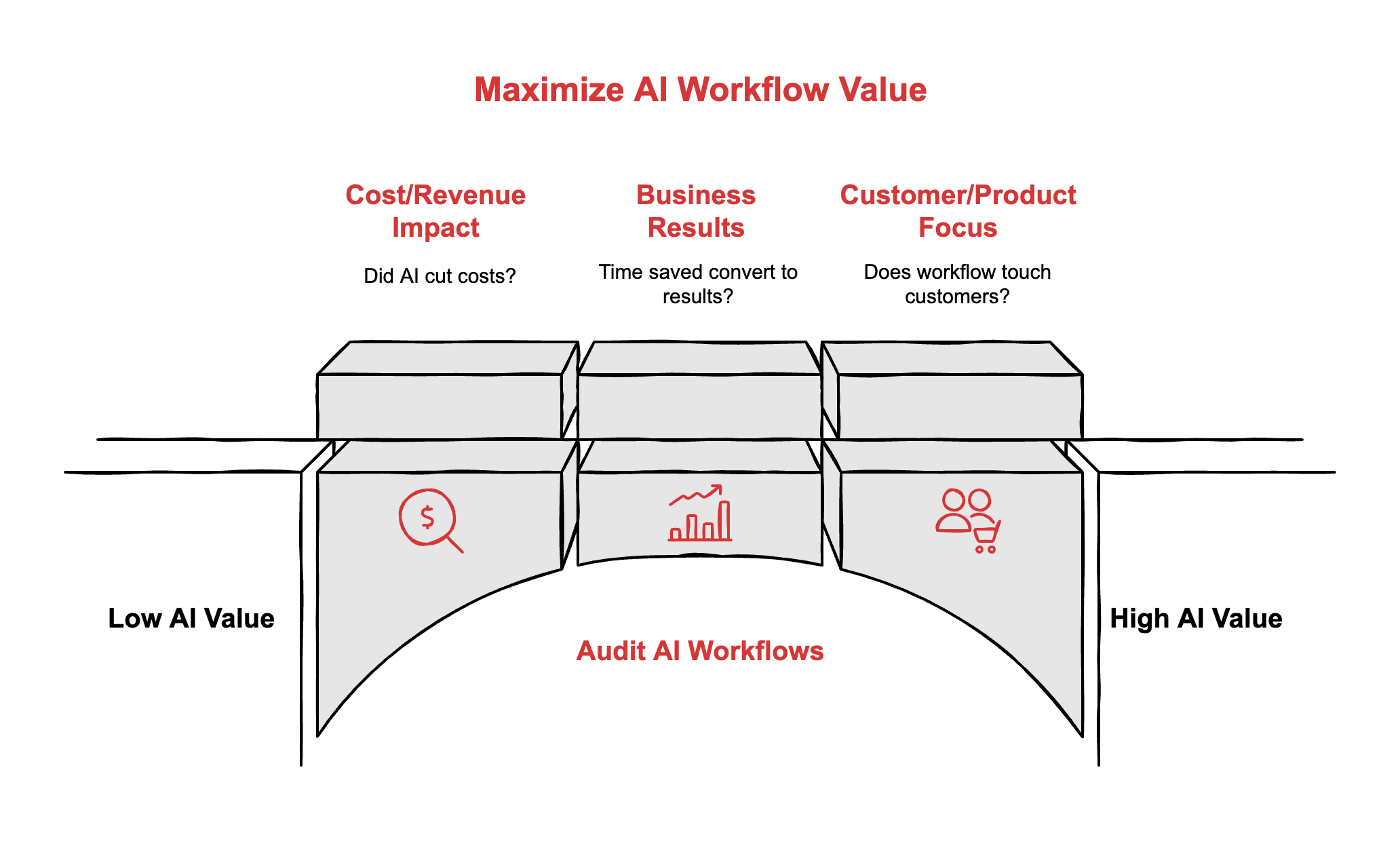
Audit your three highest-volume AI workflows right now. Ask three questions.
Did this cut costs or grow revenue? If the answer is “it saved time,” you’re not done yet. Move to question two.
Did the time saved convert to business results? More deals closed. Fewer support escalations. Faster product velocity. If no, you automated busy work.
Does this workflow touch customers or product? If it’s internal coordination, you’re polishing the engine room while the ship drifts. Customer-facing and product-building workflows generate value. Everything else supports value.
BCG’s data is blunt. IT departments increased AI spend 6% year-over-year. Core revenue functions return 62% more value per dollar.
Stop feeding the functions that feel busy. Feed the ones that make money.
What changes on Monday
Pick one workflow that touches revenue. Not the one with the most volume. The one with the most dollar impact.
Sales pipeline reviews. Customer onboarding sequences. Product roadmap prioritization.
Ask where AI cuts time from money in to money out. Not “saves the team effort.” Cuts onboarding from 19 days to 7. Shortens deal cycles 25%. Ships features 40% faster.
Run it for 30 days. Track the money metric, not the efficiency score.
Here’s a painful stat. Companies use 47% of their SaaS licenses. The other 53% sits idle, burning $21M per year on average.
You don’t need more AI tools. You need them pointed at the right work.
Adapt & Create,
Kamil