


Hey Adopter,
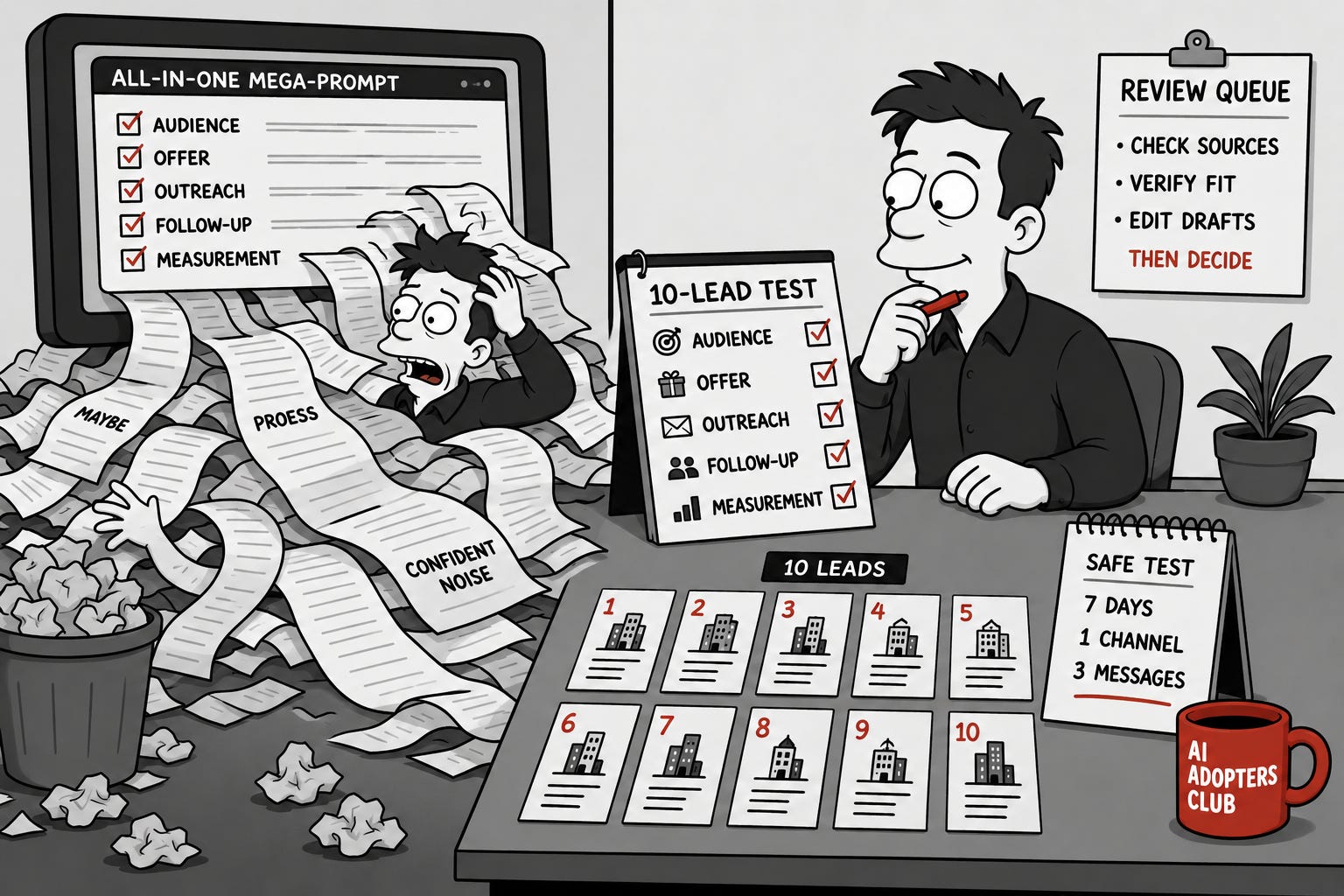
You ask AI to find your audience, create the offer, plan email and LinkedIn, build the follow-up, and decide what success looks like. It hands you a very organized pile of guesses.
Honestly, I get why mega-prompts are popular. They look complete. But the “marketing team” inside that text box knows almost nothing about your company, your customers, or which leads are real.
The prompt asks for “data-driven insights” without naming the data. It wants a comprehensive campaign inside 2,000 characters, with no requirement to show sources, admit what’s missing, or stop before contacting people.
The prompt is trying to skip the work
The five sections are useful. Audience, offer, outreach, follow-up, and measurement. Asking AI to finish all five in one shot isn’t. A long prompt can’t replace missing context.
xAI’s sales-outbound example starts with real accounts and finishes at a review list. OpenAI’s account-prioritization workflow requires source links and missing context, then stops before contacting customers.
Give AI a smaller job and make it show its work. Think fast intern, still supervised.
Keep the useful parts
Keep the five-section structure, but turn it into a test you can judge.
One audience. One offer. One outreach channel. Ten researched companies. Three drafts. Seven days.
Now you can see where AI helps, where it guesses, and how much editing is left.
Run the 10-lead test
Use this with an AI tool that can review approved websites or files. It will learn the business first, then wait for confirmation before researching leads. Keep the first run manual.

Make AI check its own work
Open a fresh chat, paste the result, then use this:
You still need to open every source yourself. AI checking AI is useful, but let’s not make the student grade the final exam alone.
Know what good looks like
For the first run, seven of the 10 leads should survive review, and two of the three drafts should need only light edits. Those are test thresholds, not industry benchmarks. If the output misses, fix the inputs and try again.
Don’t automate the first run. LinkedIn prohibits unauthorized bots from scraping or sending messages. In the U.S., CAN-SPAM covers business-to-business commercial email too. Check your local rules.
Once the process works twice, save it as a reusable instruction or skill. Until then, keep your hands on the wheel.
Sources
xAI, Grok Bot use cases, updated August 11, 2026
xAI, Get started with Grok Bot, updated August 20, 2026
OpenAI, Prioritize accounts, accessed August 24, 2026
LinkedIn, User Agreement, effective November 3, 2025
U.S. Federal Trade Commission, CAN-SPAM Act compliance guide, August 2023, edited January 2024
Your move
Pick one audience. Run the prompt on 10 companies. Review every source before anything leaves your screen.
If the work holds up, build on it. If not, at least AI didn’t introduce itself to half of LinkedIn.
Adapt & Create,
Kamil
About the author
Kamil Banc is an AI culture and adoption advisor. He helps organizations put AI to work through corporate advisory, coaching, and assessments, and publishes the AI Adopters Club. Work with him at aiadopters.club
Kamil, this is exactly why I love what you teach. I have spent decades developing, launching, marketing and selling products, and one thing has never changed: the tool is rarely the problem. It is how you use the tool.
AI is no different.
You cannot throw a generic question at AI and expect it to understand your customer, your business, your history, your offer, your margins, your competition and what makes someone actually reach into their pocket and buy.
Lead generation is not about collecting names. It is about finding the right people, understanding why they might care, and creating a reason for a conversation.
That requires context.
The more I use AI in my businesses, the more I realize it is not replacing decades of experience. It is allowing me to put those decades of experience to work faster.
That distinction matters.
Kamil, you continue to take something that can feel complicated and make it practical for the rest of us. That is why I read your work and why I respect what you are building.
Keep teaching, my friend. Some of us are paying very close attention (especially me).