



Hi Adopter,
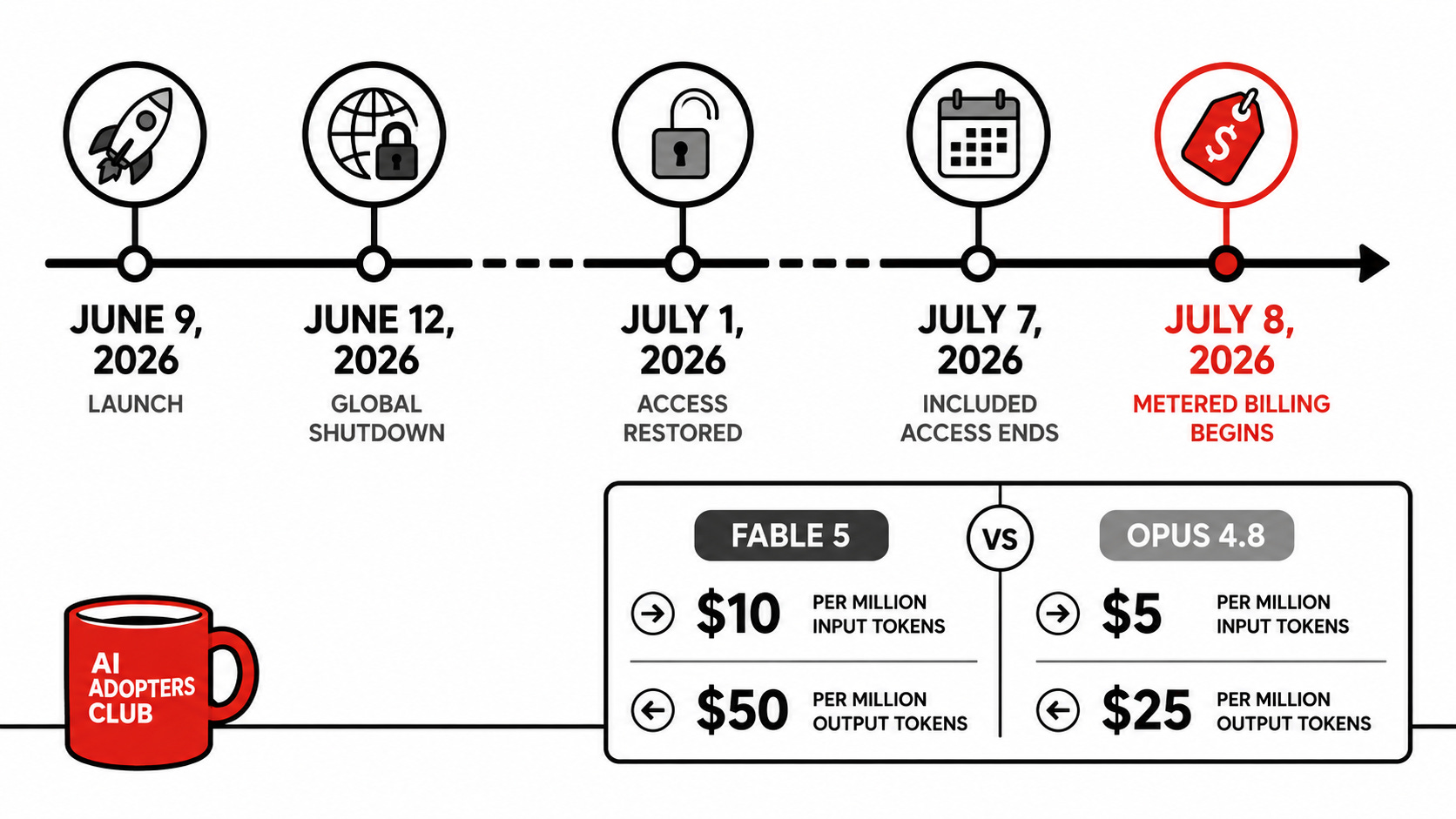
Fable 5 is back in your Pro, Max, or Team plan as of July 1, three weeks after a Commerce Department letter switched it off worldwide overnight. This time Anthropic didn’t get a slow rollout. It got a deadline. Included access, the free ride inside your existing plan, runs through July 7. After that, every token bills at $10 per million input tokens and $50 per million output tokens, exactly double Opus 4.8’s $5 and $25. Four days of the best model Anthropic has ever shipped, free, then a price tag most budgets will flinch at.
The instinct is to build something flashy while it’s cheap. That’s the wrong move. This edition is about what survives the model, not what you build with it.
The playbook already has a name
Some advanced users didn’t need long to work out what a short window with a superior model is for. Within days of Fable 5’s June launch, a convention emerged with a name: the orchestrator playbook. Plan, audit, and spec with the strongest model available, then hand the implementation to models that cost half as much. Claude Code routing guides now treat that split as standard configuration, not a power-user trick.
It sounds backwards. Building feels like the real work, so the best model should build, right? The playbook sends the frontier model somewhere else entirely: at the planning work, the thinking everything downstream gets built on. And the four days left on the clock are the cheap time to do exactly that kind of expensive-model thinking. From July 8, the same planning session runs at double Opus rates.
The part that outlives the price hike
Why plans instead of builds? Anthropic’s own launch language gives half the answer:
“The longer and more complex the task, the larger Fable 5’s lead over our other models.”
Anthropic, Claude Fable 5 and Mythos 5, June 9, 2026
Complexity is exactly where planning mistakes hide, and planning mistakes cost more than implementation mistakes do. The playbook’s write-up put it plainly: “a planning mistake at the top multiplies across every worker downstream,” while “a worker mistake stays local and is cheap to retry.”
That’s the case for spending a scarce, expensive model on audits and specs instead of one-shot builds. A wrong plan poisons everything built on top of it. A wrong implementation detail costs one retry, and a cheaper model can handle the retry fine. The free week isn’t valuable because Fable is smarter. It’s valuable because a spec written this week, with the reasoning built in, still works on July 8, when the model that wrote it costs twice as much to touch.
Three places to point it before July 7
Point it at what your team already runs. Not a new project, the prompts and SOPs people lean on daily. Ask what’s leaking between steps; long chains have a habit of quietly dropping the inputs everyone agreed on at the start, like brand voice and customer language.
Give it your most band-aided system, the one with a commit log full of patches for the same recurring bug. Ask for the root cause, not another fix.
Have it write the spec for the project you keep postponing. Insist the plan carry the why, not merely the what, so whoever implements it later, on Opus or anything cheaper, doesn’t lose the reasoning halfway through.
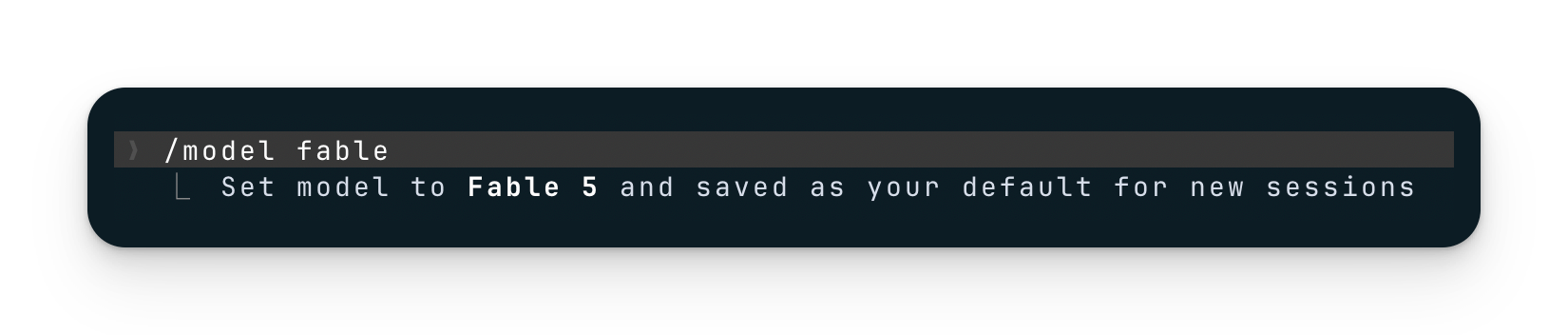
A few mechanics worth knowing. Fable doesn’t show up in the model picker by default; type /model fable to switch to it. On a standard Enterprise seat, none of this is free; your organization bills from day one, unlike Pro, Max, and Team plans. If your workflow runs through AWS, Google Cloud, or Microsoft Foundry, the restoration hasn’t reached you yet. And once July 8 lands, prompt caching cuts cached input costs by 90 percent, batch processing cuts everything else in half, if you keep reaching for Fable anyway.
Now what?
Four days from now, Fable goes back to costing twice as much as Opus, and most people will have spent the window prototyping something a cheaper model could have built almost as well. The ones ahead will be holding a spec, a root cause, and an audit trail that don’t expire when the price does. What will you still be using on July 20, the app you rushed out this week, or the plan that outlasts the model that wrote it?
The premium case study editions run this same kind of teardown every week, if four days isn’t enough time to go deep.
Adapt and Create, Kamil
Sources