


Hey Adopter,
Somewhere in your CRM right now, there’s a list of people who used to pay you money and stopped. You know they’re there. Your team knows they’re there. Nobody’s doing anything about it because win-back campaigns feel like a big, complicated project that requires clean data, segmentation models, and a marketing automation degree.
They don’t.
A win-back campaign is one of the highest-ROI things you can build with AI, and most companies never run one. The maths is simple: acquiring a new customer costs five to seven times more than recovering one who already knows your product. Properly segmented win-back programmes recover 15-30% of churned customers. A single “we miss you” email on its own? A fraction of that.
The difference is structure. Not cleverness, not better copy, not fancier tools. Structure.
Why most win-back attempts fail
The typical approach looks like this: someone in marketing writes a nice email that says “we miss you,” attaches a 20% discount code, blasts it to every cancelled customer from the last year, and wonders why the conversion rate is embarrassing.
Three problems with that. First, you’re treating churn as one event when it’s actually six or seven different events. Someone who left because your pricing didn’t make sense needs a completely different message than someone who left because you didn’t have the feature they wanted. Lump them together and you speak to nobody.
Second, you’re leading with a discount before you’ve reminded them why they cared in the first place. That trains your best former customers to expect a deal every time they consider coming back.
Third, the timing is random. Behavioural research from Wharton (Dai, Milkman, and Riis, 2014) found that people are significantly more likely to take action on goals immediately following what they call “temporal landmarks,” things like the start of a new week, month, quarter, or year. Sending your win-back email on a random Wednesday afternoon is ignoring a free psychological tailwind.
What a proper win-back programme actually looks like
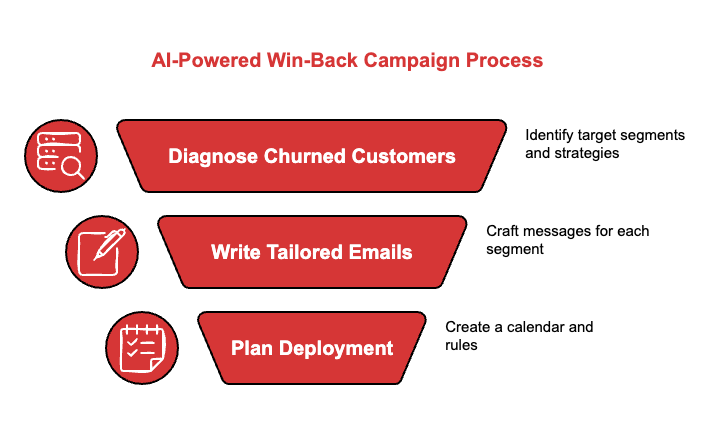
The research across SaaS and e-commerce points to the same four-step sequence every time: segment by reason and value, generate tailored messaging per segment, deploy a timed cadence, then escalate offers based on response behaviour. Each step feeds the next.
I’ve built this into a three-prompt chain you can run in one sitting. Here’s how it works and what you’ll walk away with.