


Hi Adopter,
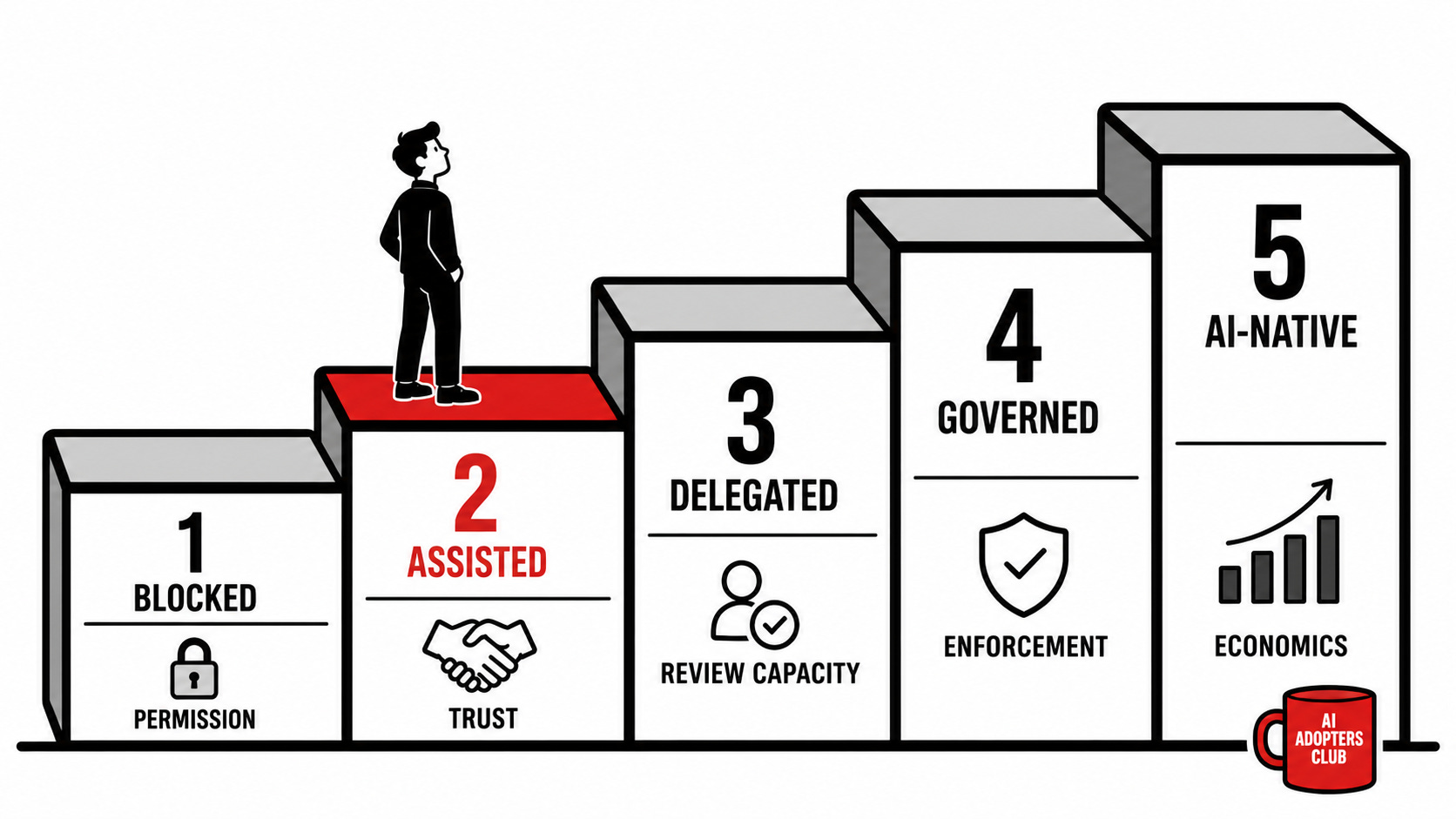
You’ve seen the ladder going around this month. Boris Cherny, the person who runs Claude Code at Anthropic, mapped AI adoption in five steps by how many agents you’re running: zero, one, ten, a hundred, a thousand and up. He’s earned the right to draw it. He’s had AI writing basically all his code for months and runs agent fleets most of us can’t picture.
And the shape is right. What breaks changes as you scale. Early on your problem is access. Later it’s whether you can review, govern, and pay for what the machines are doing.
Here’s where it falls apart for the rest of us. The number of agents you run tells you almost nothing about whether you’re any good at this. A hundred agents nobody’s checking isn’t maturity. It’s a bigger invoice and a slower incident.
I see the same thing in almost every company I walk into. The tools are there. Somebody ran a pilot. And then it just sits. Not because the model’s weak. Because nobody redesigned the work around it, nobody’s measuring anything, and the review pile quietly ate the time savings.
Read the ladder by what’s actually blocking you
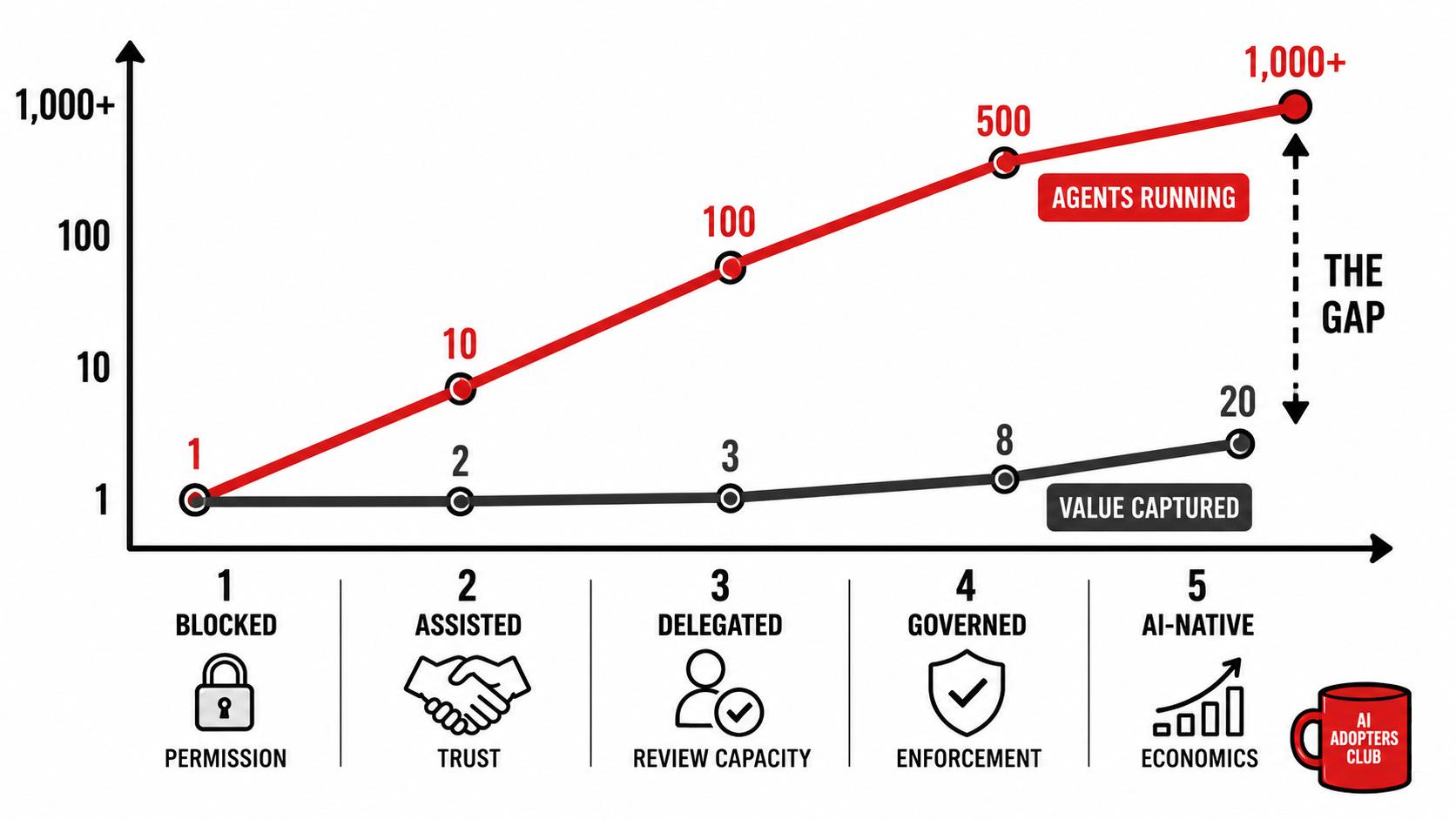
So here’s how I’d read the stages instead. Not by agent count. By the one thing that’s actually blocking you at each step:
Blocked. People technically can’t use it, so half of them use it in secret anyway. What’s in your way is a real owner and a clear yes. (Cherny calls this Gated.)
Assisted. One person, one AI, real work. What’s in your way is trust. Can every output show its receipts, and do you know your rework rate?
Delegated. Lots of tasks running at once. What’s in your way isn’t the model, it’s your capacity to check the output without drowning. (Cherny calls this Parallel.)
Governed. The system’s doing work you can’t watch action by action. What’s in your way is turning your policy PDF into controls the system actually enforces. (Supervised autonomy.)
AI-native. You’re running a portfolio of automated work. What’s in your way is money and judgment. Every workflow needs an owner, a real cost model, and a kill switch for the ones quietly automating busywork.
A couple of traps
The obvious one: more agents means more mature. It doesn’t. Agent count is a vanity number. You can be Stage 2 in engineering and Stage 0 in finance in the same building, because it’s per-workflow, not per-company.
The bigger one: treating this like a software rollout. It’s an operating-model change. What’s blocking you is almost always people and process, your review capacity, your incentives, whether anyone actually owns the outcome, not the tech.
And watch the mood in the room. In a 2026 study of software engineers, 84% felt more productive while the work itself got worse to do: less flow, more time spent checking the machine instead of building. Feeling good about your AI isn’t the same as being good at it. If your only evidence is vibes, you’re probably at Stage 1 telling yourself you’re at Stage 3.
So the real question isn’t how many agents you’re running. It’s which gate you’re stuck at, and what specifically clears it.
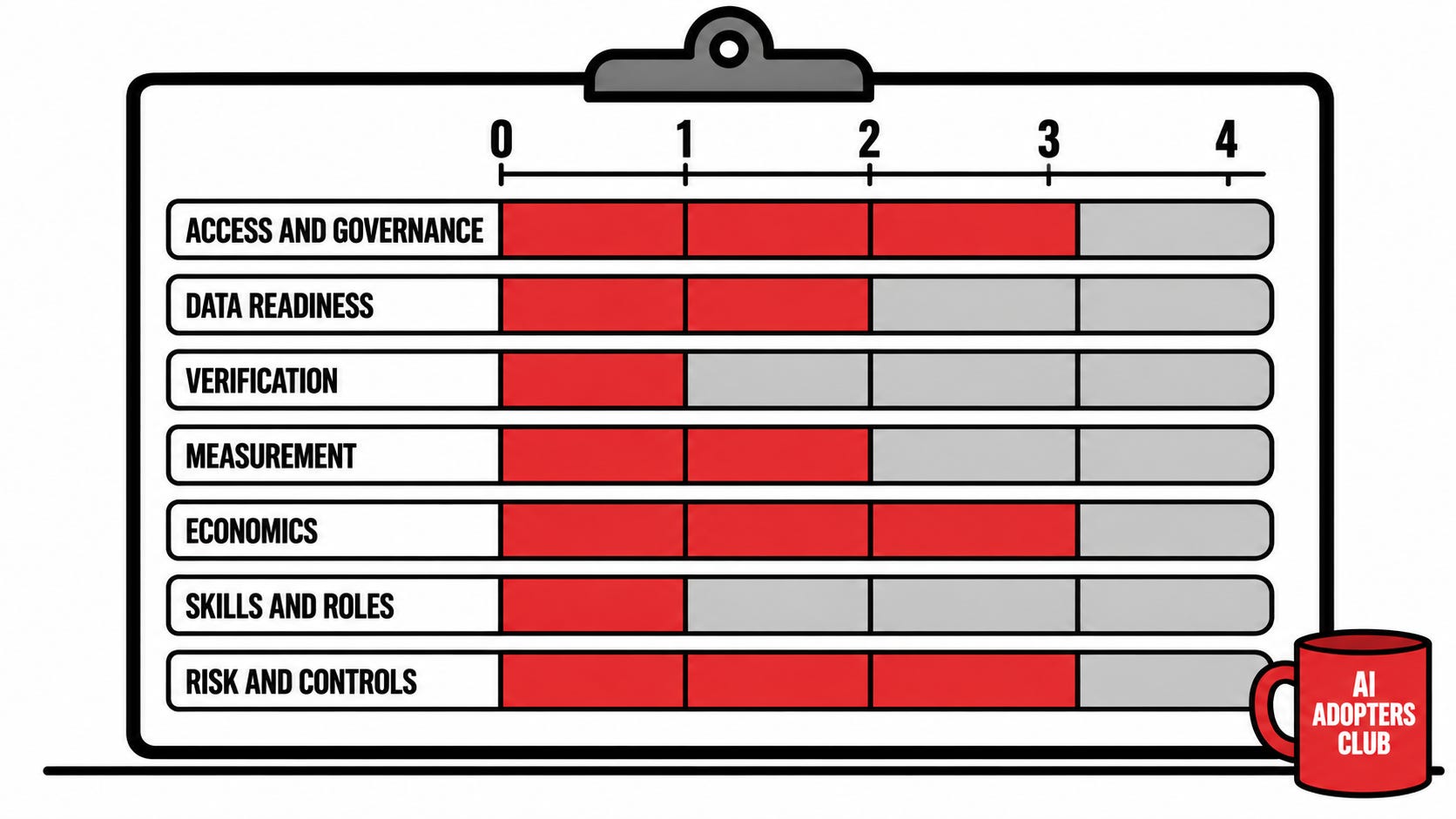
That’s what the premium below does, and it does it for you. It’s a prompt. You paste it into your AI, feed it a few honest facts about your setup, and it scores you across the things that actually matter: access and governance, data, verification, what you measure, cost, skills, risk. Then it tells you your stage, the one constraint holding you back, and a 30 to 90 day plan with exit criteria you can measure. Not “name a sponsor.” The actual gate and the number that proves you cleared it.
Run it yourself in ten minutes. Or reply and I’ll run it with you on your real workflows.
The self-assessment prompt
Paste this into Claude or ChatGPT. Answer what it asks, or paste in whatever you already know and let it press you for the rest. Be honest. It’s more useful when you don’t flatter yourself.
Two things after you run it.
One, it’s built to be blunt. If your data and governance aren’t ready, it’ll tell you to fix that before you scale, not cheer you up the ladder. That’s the whole point. Most maturity advice is nice to read and useless on Monday morning. This one’s meant to ruin your week in a productive way.
Two, if you’d rather I run it with you, on your actual workflows, with a plan we build together, just reply to this email. No form, no funnel. We’ll find a time.
Wherever the prompt lands you, pick the one workflow that costs you the most every week and clear its next gate. Not ten. One. What would it change about next quarter if that one actually worked?
Adapt and Create, Kamil
Kamil Banc is an AI culture and adoption advisor. He helps organizations put AI to work through corporate advisory, coaching, and assessments, and writes AI Adopters Club. Work with him at by connecting directly.
Really interesting post. Running agentic programs at a media company, I'm working on a build methodology right now that maps directly to these gates.
The adoption gap isn't skepticism. It's that most teams treat agents like software rollouts when they're actually operating model changes.
The gate failure pattern is real. We built our intake methodology around forcing visibility at each gate. Permission clears immediately (people want to use this). Trust is where most orgs actually stall. Audit trails and output verification aren't bolted on later. They're baked in from intake.
Capacity gate is brutal in media tech. One team member can't review an agent that touches rights, licensing, or catalog data. The methodologies that work are ones that make human review a design constraint, not a compliance afterthought.
Enforcement is where the real scaling happens. Once you've got that locked, economics becomes visible. Then you can actually kill things that don't work.
The people already using Claude on personal accounts have cleared all five gates in their own minds. They just haven't told anyone. Amnesty is the right frame, but only if you mean it from gate one.