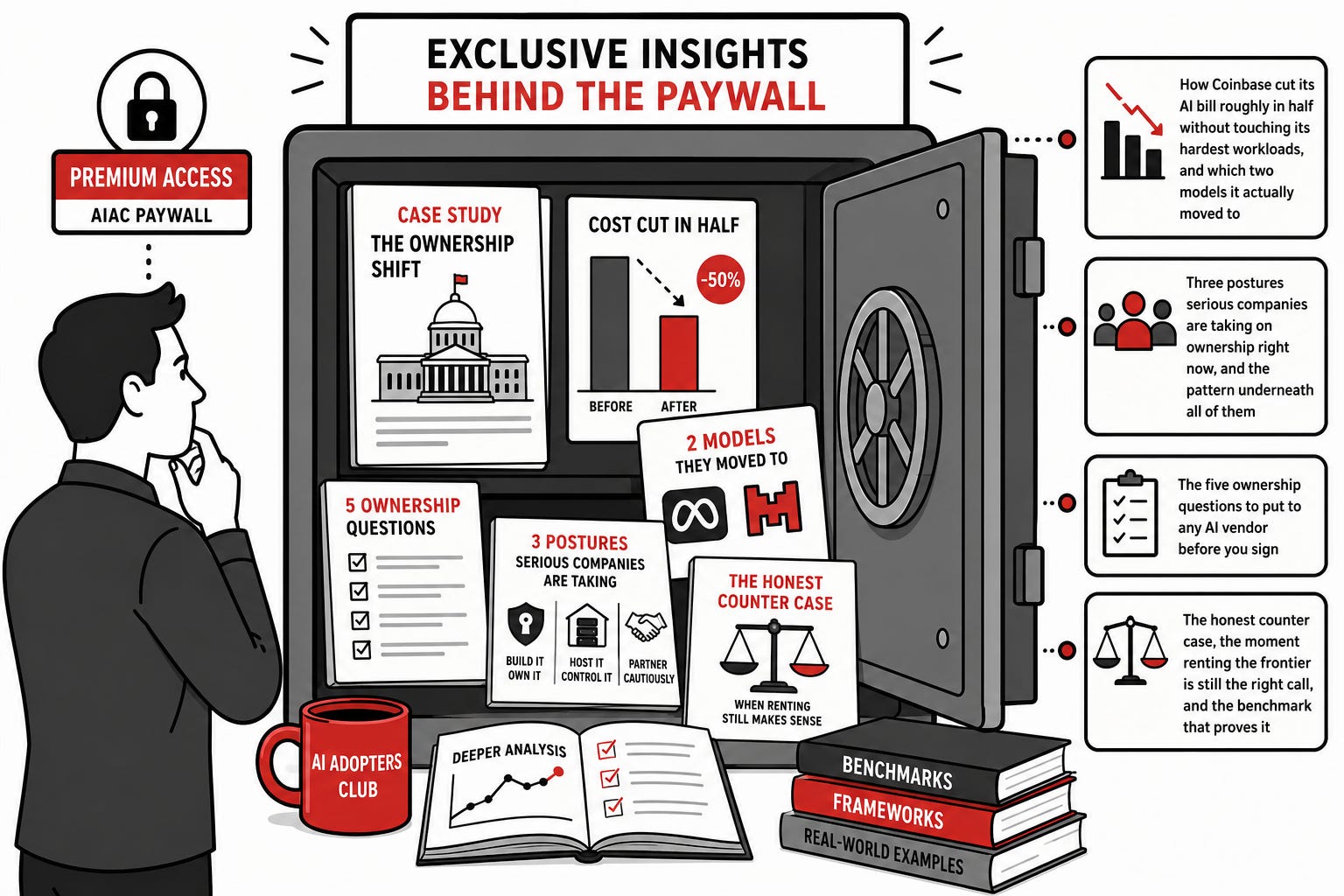
The full breakdown and the playbook live below the paywall. Upgrade to paid to read the rest.
Most readers expense it to their employer. It is AI education that turns you into a real asset to the org.
The AI You Rent Can Be Switched Off
A frontier model vanished worldwide on a Friday afternoon. A Palantir CEO went on air and said the quiet part loud. Both point at the same decision on your desk.
On Friday, June 12, 2026, at roughly 5:21 p.m. ET, a letter from the US Commerce Department reached Anthropic and did something no procurement contract anticipates: it switched off a live product, worldwide, for everyone. Fable 5 and Mythos 5, Anthropic’s two newest models, had launched three days earlier. By the next morning both were dark everywhere. British hospitals piloting Mythos 5 lost it mid-project. European researchers studying it were cut off with no appeal. Anthropic had hours, not weeks, to comply.
That is not a story about export control law. It is a preview. Any enterprise that has standardized on a closed, rented frontier model just watched the thing it depends on get disabled by a party with no contract with the company using it, no notice period, and no recourse. Nineteen days later, on CNBC, Palantir’s CEO said the quiet version of this that is already happening inside enterprise procurement conversations: companies are “renting tokens” for no value while the labs “get my IP.” Two stories, one decision. Rent the model, or own the stack.
The model that got switched off
Fable 5 and Mythos 5 launched June 9, 2026 as Anthropic’s most capable models to date. Three days later, Commerce ordered Anthropic to suspend all foreign-national access under the “deemed export” rule, the doctrine that treats showing controlled technology to a non-US person as an export, even when that person is a researcher on the lab’s own payroll. Anthropic could not segment its user base by nationality in real time. The only lever available was the global one, so the company pulled it. Every user on Earth lost both models at once, including the ones the directive was never aimed at.
Anthropic pushed back in public, and the pushback reveals the standard actually being applied. The company said the government had offered only “verbal evidence of a potential narrow, non-universal jailbreak,” and warned that applying the same bar industry-wide “would essentially halt all new model deployments for all frontier model providers.” The threshold for a government kill switch turned out to be lower than the threshold most enterprises assume when they sign a vendor agreement.
The allied reaction is the part that marks this as structural, not a one-off. French President Macron called it a “wake-up call,” and a Renew Europe member of the European Parliament called it “digital colonization.” The complaints came from governments, not just customers. A vendor relationship that a G7 government can sever with a Friday-afternoon letter, with no warning to allies mid-deployment, is not a vendor relationship. It is a dependency.
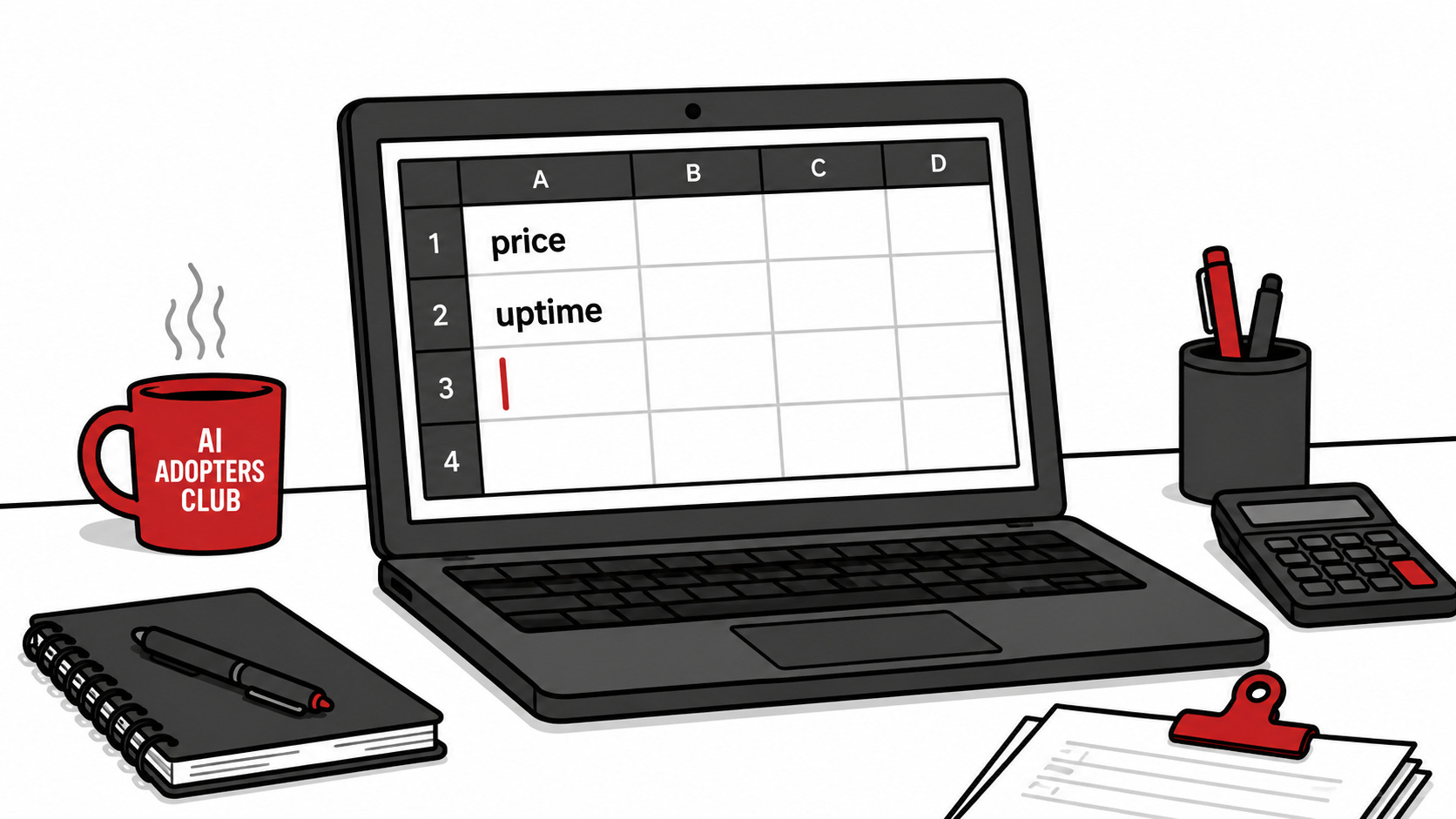
For a procurement team, that reframes the whole risk column. “Can be turned off by a government with no notice or appeal” now sits next to price and uptime on the same spreadsheet.
The reason to own just changed
The old argument for running your own model, or an open one, was cost. That argument still holds, and it keeps getting stronger. Open weights now run roughly an order of magnitude cheaper than the closed frontier, and the market has already priced how disruptive that gap can be: when China’s open models first showed the West what cheap, capable weights could do, Nvidia lost $589 billion in market value in a single day, the largest one-day loss in US market history. Chinese open models, essentially absent from global usage in late 2024, approached a third of it in some weeks during 2025 before settling to a lower full-year average. That gap alone justifies a second look at what you rent.
But the newer, sharper argument is coming from inside boardrooms in the country that builds the frontier models, not from Beijing. On CNBC, Palantir CEO Alex Karp said the quiet part out loud: “The basic view among enterprises in this country is ‘I’m going to chillax and waste my time with tokens, I’m going to get no value, and they’re going to get my IP.’” His pitch turns into two questions most procurement teams have never had to ask aloud: “Why would they get access to my data if they’re going to build my alpha? Why wouldn’t I control the weights?”
“They want to know they own the means of production. It’s not being transferred to someone else. The jig is up.”
Alex Karp, Palantir CEO, CNBC, July 1, 2026
Strip the theater and Karp is describing the same fear the Fable 5 shutdown just demonstrated through a different mechanism. A government cut off access with a letter. A vendor cuts off access with a pricing change, a deprecation notice, or a model that quietly gets worse. Either way, the enterprise that built its workflow on someone else’s weights does not control its own continuity, and does not control what that vendor’s systems learn from its data.
That is the line the rest of this piece defends. Ownership is no longer the cheap option. It is the safe one. The two have stopped being a tradeoff.
This has a name, and it isn’t Japan
Every leader reaching for a historical parallel here picks Japan. In 1986, the US forced Japan into a semiconductor agreement, and by 2001 Japan’s DRAM market share had fallen from roughly 75 percent to 20 percent. Wrong analogy. Japan was an ally who complied, the dispute covered one product, and the US never restricted its own technology from its own allies.
The right analogy is CoCom, the Western technology embargo on the Soviet bloc that ran from 1949 to 1994. CoCom did three things, and all three are happening again. It was porous on the adversary: Toshiba secretly sold restricted milling equipment to the USSR, letting Soviet submarines run quieter, a scandal the Pentagon disclosed in 1987. Today the chips leak through shell companies while Commerce has admitted its own roughly year-long enforcement gap. It made the target self-reliant: denied Western systems, the USSR built its own, the same mechanism behind DeepSeek’s efficiency breakthroughs. And it fractured alliances, the way the Fable 5 shutdown just fractured them again.
CoCom dissolved in 1994, replaced by the toothless Wassenaar Arrangement two years later. The restricted technology diffused globally within five years anyway.
Restricting access did not preserve the lead. It taught the other side to stop needing you.
Capability built on access you control by denying it to others is a fragile foundation. It was fragile for a superpower. It is fragile for your company too.
Below, the part you can actually use this week:
How Coinbase cut its AI bill roughly in half without touching its hardest workloads, and which two models it actually moved to
Three postures serious companies are taking on ownership right now, and the pattern underneath all of them
The five ownership questions to put to any AI vendor before you sign
The honest counter case, the moment renting the frontier is still the right call, and the benchmark that proves it