


Hey Adopter,
I spend a lot of time advising businesses on AI adoption. The conversation almost always starts with software pricing. It almost never ends there.
This piece is built on enterprise AI deployments across logistics, telecom, professional services, and technology. Every number below comes from that report or the published research it cites.
Forward this to whoever signs off your AI budget. If they only see the software line item, the project is already in trouble.
The math nobody puts on the first slide
Executives keep budgeting AI like they budget SaaS. Pick a vendor. Approve a licence. Add some implementation hours. Wait for the productivity gains.
Stanford’s data tells a different story. When researchers asked 50 practitioners what was the hardest part of their deployment, 77% of the answers had nothing to do with the model. Process documentation came first. Data quality came second. Change management came third. Technology was consistently described as the easiest part of the work.
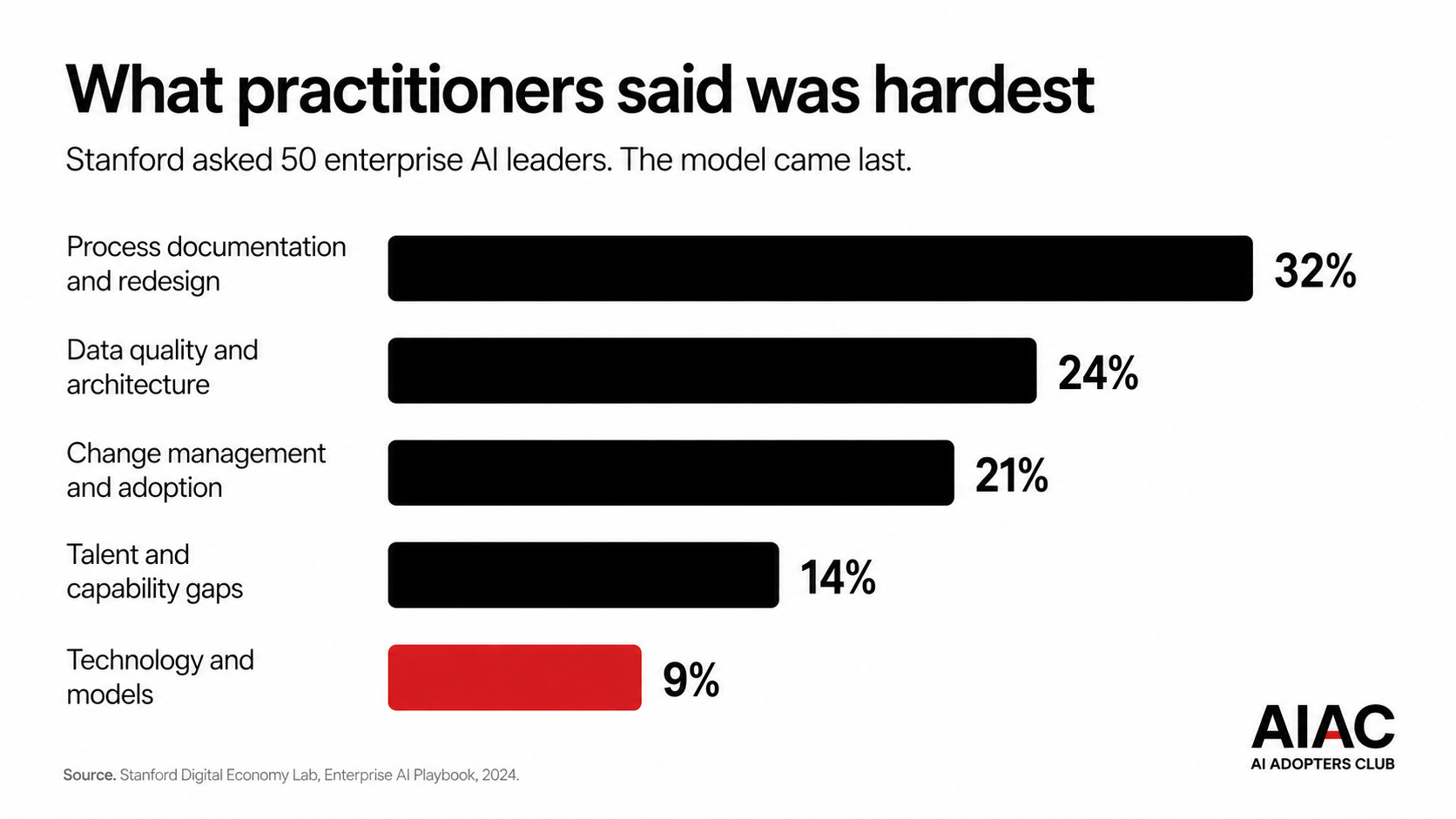
The macro picture is worse. Accenture estimates that 80% to 85% of companies are stuck in what they call a Proof of Concept Factory, running experiments that never scale and absorb the budget anyway. McKinsey’s State of AI research shows that high performers, the organisations attributing more than 5% of EBIT to AI, are not the ones with better models. They are the ones rewiring their processes and data products. Same software. Different ratio of investment.
Which leaves the obvious question. What is the right ratio?
The number that changes the conversation
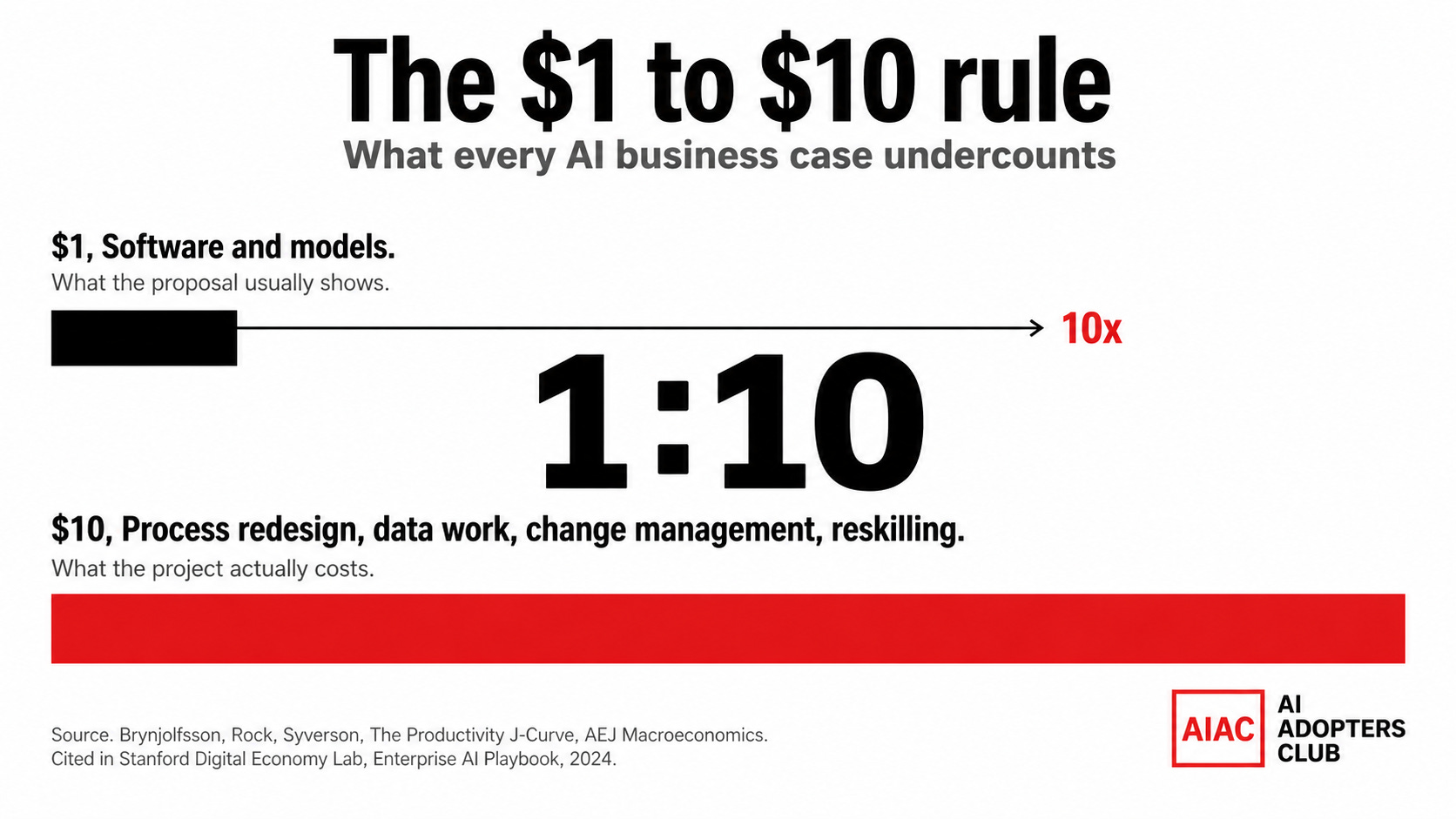
Erik Brynjolfsson’s productivity J-curve research, cited in the Stanford report, found one ratio that explains why so many tech investments underperform their business case in year one.
“For every $1 of tangible technology investment, companies spend up to $10 on intangibles, process redesign, reskilling, and organisational transformation.”
That is the rule. One to ten. The model is the cheap part. The deployment is where the budget goes, and most CFOs never see that number on the proposal.
It also explains the second Stanford finding nobody discusses on a vendor call. Sixty-one percent of the AI projects that succeeded were preceded by a failed attempt at the same problem. The failure was a sunk cost that never appeared in the successful project’s ROI calculation, but it was usually essential to it. The first attempt taught the team what could not be automated until the work itself was redesigned.
So who is doing this right, and what does the spend look like in practice?
Below the fold, premium subscribers get the full breakdown:
The $1B logistics case. How a refrigerated trucking firm cut seven invoice clerks to two in eight weeks using off-the-shelf Azure tools, and where the real money went.
Three contrasting approaches from telecom, professional services, and technology companies showing how the $1 to $10 rule shows up at scale.
Five rules that separate the AI budgets that pay off from the ones that fund pilot graveyards.
The adopter’s playbook. What a 50 to 500 person company can copy, counter, and avoid this quarter, with the exact spend categories your CFO needs in the proposal.