



Hey Adopter,
So, quick version of what you’re getting today. Why most people chasing the “build a small AI tool” idea pick the wrong thing, where the good ones hide, and how to test one before you burn four months of evenings on it.
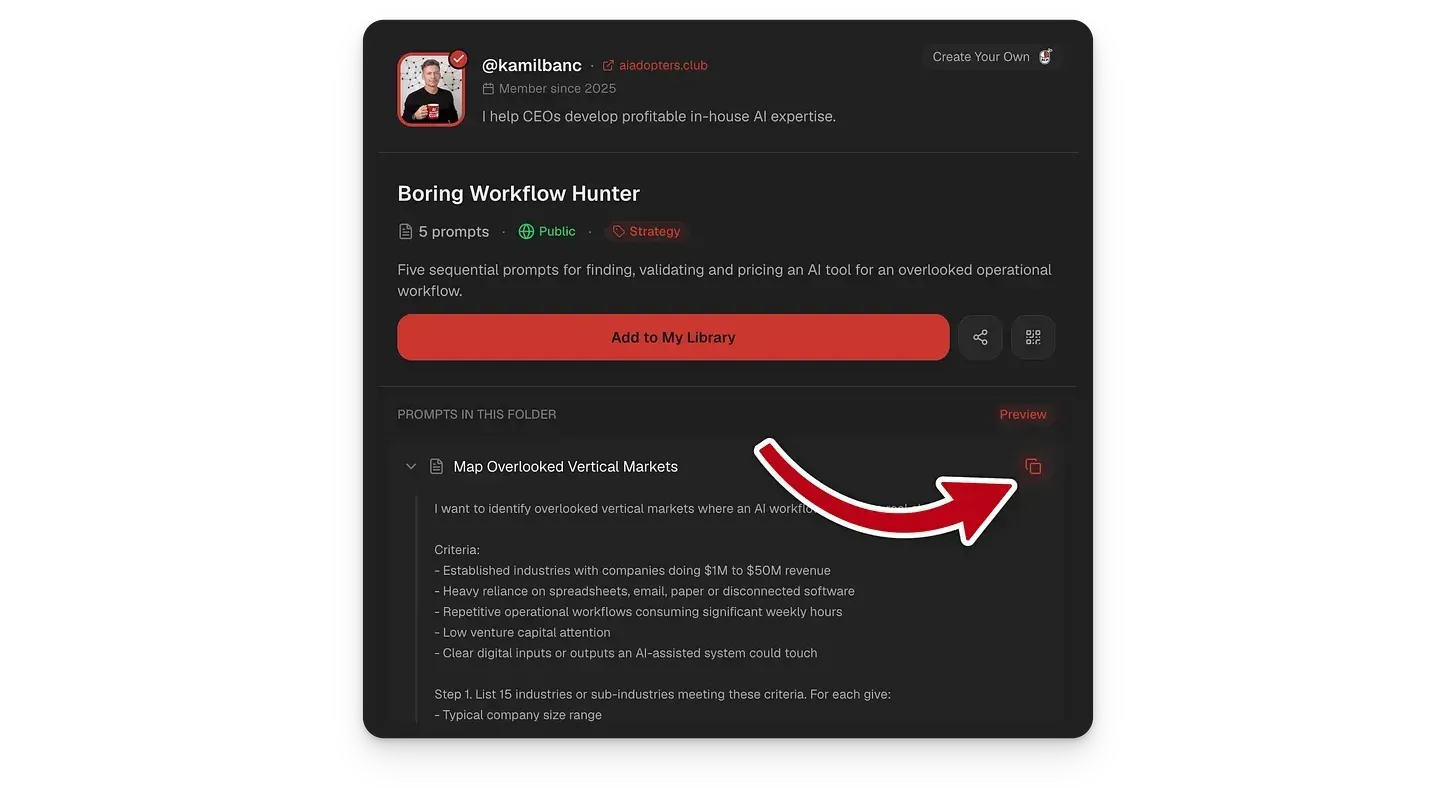
The prompt pack that runs the whole process is here.
Grab it now, read the rest, then go use it.
The guy who did this with air filters
David Heacock took over his family’s failing machinery business in Alabama and turned it into an air filter company. North of $250m a year now, bootstrapped, in a category nobody thinks about.
His point about AI is the one I keep coming back to. In software, AI improves something already built to scale. In a physical business it changes the arithmetic, one operator handling work that used to need layers of staff. At Filterbuy he pointed it at scheduling, forecasting and error rates. Not the factory floor.
LinkedIn has already turned this into a side hustle pitch. Find a dull industry, build a small tool, charge $500 a month. Honestly, the pitch isn’t wrong. It skips the one part that matters.
Most of these die at the picking stage
Freemius mapped the revenue spread across micro-SaaS. Around 70% earn under $1,000 MRR. Another 18% sit between $1,000 and $5,000. The top 1% clear $50,000.
Those aren’t builds gone wrong. I spend 10 to 12 hours a day in Claude Code and I’ll be honest with you, shipping something functional stopped being the hard part a while ago. What kills these is picking a workflow nobody was suffering over, then finding out four months later.
The expensive bit flipped. Writing the software got cheap. Knowing which two hours of somebody’s Tuesday are worth deleting did not.
So where does that knowledge live? - Not on Product Hunt
It lives with people mid-task.
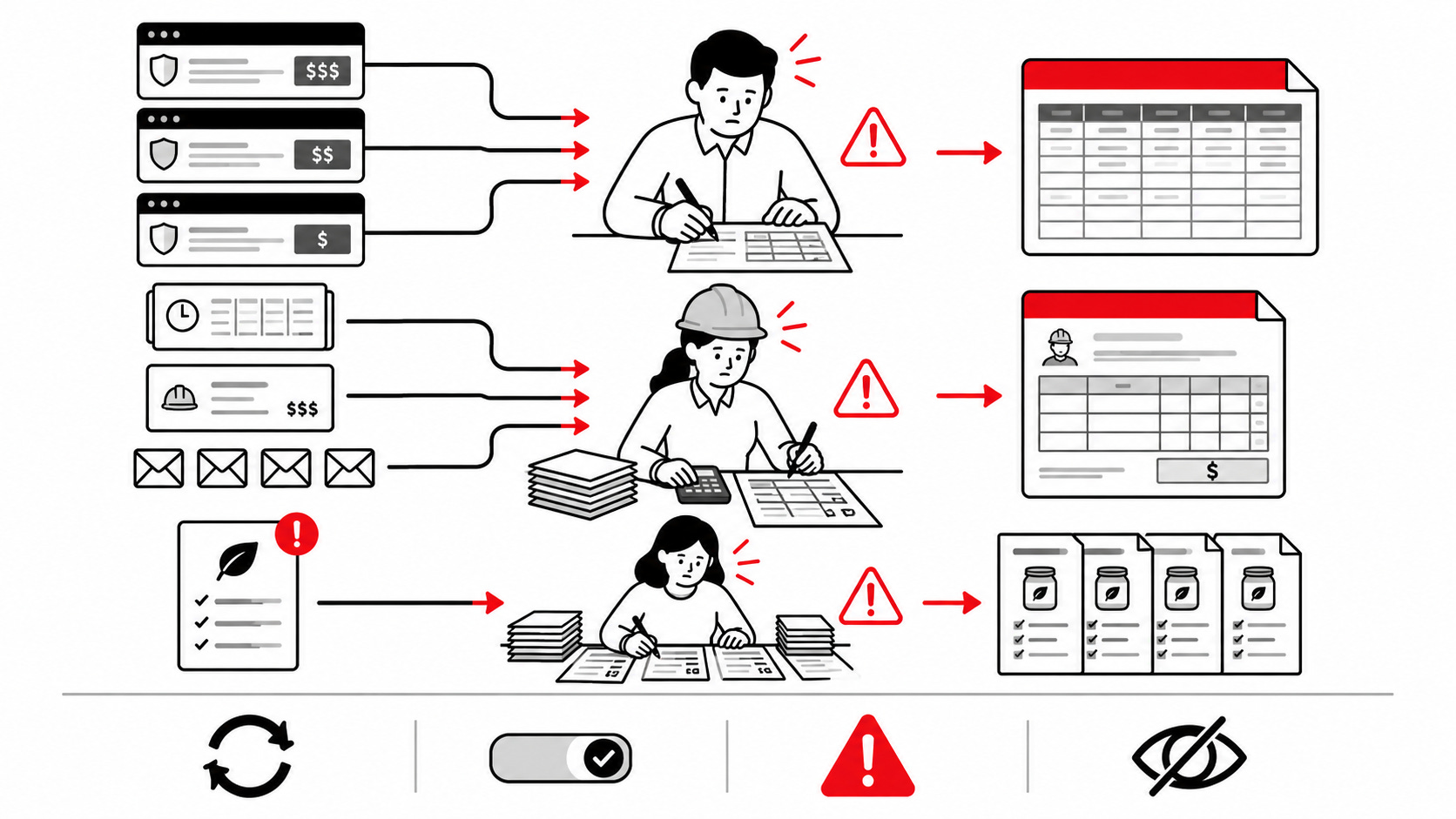
An insurance broker rekeying renewal data out of three carrier portals into one spreadsheet, because the portals don’t talk to each other. A construction admin building certified payroll every week out of timesheets, union rates and four subcontractor emails, by hand. A food distributor updating allergen specs across 200 product sheets every time a supplier swaps an ingredient.
Same shape every time, right? High frequency. Low judgement. Expensive when wrong. Invisible to anyone who hasn’t done the job.
Which gives you a test. If you can’t name the workflow and the person who does it without looking anything up, you don’t know it well enough to build for it yet.
Most of you reading this hold a better hand than the people writing the threads.
You already sit inside the best version of this
Bessemer’s vertical AI playbook notes that Shopify and others started life as internal tools. Someone solved their own problem first, then noticed other people had it too.
You’ve got what an outsider spends a year trying to buy. Domain knowledge. Access to the people doing the work. A salary while you figure it out. And an employer who’ll be your first user for free.
So start there. Pick the ugliest recurring thing on your team, the one everyone works around. Build the smallest version handling the ordinary case correctly. Put it in front of the person who does the task and watch them use it without you. Then don’t add anything until somebody asks twice. Overbuilding ahead of proof is how most of these fall over.
Two outcomes, both good. Either you’re the person who took a day a week off your department’s plate, which beats any certificate. Or the pain turns out to be real and shared across the industry, and you’ve got a validated product with no one to acquire. Put a price on it the second a different company asks. Free pilots teach you nothing about whether anyone would pay.
One thing separates both of those from a wasted quarter.
Ten conversations beat ten estimates
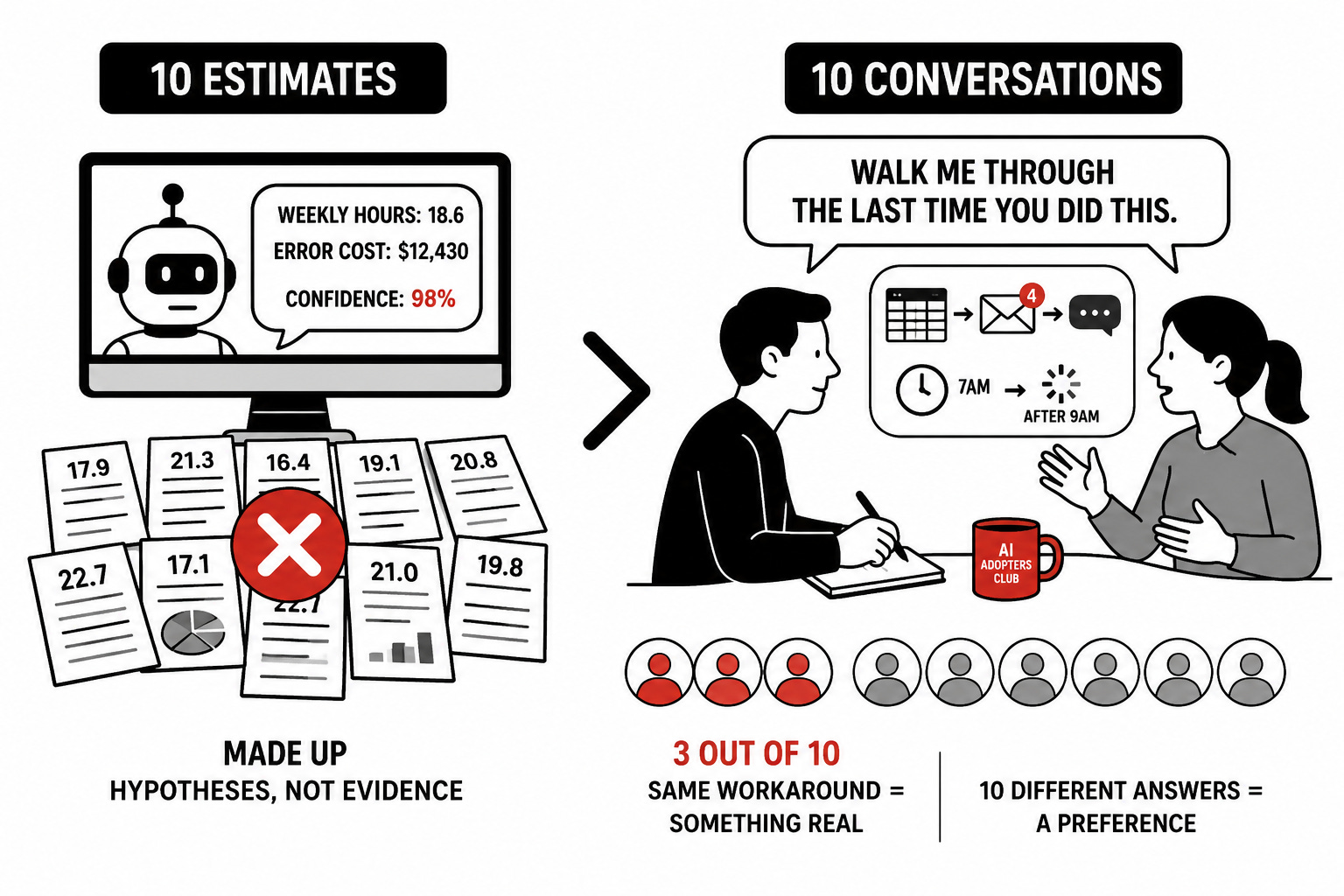
Ask a model to size a workflow and it hands you weekly hours and error costs with total confidence. Those numbers are made up. Fine as hypotheses. Useless as evidence.
Test them the slow way. Ten conversations with the people doing the task. One question does most of the work.
Walk me through the last time you did this.
Then shut up and listen. You’re waiting for the workaround. The shadow spreadsheet. The colleague they text to check a number. The step they do at 7am because the system crawls after nine. That’s where the hours hide.
Three out of ten describing the same workaround, you’ve got something. Ten different answers, you’ve got a preference.
Your next seven days
Write down ten painful workflows in your own function without looking anything up. Rank them by how many people do them and how often. Book three conversations about the top one.
More on that prompt pack
Five prompts, built to run in order. Feed each output into the next.
One narrows you to an industry. Two surfaces the workflows hiding inside it, in the words the people doing them use. Three pressure-tests your top five against software already on the market. Four picks a winner and names your first ten customers. Five asks whether the thing holds up or gets shipped as a feature by somebody bigger next quarter.
One rule holds the whole thing together. Every hour estimate, error cost and market size these prompts give you is a guess, so I’ve written them to admit it. Each number comes back with a confidence label. Take the top three guesses into your ten conversations and let the people doing the work confirm or kill them.
Prompts do the narrowing. Calls do the deciding.
The barrier used to be an engineering team you couldn’t afford. Now it’s knowing where the hours go. And you already do.
Adapt & Create, Kamil
The best AI startup ideas are rarely found. They’re discovered while solving real problems.
I’ve spent 30 plus years bringing products to market, and not once did success come from chasing trends. It came from listening, observing, and building something people actually needed.
The ten conversations tell you which Tuesday is ugly. They don’t tell you if a stranger will pay to leave the workaround they already live with. Someone on your own team will use it because they like you. That’s a different kind of evidence.