


Hey Adopter,
Yesterday, I came across the news that Netflix is testing an OpenAI-powered search feature, allowing users to find content based on their mood rather than just titles or genres. This caught my attention not just as another AI headline, but as a revealing move in Netflix's broader strategy. While everyone's focused on the shiny new search tool, I started digging into what's behind it: a decade-long investment in AI that quietly generates billions in business value.

Most companies treat AI like a trophy. Nice to show off in investor decks, useless in practice. While executives drone on about "AI transformation," Netflix quietly built a $1 billion competitive advantage using algorithms that actually work.
The difference? Netflix sees AI as a business tool, not a tech novelty. They've woven it into everything from what shows you see to how those shows get made. And they've done it without the typical corporate theater that plagues most AI initiatives.
Let's break down what Netflix got right and what your team can actually implement next week.

Want the full Netflix AI playbook? My exclusive 28-page case study reveals:
$1B Impact Blueprint: The exact AI implementation that saves Netflix over $1 billion annually in reduced churn
Evolution Roadmap: Step-by-step progression from simple algorithms to company-wide AI integration
Risk Management Framework: How Netflix navigates complex ethical and labor challenges as AI adoption expands

The Business Case, Not The Tech Stack
Netflix's recommendation system alone saves the company over $1 billion annually by reducing subscriber churn. That's not a typo. Their AI doesn't just recommend shows you might like. It directly impacts the bottom line by keeping subscribers engaged and paying.
While your company might not have Netflix's user base, the principle applies everywhere. Start with the business metric, not the technology. Before writing a single line of code, ask: "What specific business problem will this solve, and how will we measure success?"
Netflix measured success through retention and engagement, not model accuracy. They discovered that obsessing over theoretical metrics (like RMSE in their famous Netflix Prize competition) didn't necessarily translate to real-world results. The technically "best" algorithm was too complex and costly to implement in production.
Small Starts With Fast Feedback
Netflix didn't begin with a grand AI manifesto. They started with a single problem: helping DVD subscribers find movies they'd enjoy. Their first algorithm, Cinematch, was relatively simple but solved a genuine pain point.
What's your equivalent of Cinematch? Instead of boiling the AI ocean, identify one specific workflow where predictions or automation would create immediate value. Customer service response suggestions? Inventory forecasting? Sales lead prioritization?
Pick something small enough to implement in weeks, not quarters. Then ruthlessly iterate based on real-world feedback. Netflix now runs thousands of A/B tests yearly to continuously refine their systems. Each experiment teaches them something new about user behavior and preferences that human intuition alone would miss.
Data As Strategic Asset Not Afterthought
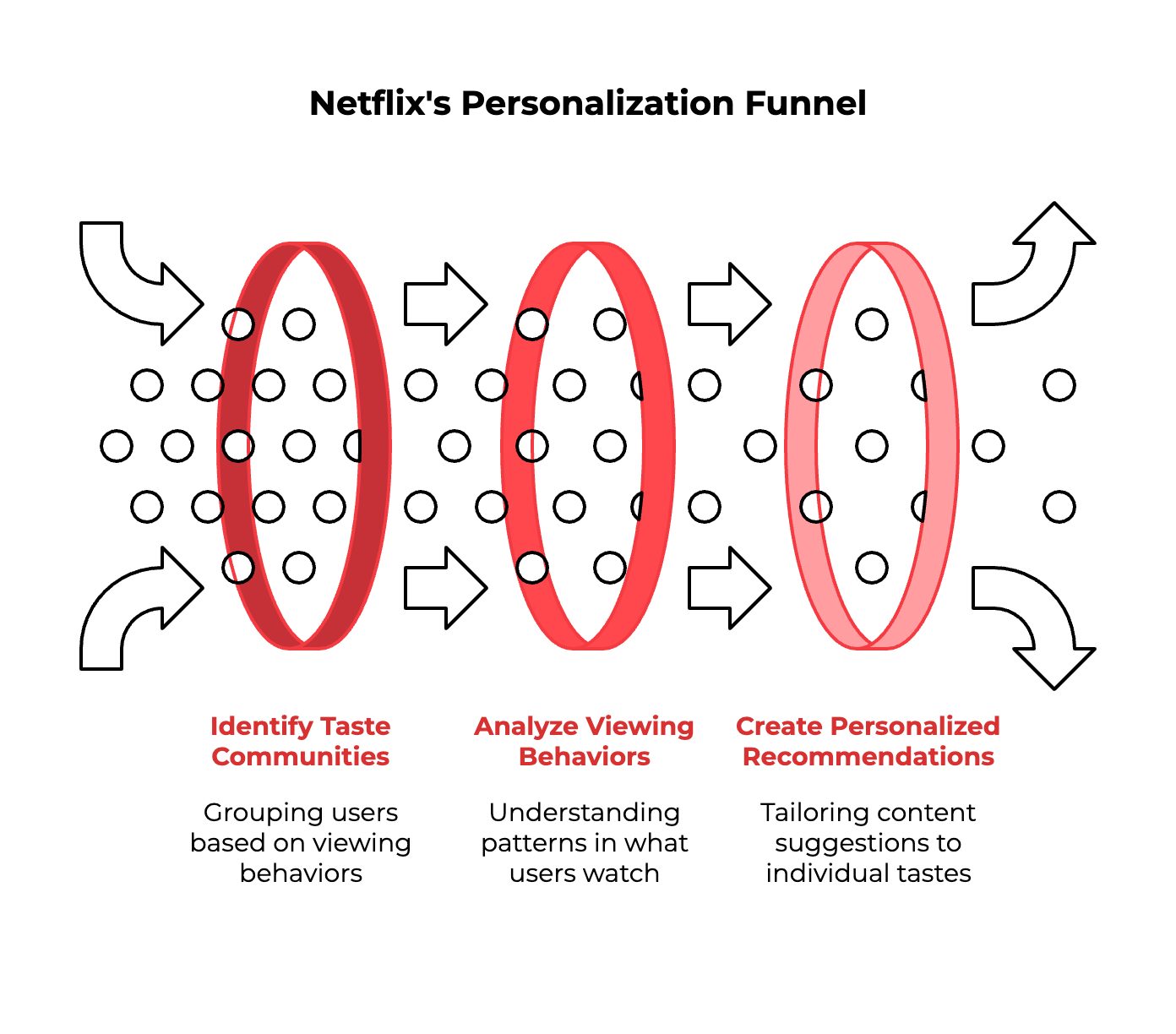
While most companies treat data as exhaust, Netflix treats it as fuel. They meticulously collect and analyze everything from viewing habits to exactly when you pause, rewind or abandon content.
This isn't arbitrary data hoarding. Each data point feeds directly into improving their product and business decisions. Their content investment decisions (what shows to produce or license) are heavily influenced by analysis of viewing patterns and audience segments.
Your organization probably sits on valuable data that's currently unused. Before rushing to build complex AI, take inventory of what signals you already capture but don't leverage. Often, the most valuable insights come from combining existing data in new ways, not from fancy new algorithms.
Build For The Actual User Not The Ideal One
Netflix's personalization goes far beyond recommending content. They even personalize the artwork you see for the same show based on your viewing history. Horror fans might see a creepy thumbnail for a show while comedy fans see a humorous one.
This reflects a deep understanding that how you present information matters as much as the information itself. The same principle applies to any AI tool you build internally. A brilliant forecasting model will collect dust if it doesn't fit naturally into users' workflows.
When implementing AI tools, spend as much time on the interface and user experience as you do on the underlying model. The most powerful algorithm is worthless if people find it confusing or cumbersome to use.
Avoid The AI Ethics Blind Spot
Netflix's AI journey hasn't been without challenges. They've faced privacy concerns, potential algorithmic bias issues, and tensions with creative professionals worried about AI replacing their jobs.
As you implement AI, build ethical considerations into your process from the start. This isn't just good citizenship. It's risk management. Netflix has paid millions in regulatory fines for privacy violations, and had to navigate complex labor relations due to AI's impact on creative work.
The most successful AI initiatives include stakeholders from legal, ethics, and affected departments early in the planning process, not as an afterthought.
Make AI Practical Not Precious
While companies like Netflix leverage sophisticated technology, much of their success comes from operational discipline rather than algorithmic wizardry.
They've built a clear strategic vision for how AI links to business objectives, invested in scalable infrastructure, and created a culture of continuous experimentation. Most importantly, they integrated AI into everyday workflows rather than treating it as a separate initiative.
Your team can't build Netflix's entire AI ecosystem overnight. But you can adopt their practical, business-first approach that has consistently turned algorithms into competitive advantage.
Start small, focus on real problems, measure actual business impact, and build for the long term. The companies that win with AI aren't those with the fanciest technology. They're the ones relentlessly connecting it to tangible business outcomes.
Adapt & Create,
Kamil