


Hey Adopter,
A business traveller at the Renaissance Charleston asked the hotel’s new AI concierge for a simple recommendation. Italian restaurant. Bar seating. Quick dinner.
The AI, branded “RENAI” and marketed in glossy in-room brochures as a tool that could parse complex, multi-variable queries, responded with four words: ask the hotel concierge “Dana.”
That is not a funny glitch. That is the entire story of enterprise AI right now, compressed into a single failed dinner question. A company layers a conversational interface over disconnected backend data, launches it to customers, and the system can talk but cannot act. It adds a step instead of removing one.
Marriott knows this. And the fix is costing them over a billion dollars a year.
This piece breaks down where that money actually goes, what the financial returns look like, which bets blew up spectacularly, and what every operator deploying AI inside a company can learn from the gap between Marriott’s public story and its operational reality.
The parking lot that costs $1.2 billion
During Marriott’s Q4 2025 earnings call, CEO Anthony Capuano told analysts the company is “pulling into the players’ parking lot” and “not even in uniform on the field.” The message was clear: relax, AI is still early, we are being responsible.
Then the numbers arrived. An estimated $1.2 billion spent on AI and related infrastructure in 2024. A 2026 capital budget of $1.1 billion, with nearly 40% reserved for replacing core reservation, property management, and loyalty systems.
Nobody spends that kind of money parking the car. The language was calibrated for a Wall Street audience tired of speculative AI hype. The balance sheet tells a different story.
Below the paywall, we unpack the architecture Marriott is building, the $17.7 million partnership that ended in bankruptcy court, the workforce cuts that leadership says have nothing to do with AI, and the Google integration that could break how hotels get booked entirely.
The real reason for the rebuild
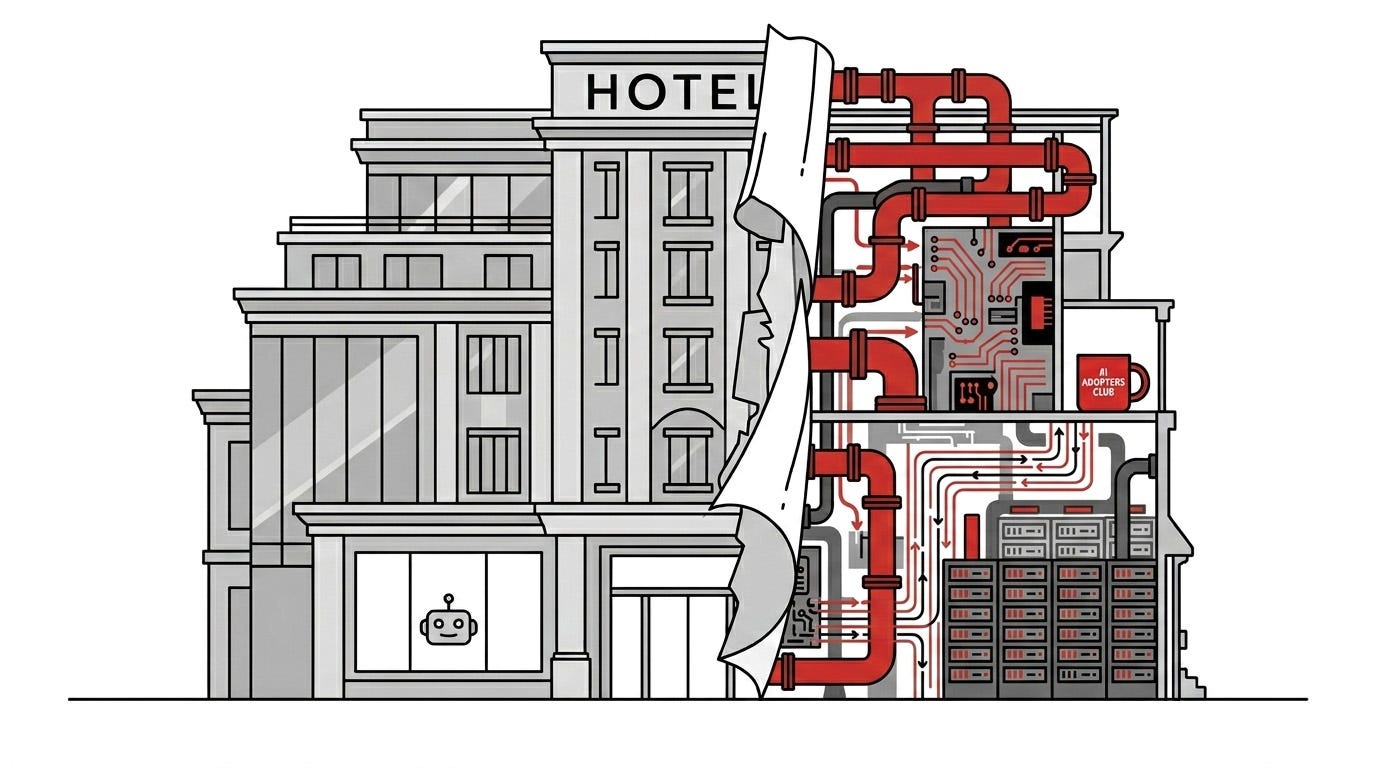
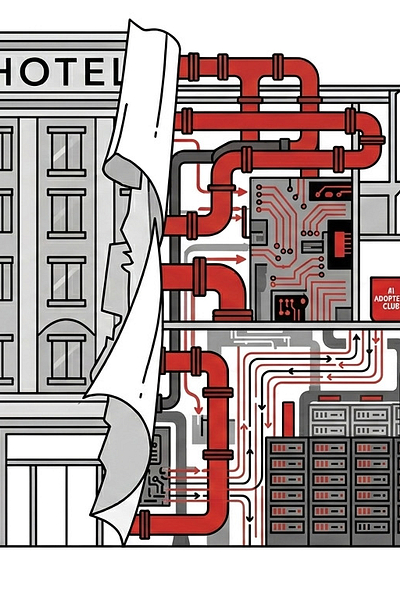
The RENAI failure was not a deployment mistake. It was an architecture problem. Marriott’s core systems, some dating back to the pre-cloud era and further complicated by the $13 billion Starwood acquisition in 2016, were never designed to feed data to an AI layer. Reservation systems, property management, loyalty data, local inventory: all siloed. A chatbot bolted on top of that infrastructure could generate sentences but had no access to the information needed to answer the actual question.
This is why the company is not building chatbots. It is replacing the plumbing underneath them.
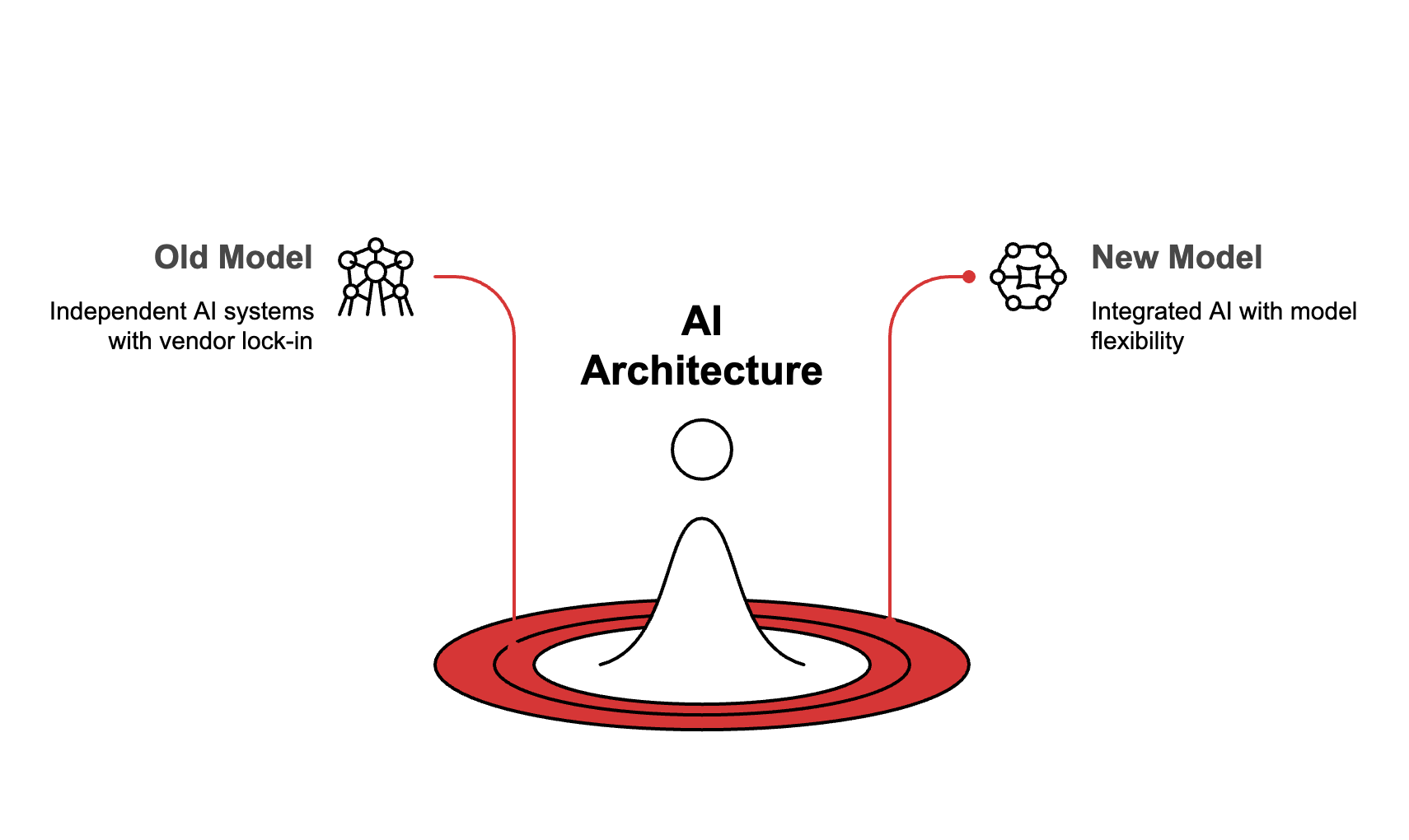
CIO Naveen Manga calls the new infrastructure a “model-agnostic chassis” with an “agentic mesh”. Strip the jargon and the idea is: a middleware layer that lets the company plug in any AI model via API and swap it out when something better ships. No vendor lock-in. No rebuilding the foundation every time the AI market shifts.
The company learned this the hard way. Early experiments involved building AI use cases as vertical, siloed projects. Each one was slow to build and impossible to reuse. Now they are targeting 10 high-value AI use cases in 2025 through horizontal architecture, building capabilities once and deploying them across the enterprise.
A 2025 Forrester prediction validates the urgency: three out of four firms building aspirational agentic architectures on their own will fail. Gartner adds that more than 40% of enterprise AI projects will be scrapped by 2027.
Where the money actually shows up
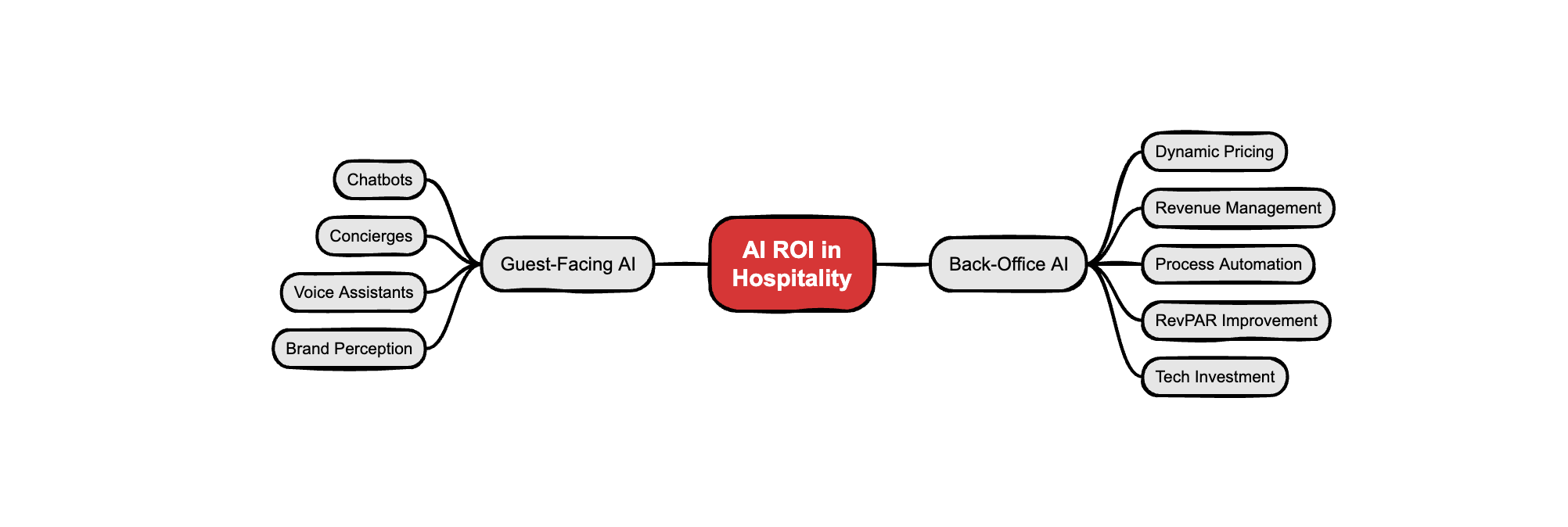
The visible AI, the chatbots and concierges, generates press coverage. The invisible AI generates margin.
Dynamic pricing models that ingest competitor rates, demand signals, historical booking patterns, and local events are delivering verified 8-10% RevPAR improvements across the hospitality industry. RevPAR, Revenue Per Available Room, is the metric that moves hotel balance sheets. An 8-10% lift on that number is pure profit margin that static pricing models left sitting on the table for decades.
This creates a flywheel. Higher RevPAR generates cash. Cash funds the next technology upgrade. Better technology sharpens the pricing models. The cycle compounds. And none of it is visible to the guest.
An industry analysis comparing Marriott and Hilton makes the strategic divide clear. Hilton invests in guest-facing personalisation. Marriott invests in back-office automation. The press follows the robot concierge. The margin follows the algorithm.
The $17.7 million warning
Sonder, a tech-forward hospitality startup, tried to plug its bespoke systems into Marriott’s legacy infrastructure. The integration went sideways, fast. Costs spiralled beyond every projection.
Sonder’s interim CEO admitted publicly that the integration was “substantially delayed due to unexpected challenges in aligning our technology frameworks, resulting in significant, unanticipated integration costs.” In November 2025, Sonder initiated a complete wind-down of operations. Marriott filed claims in bankruptcy court for approximately $17.7 million.
That number includes $14.4 million in unamortized key money. An entire company, destroyed by the gap between how long it thought integration would take and how long it actually took. Any operator planning a core system migration should treat Sonder as a financial autopsy: budget for a timeline twice as long and three times as expensive as the vendor’s initial projection.
The layoffs that are not about AI
In late 2025 and early 2026, Marriott cut customer service staff at its Customer Engagement Centres in Omaha and Wichita. Corporate spokespeople told press that “artificial intelligence was not a factor in this decision.”
At the same time, Manga confirmed that an AI coaching system for contact centre agents was among the company’s top 10 priority use cases. Paul Dyrwal, VP of Generative AI, described his focus as using AI to reduce bureaucratic inefficiencies. The World Economic Forum estimates 44% of workers need reskilling.
One anonymous employee on a Marriott forum posted: “Several more to come as the company goes to more AI-driven solutions and relies less and less on the human element.”
The gap between the press release and the org chart is the story of AI workforce change everywhere. Repetitive, manual, cost-heavy roles compress first. Technical and AI-adjacent roles expand. The public narrative says AI is additive. The headcount says otherwise.
The distribution play that changes everything
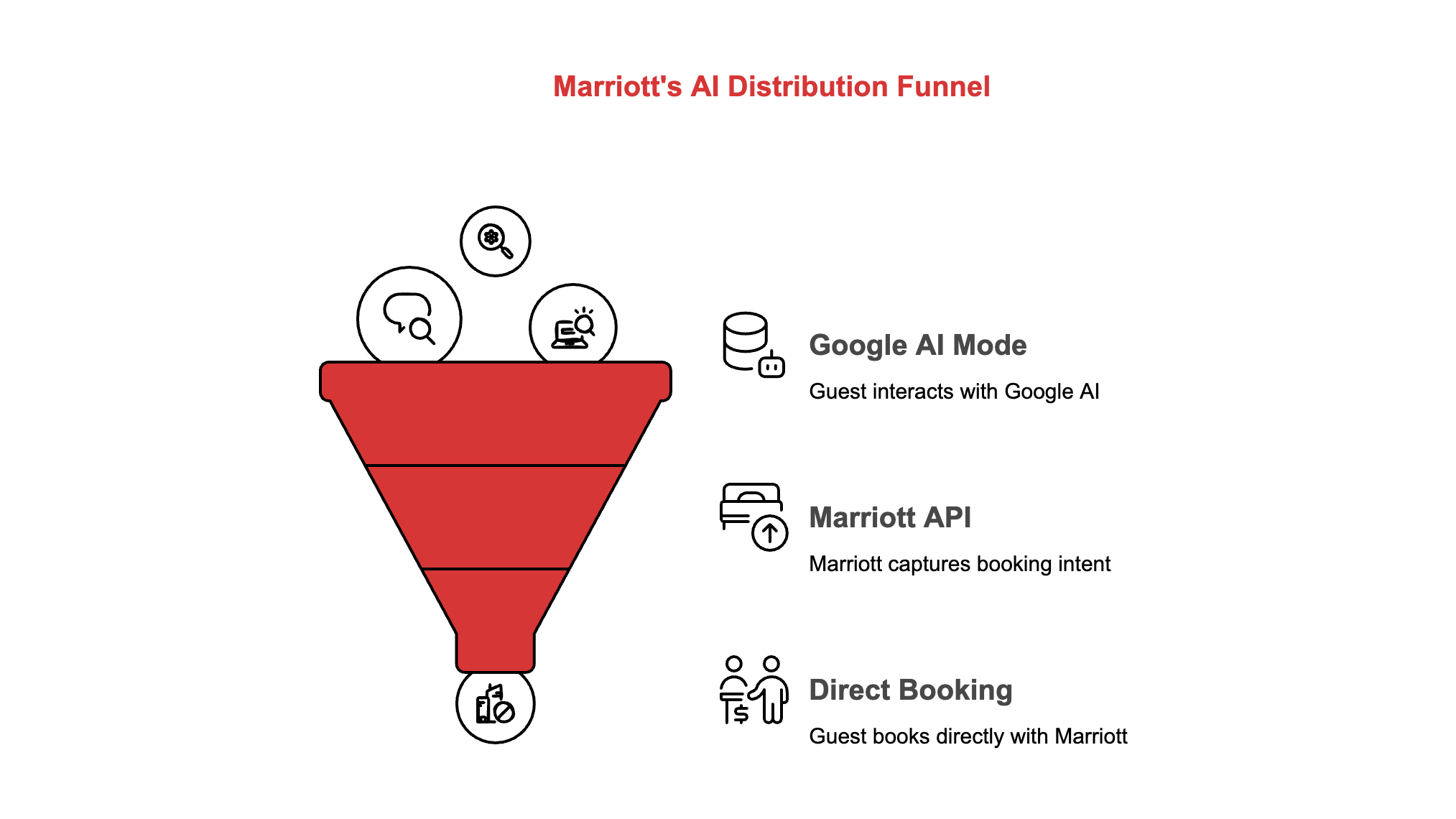
Marriott’s direct-booking integration with Google AI Mode is the most aggressive move in this entire strategy. When a customer asks a device to book a hotel, Marriott wants that transaction flowing through its own API, not through Expedia or Booking.com and their 15-20% commissions.
Google becomes the utility layer. Marriott captures intent at the top of the funnel. But analysts warn this only works if the hotel has digitised its local assets, spa inventory, dining, event spaces, into machine-readable formats. If those offerings are not API-accessible, AI search agents cannot see them. You compete on price alone.
The data moat is what makes this viable. Marriott Bonvoy hit 271 million members in 2025. Competitors can license the same models from OpenAI or Google. They cannot license decades of guest preference data.
What this actually means if you are deploying AI at work
The Marriott case study is not a hospitality story. It is a story about what happens when a massive organisation discovers that AI does not work as a layer on top of broken systems. It works as a reason to fix the systems.
Every company deploying AI faces the same architectural choice Marriott faced. Build vertically, one siloed project at a time, and watch each one become obsolete before the next one ships. Or invest in horizontal middleware that lets you swap models and reuse capabilities, knowing the upfront cost is brutal but the compounding payoff is real.
The financial returns are hiding where nobody photographs them. Algorithmic pricing, process automation, backend optimisation. These are not exciting. They are, by a wide margin, the most proven way AI generates measurable business value today.
And the workforce question is not going away. The gap between what companies say about AI and headcount and what the org charts show is widening every quarter. Professionals who understand this gap, who can read the architecture decisions behind the press releases, will navigate the next three years very differently from those who take the earnings call at face value.
The dinner question RENAI could not answer cost Marriott nothing. The infrastructure required to make sure the next AI concierge can answer it is costing them over a billion dollars a year. That ratio tells you everything about where the real work is.
Adapt & Create,
Kamil
References and source notes
Marriott AI strategy and agentic architecture , CIO Dive. Model-agnostic chassis, agentic mesh, top 10 AI use cases. Link
Marriott Q4/full-year 2025 earnings , PhocusWire. $1.1B 2026 budget, Bonvoy membership, CEO Capuano quotes. Link
Sonder wind-down , Serviced Apartment News. Marriott-Sonder licensing termination and collapse. Link
Sonder Holdings press release , Investor Relations. Interim CEO on integration cost overruns. Link
RENAI concierge failure , Reddit. First-hand guest account of the AI failing a dinner query. Link
AI in hospitality ROI , Articsledge. Dynamic pricing and verified RevPAR data. Link
AI personalisation ROI for hotels , Naitive Cloud. 8-10% RevPAR improvement data. Link
Hospitality’s AI crisis , Mythos Group. $1.2B estimated Marriott AI spend in 2024. Link
Marriott-Google AI direct booking , TRAVHOTECH. Google AI Mode integration and machine-readability requirement. Link
Marriott-Sonder court filing , Hotel Dive. $17.7M claim and unamortized key money. Link
Marriott customer service layoffs , Hospitality.today. CEC cuts in Omaha and Wichita. Link
Employee layoff sentiment , Reddit. Anonymous posts on AI-driven workforce reductions. Link
Paul Dyrwal on AI at Marriott , Writer. VP of GenAI on reducing inefficiency. Link
Frontline workforce training , Great Place to Work. WEF 44% reskilling statistic. Link
AI workforce reinvention , Accenture. CHRO Breland on cross-disciplinary AI adoption. Link
Hilton vs Marriott AI , Websrefresh. Guest-facing vs back-office strategy comparison. Link
Forrester 2025 AI predictions , Forrester. 75% agentic architecture failure rate. Link
Marriott Global Tech culture , Life at Marriott. Legacy system and Starwood acquisition context. Link