


Hey Adopter,
I spend a lot of time advising US companies on AI culture. The same scene plays out in every board room. Someone waves a compliance memo banning ChatGPT while the head of sales is pasting client emails into it from his phone under the table.
That gap between the official policy and the actual behaviour is the whole game. One bank figured out how to close it, and in the process built the largest bottom-up enterprise AI programme in European financial services.
This piece is built from a new case study report I published today on BBVA’s generative AI programme. Fourteen pages, 22 sourced references, cross-referenced across three independent research tracks. Single company, but the programme spans 120,000 employees across 25 countries. The full PDF is available for premium subscribers at the download link below.
Forward this to whoever owns AI adoption at your company. Or whoever is still trying to ban ChatGPT.
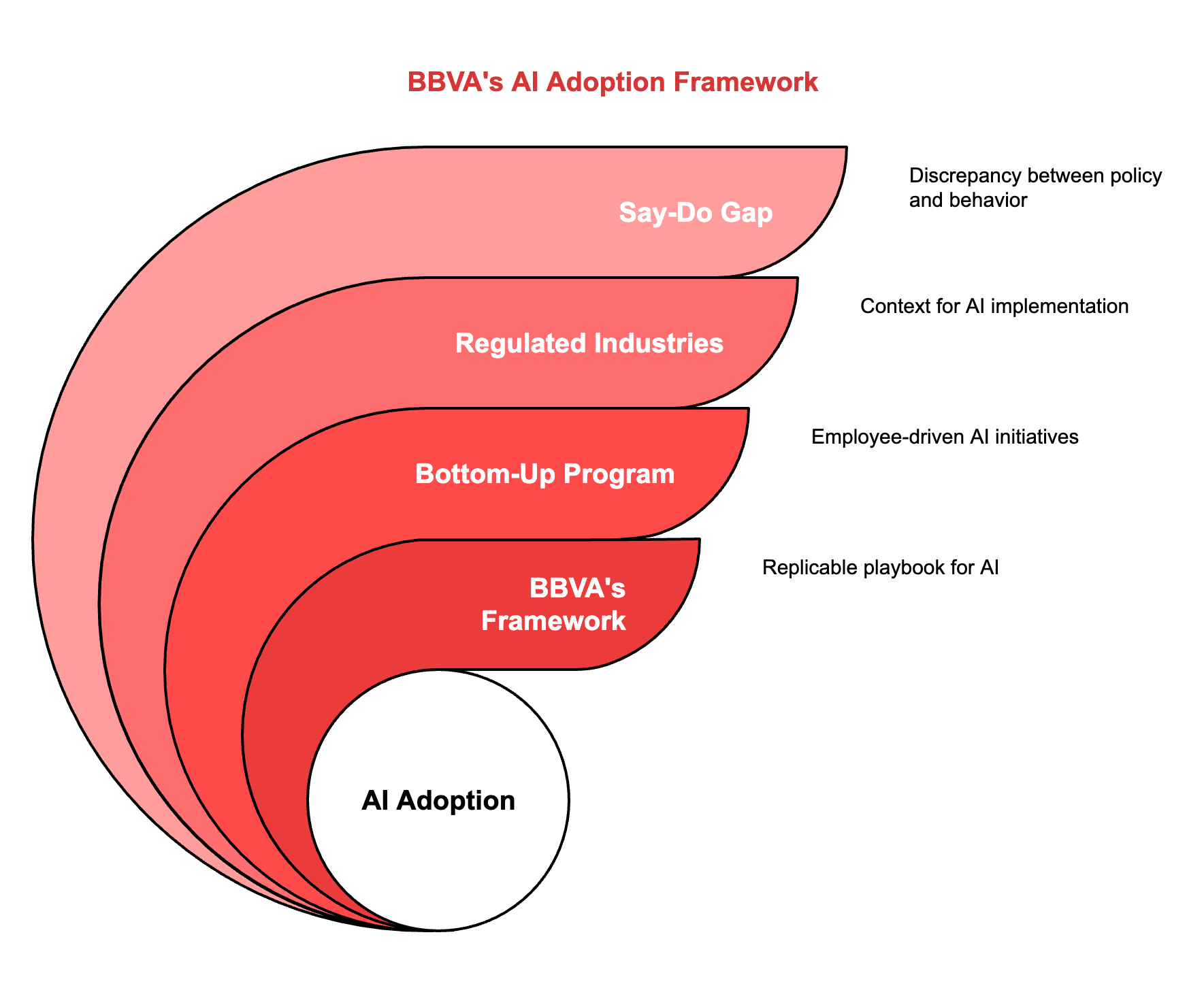
The say-do gap nobody wants to sit with
Seventy-four percent of companies show no measurable value from AI investments. Forty-two percent have abandoned most AI initiatives by mid-2025. Only seven percent have AI fully deployed enterprise-wide. Meanwhile the industry is spending $252 billion on AI and failing to capture value from it.
And at every one of those companies, employees are doing the work anyway. On personal laptops. With personal accounts. Outside the firewall and outside the audit trail.
Most regulated institutions respond to this with a ban. A policy memo, a training video, a compliance module nobody remembers. The tools get faster, the policy stays slow, and the gap between what leaders authorise and what employees do widens every quarter.
One bank looked at the same problem and made the opposite call.
The killer number
Twenty thousand custom GPTs. Built by employees. Not by IT.
That is the number that separates BBVA from every other enterprise AI programme I have studied. JPMorgan deployed LLM Suite to 200,000+ employees, centrally governed. Goldman Sachs launched GS AI Assistant firmwide, centrally governed. BBVA let frontline staff build their own tools. The result: a Peru operations assistant that cut query time by 87%. A legal GPT handling 40,000 annual queries with a nine-person team. An indigenous language translator bringing financial products to Nahuatl and Maya speakers. A fraud detection tool that uses emotion-based security questions. No central AI team would have designed any of those.
Elena Alfaro, the executive running the programme, put it plainly:
“Instead of shadow AI, we gave them a platform that was safe so they could start experimenting.”
That one sentence reframes the entire debate. Shadow AI is not a compliance failure. It is a demand signal. BBVA hit 80%+ daily active usage among 120,000 employees because they stopped trying to stop it, and started trying to serve it.
Which raises the question: what did they do, and can you steal it?

Download the full case-study and 60+ others
Below the paywall, premium subscribers get the full breakdown:
The scarcity play that created 83% daily usage. Why allocating only 3,000 licences at a 125,000-employee bank was a design choice, not a budget constraint, and how to run a version of it inside any 50-person team.
The Champions and Wizards network that broke every rule of corporate training. Three hundred peer leaders, zero central curriculum, and the most active internal forum in BBVA’s history.
Five use cases frontline employees built themselves, including the tool now deployed to 5,000 people in 22 countries and the 150-agent architecture powering BBVA’s app inside ChatGPT.
The five moves from the April 2026 HBR article, translated to mid-market budgets, plus the governance stack that made a regulator comfortable with 20,000 unsupervised GPTs.
🔒 The rest of this post is for premium subscribers
What follows is the editorial breakdown. What the report means, what patterns it reveals, and what you can steal.