

Hi Adopter,
You’ve got an offer and a price, and until a real buyer sees it, you’re mostly guessing how they’ll react. So I ran my own 1:1 AI coaching offer past 100 simulated customers at two prices, to see what they’d push back on.
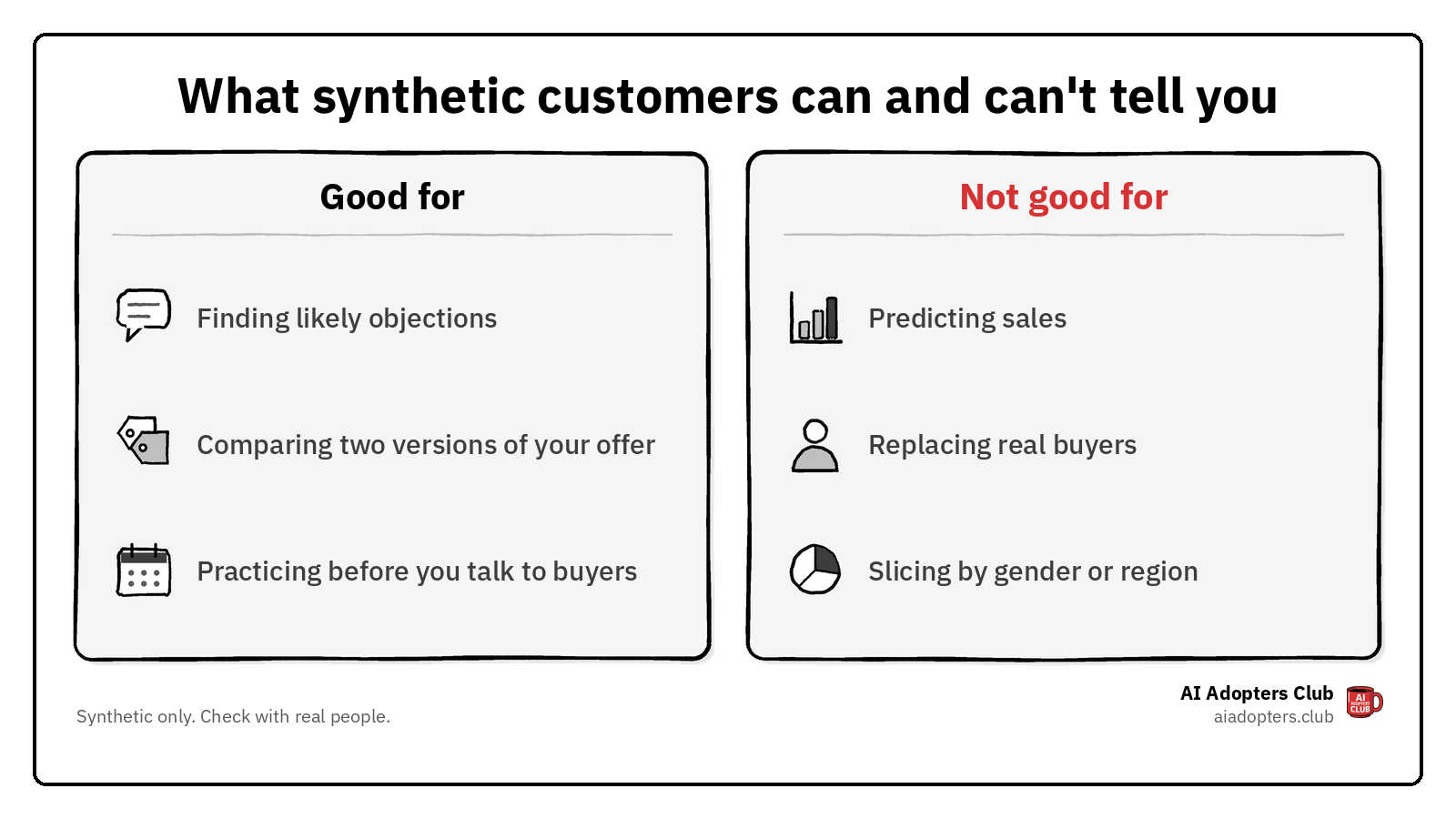
All of it is synthetic. Every customer was made up, every answer was written by AI, and no real person checked any of it. So this is a rehearsal, not market research. Honestly, the most useful thing it gave me was a list of objections.
I’ll give you the full prompt kit below, so you can run the same thing on your own offer. Use this when you have a written offer and want to find objections and compare versions before you talk to real buyers. You need your offer text with a price and a chat assistant. Treat the output as a rehearsal.
Where the idea came from
On Saturday a post on X, seen more than 1.1 million times, claimed “A toothpaste company has quietly killed the entire market research industry.” The idea was that you ask AI to play your customers and get their real buying intent back.
I had my AI agent team pull the paper behind it. The paper is real, and it’s interesting, but it doesn’t say that. Researchers from PyMC Labs and Colgate-Palmolive tested AI personas against 57 real product surveys.
Ask an AI persona to rate a product from 1 to 5 and it plays it safe, mostly picking 3. So the researchers let the persona answer in its own words instead, then measured how close that answer sat to sentences like “It’s very likely that I’d buy it” or “It’s very unlikely that I’d buy it.” That method is called semantic similarity rating, or SSR, and it turns a sentence into a score.
Where it did well was ranking which products people would like more. On that, it got about 90% of the way to how consistent real people are with each other.
What the post left out:
It measures what people say they’d buy on a survey, not what they actually buy.
It ranks products against each other. It doesn’t predict any one person.
The reference sentences were tuned by hand on those same surveys, so nobody knows yet how well they work elsewhere.
The paper never tested prices.
The authors call it “not a wholesale replacement for human research.”
So nobody killed market research. But it gave me an idea for a rehearsal.
What I ran
My AI agent team took the text of my coaching page and added a price. My real range is USD 1,500 to 2,500, so we tested both. We assumed a monthly fee, because the page doesn’t say.
We wrote 100 personas that look like my readers, business owners, operators and professionals adopting AI. At each price, every persona gave two quick 1 to 5 ratings and two short written answers. That’s 800 answers.
Two caveats you should know. My AI assistant wrote all 800 answers in one session instead of starting fresh for each one, so earlier answers could color later ones. And there was no human check. Nobody real answered, so I can’t tell you how accurate any of this is. That was my call, and it’s why everything here is labeled synthetic.
What came out
At USD 1,500 a month
Quick 1 to 5 rating: average 2.50, with 12% at a 4 or 5
SSR score: average 3.25, with 46% at a 4 or 5
At USD 2,500 a month
Quick 1 to 5 rating: average 1.89, with 2% at a 4 or 5
SSR score: average 2.92, with 34% at a 4 or 5
Both methods liked the lower price better. They just disagreed a lot on how warm people were.
I don’t trust the 46%. One persona wrote “No, very unlikely. 1,500 a month is far beyond what I can spend as a freelancer.” It rated the offer a 1, and SSR scored that same answer 3.45. Our reference sentences were never tuned the way the paper’s were, so even a clear no drifts toward the middle.
The quick ratings aren’t the truth either. They’re one AI’s guess at 100 invented people.
The objections were the useful part
The numbers didn’t tell me much. The written answers were more useful, because each one says why.
Price came up in most answers. Many of the bluntest came from solo consultants and very small firms. “The price doesn’t fit a one-person practice that’s already watching costs.”
Some already do it themselves. A recurring reason was that the persona already uses AI or builds its own workflows. “I can tinker with the tools myself, and that fee is impossible on my income.”
Someone else holds the budget. About ten answers said another person would have to approve the spend. “I’m a department head, not the budget holder.”
Confidentiality came up, but rarely. Only 8 of 400 written answers, mostly from small professional firms.
Keep in mind one AI wrote every answer, so these hundred people can share one voice. Treat the list as guesses about what real prospects might say. Then go ask them.
