


Hey Adopter,
This post is about what I built to fix your corporate branding, the thinking behind it, and how you can run it on your own brand this afternoon.
You know the feeling.
You open three browser tabs. Your personal site. The product you launched last year. The newsletter you write from. They’re all yours. None of them look like they belong to the same person.
The personal site is dark and editorial. A designer built it for you in 2022. The product is bright and cheerful. A different designer, different palette, different typography. The newsletter is Substack’s defaults. You never chose them. They chose you.
You know it’s broken. You’ve been quoted $75,000 by an agency. $12,000 by a boutique. Neither has the budget or the calendar. So nothing happens. And every week the brand fragments a little further.
Why I built it
This started with a specific problem I kept seeing.
Over the last year, founders and operators kept coming to me with roughly the same situation. A personal brand website. A separate product or course site. A newsletter or event page. Three touchpoints, each by a different designer, on a different platform, years apart. Each one sensible in isolation. Together, a mess.
Three sites. Three type systems. Three palettes. Three platforms. Classic founder-portfolio fragmentation. Common even in the best personal-brand empires.
I didn’t want to keep handing people Pinterest boards or a PDF with some mood words. I wanted a real system. But the kind of brand-strategy artifact that would genuinely be useful, the kind Pentagram or Wolff Olins produces for major clients, takes weeks of work and a team. That’s not something a single operator can run on their own brand in an afternoon.
So I spent time thinking about how to get there through the effective use of AI.
Here’s the part I want to be honest about, because it’s the actual method worth copying. I didn’t go and read the canonical brand-strategy literature myself. I had Claudia, my AI assistant, educate herself on it. Wally Olins on the three architectures. David Aaker on the Brand Relationship Spectrum. Pentagram’s MIT Media Lab precedent. Wolff Olins on Tate. She studied how actual brand strategists work: the discovery interviews, the competitive audits, the architecture decisions, the token systems. I did the orchestration and the thinking on top of what she surfaced. Together we mapped the method onto a structured AI workflow: structured discovery phases, parallel research and audit subagents, token-architecture synthesis, live HTML proof, designer-ready handoff briefs.
That’s the real AI Adopters lesson worth calling out. You don’t have to personally master every adjacent discipline to produce work in it. You direct the AI to become expert on the thing. Then you do the orchestration, the judgment, the synthesis on top. The combined output is something neither of you could have shipped alone.
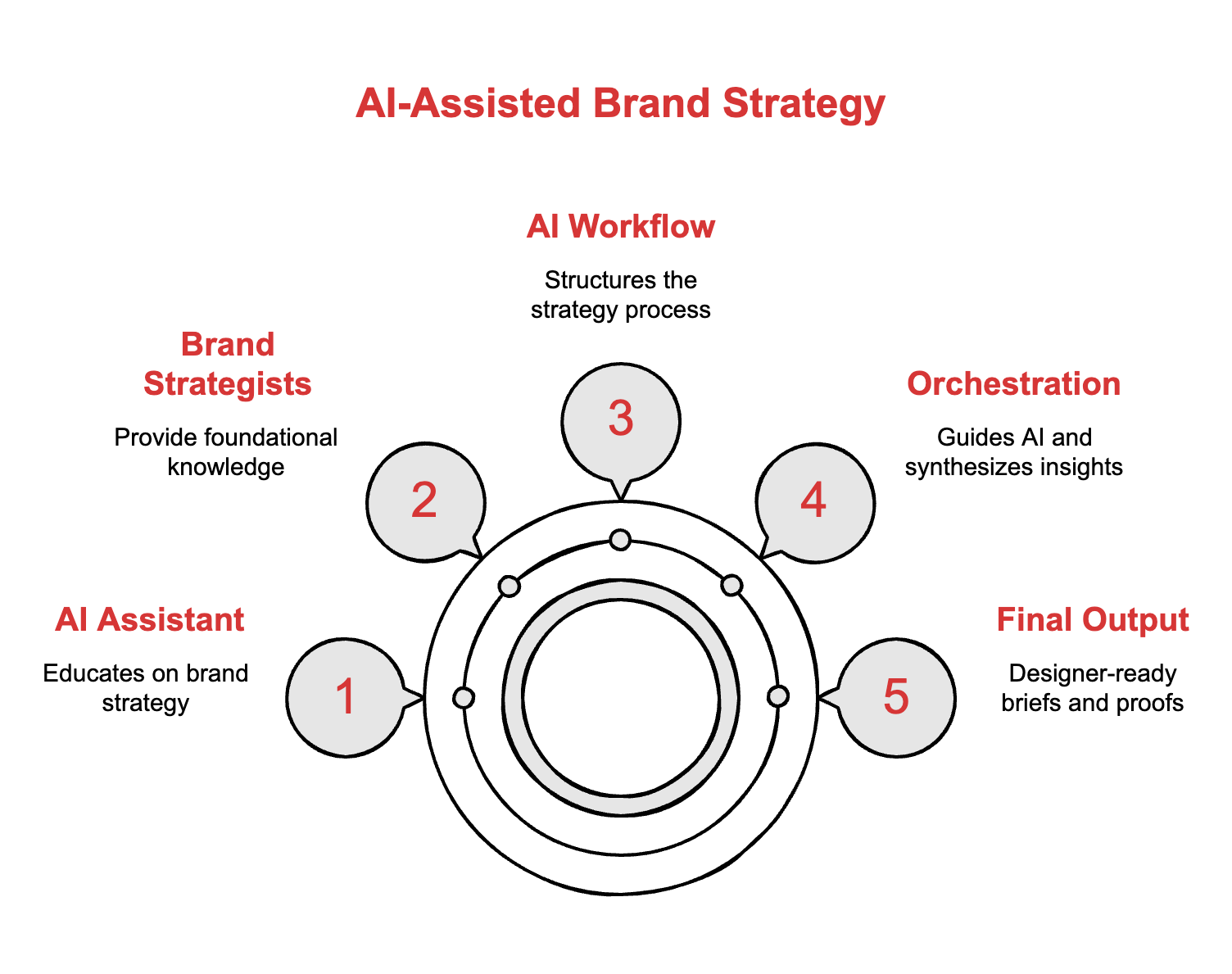
The result is a skill. You run it, answer structured questions, and it produces the brand-strategy artifact, an eight-folder brand bible with tokens, architecture decision, live showcase, and designer brief, that would otherwise take an agency months.
It’s the first time I’ve seen this kind of output produced from a single-operator session. And it’s why I’m shipping it to Premium members today.
The method, in principle
Here is what the skill does, in one pass.
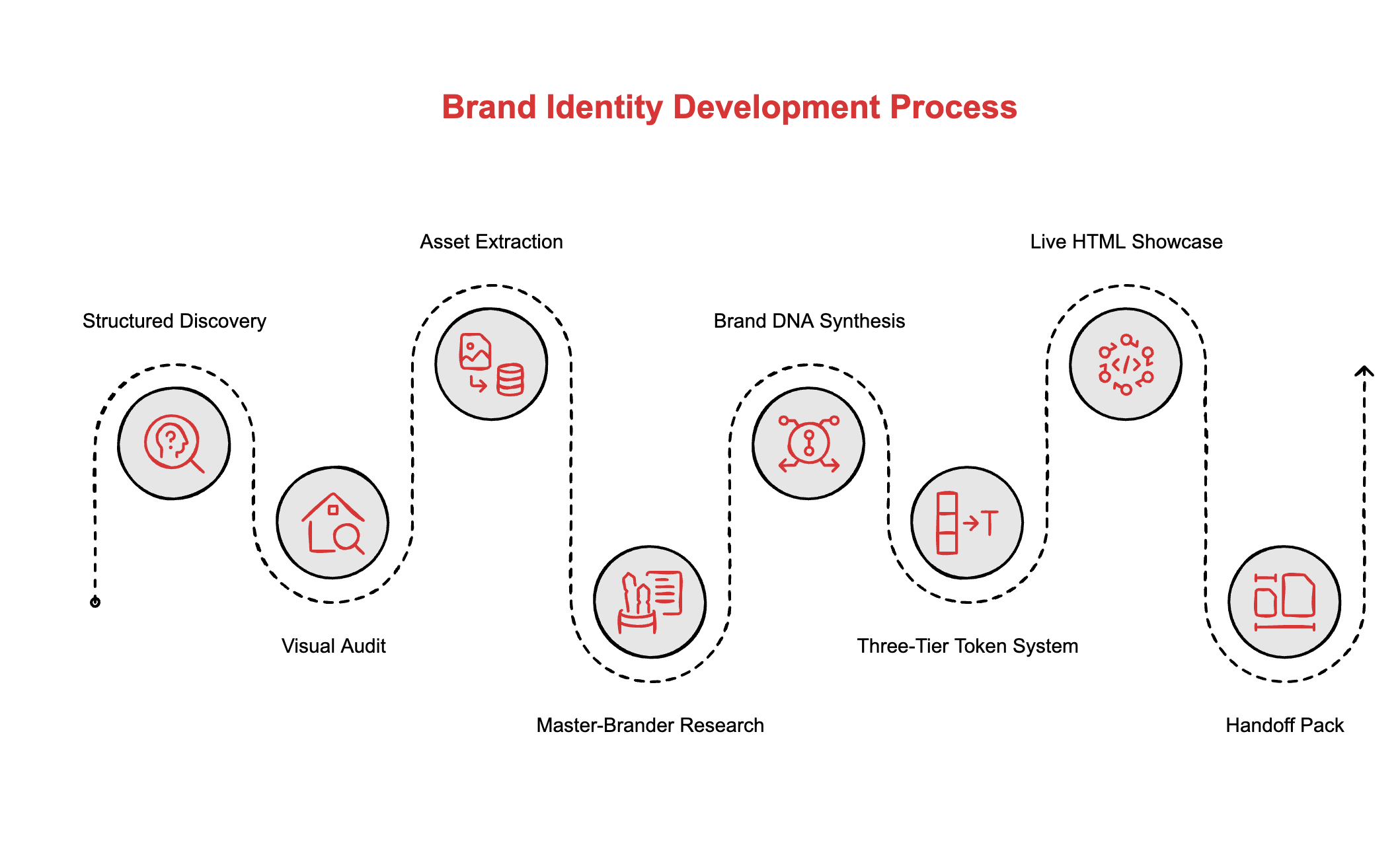
Structured discovery. Up to 41 interview questions across six rounds. Not optional. The single biggest reason AI brand work produces generic output is skipping the interview. The skill refuses to synthesise anything before you answer at least ten honest questions about your audience, your competitors, your admired brands, your register, your non-negotiables. Your answers get saved verbatim to a file you keep.
Visual audit. If you have live properties, the skill audits them. In Claude Cowork, it uses the Claude in Chrome extension to navigate each site at desktop and mobile breakpoints, screenshot the hero, and extract every computed colour, font, and typography token via JavaScript. The raw observations land in a per-property file.
Asset extraction. A subagent downloads your canonical logos, fonts, favicons, and Open Graph images into an organised folder. You find out, among other things, which of your properties ships a proper social-share image and which one silently leaks every link unfurl because it’s missing.
Master-brander research. In Deep mode, a research agent goes and produces a methodology document grounded in Wally Olins (the three-structure taxonomy), David Aaker (the Brand Relationship Spectrum), Pentagram (the MIT Media Lab precedent), Wolff Olins (Tate, Orange, Uber 2016), Massimo Vignelli, Walter Landor, Stefan Sagmeister. Five to eight personal-brand empire case studies relevant to your situation. Anti-patterns with risk flags. Every claim cited.
Brand DNA synthesis. Every divergence across your properties gets ruled as strategic (keep), accidental (remove), or legacy (sunset). An architecture decision, monolithic, endorsed, or house of brands, argued with specific rationale rather than listed as three options. This is the heart of the system.
Three-tier token system. A platform-agnostic tokens.json file. Tier 1 is the family DNA: typography, spacing, grid, radius, motion, neutral palette, accent ramp. Inviolable across all your entities. Tier 2 is per-entity expression: each property maps Tier 1 primitives to semantic roles (surfaces, inks, accents). Tier 3 is component tokens (buttons, cards, nav) derived from Tier 2. Same structure a senior design system architect would spend a month producing.
Live HTML showcase. A working web page where you click between your entities and watch the same components re-skin themselves via token swap. This is the proof. This is what convinces your team the system works, and convinces your designer you’re serious.
Handoff pack. Designer brief, developer brief, decision log, open questions. Ready to hand to a contractor.
Eight folders. 15 to 120 minutes of your time depending on which of three modes you pick.
Why this matters for your business
A system like this pays back in four specific ways. I’ve watched all four happen, either with clients or in my own practice.
It ends the trust tax. Every inconsistency between your properties is a small friction on first impression. A visitor on your personal site who clicks through to your product should feel like they walked into a different room of the same house, not a different house. Until that’s true, you’re paying a trust tax on every new reader, lead, and customer. Compounding, invisibly, forever.
It makes marketing compound. Money spent on a brand that rhymes across properties compounds. Money spent on three fragmented brands scatters. Every ad dollar, every podcast appearance, every inbound link reinforces the whole only if the whole is coherent. Coherence is the free lever almost nobody pulls on purpose.
It de-risks designer handoff. The single most expensive phase of any design engagement is the first two to four weeks, where the designer tries to extract from you what you already know but haven’t articulated. This skill produces that articulation as a structured artifact. A designer opens the folder, reads for an hour, and can start real work on day one. Agencies bill for this phase at their full rate. You can eliminate it.
It gives you a decision surface. The open-questions.md file at the end of each run names every decision the skill couldn’t make for you. No hand-waving. No “we’ll figure that out later.” You know exactly what’s unresolved and can decide explicitly, with a full picture in front of you. That’s the artifact every strategic consultant tries to produce and most never quite do.
This is not a magical brand generator. It’s structured, disciplined, defensible output. The kind of artifact a boutique strategy shop would charge you $25,000 to produce and spend three months producing. Running the skill costs your existing Claude plan and between fifteen minutes and two hours of honest conversation with an AI that has been briefed on the canonical brand-strategy literature.
What’s behind the paywall
I’ve packaged everything into one Google Drive folder. Yours to copy, fork, modify, or share with your team.
Inside:
The complete skill. Drop it into Claude Cowork or Claude Code. It’s ready to run.
A three-step install guide. No terminal required if you’re using Claude Cowork in a browser. Five minutes from zero to first conversation.
The exact activation prompt. Copy, paste, answer. The skill takes it from there.
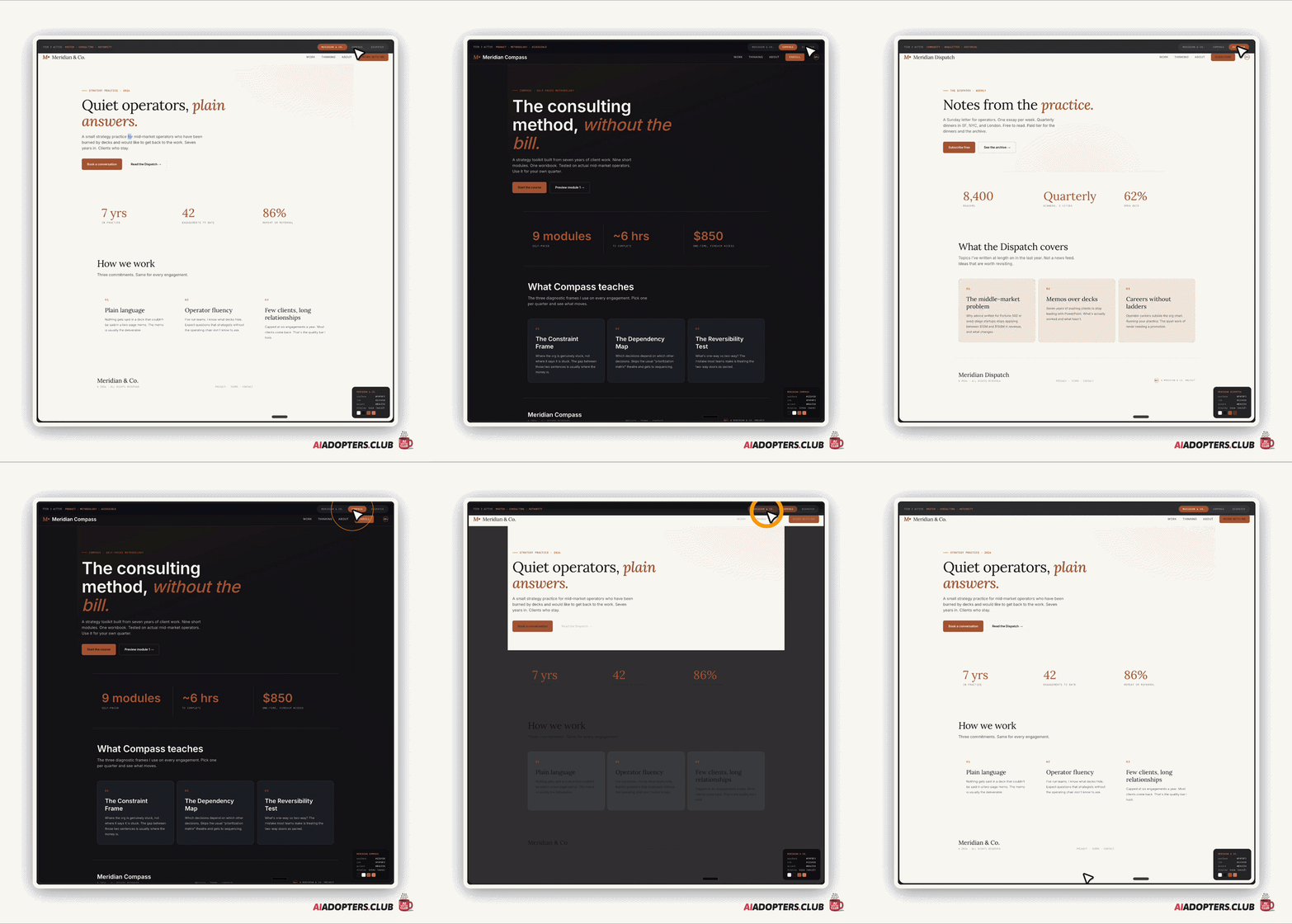
A full fictional example output. A made-up brand called Meridian & Co., a strategy consultant who expanded into a product and a newsletter. The skill run all the way through, every folder populated. Open the HTML showcase in a browser. Click between the three entity tabs. See the system work before you install anything.
Preview screenshots so you know what to expect.
One Drive link. Yours to keep.
If you’re an AI Adopters Club Premium member, you’re about to unlock it. If you’re not, the upgrade is one click. Annual membership is less than the hourly rate of the boutique brand consultant this skill replaces.
The unlock: your Drive link
Download the bundle in Google Drive
The folder is read-only by default. Click Add to my Drive or Make a copy to put it in your own Drive so you can modify, share with your team, or archive.
Three-step install, short form
If you’ve already read 01-INSTALL-IN-3-STEPS.md in the bundle, skip this. This is the condensed version.
1. Claude Cowork path (recommended).
Go to claude.ai/cowork. Sign in. If you want to audit live sites, install the Claude in Chrome extension.
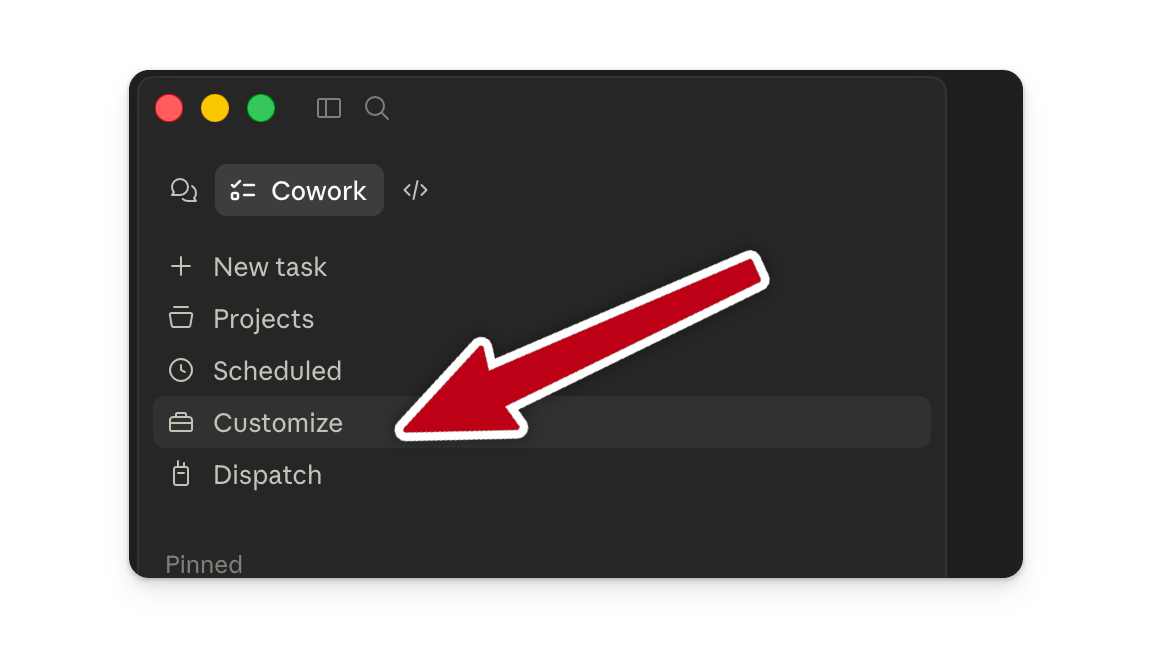
The way you install the skill is as follows. You open the desktop app and look for the Customize button in the sidebar. Then you install the skill based on the images below.


2. Claude Code Desktop path (alternative).
If you run Claude Code locally, unzip the bundle and drop the brand-system-builder folder into ~/.claude/skills/.
On Mac, hit Cmd+Shift+G in Finder, paste ~/.claude/skills, create the folder if it doesn’t exist, drop the skill in. Restart Claude Code. Paste the activation prompt.
What to expect on your run
Phase 1 (discovery). 15 to 45 minutes of structured questions. The skill will ask in rounds of three to five questions at a time. Answer honestly. The output quality scales directly with the honesty of the intake.
Phase 2 (audit). If you gave the skill live URLs, it opens each one in the Claude in Chrome extension (or Playwright if you’re on Desktop) and extracts computed tokens. Takes five to ten minutes per URL.
Phase 3 (assets). A subagent downloads your canonical logos, fonts, favicons, and OG images. Runs in the background while Phase 2 is happening.
Phase 4 (research, Deep mode only). Another subagent produces the master-brander methodology document. 5 to 10 minutes.
Phase 5 (synthesis). The skill writes the brand DNA files. This is where it takes real positions. Expect to be asked to confirm or push back on the architecture recommendation.
Phase 6 (design system). The tokens.json file, the brand bible narrative, the live HTML showcase. This is where the work becomes tangible.
Phase 7 (applications). Two to five specimen files demonstrating the system in context: hero, OG image template, email signature, one-pager, business card. The skill scopes these to whichever applications you flagged as priority.
Phase 8 (handoff). Designer brief, developer brief, decision log, open questions. The contractor-ready package.
Phase 9 (README). The executive summary at the top of the folder. Link to send around.
Total: 15 minutes to 2 hours depending on mode.
The one thing that makes this different
Most AI brand tools ask you three generic questions and spit out a mood board. This doesn’t.
This skill forces you to take positions. It asks you what you’re NOT. It asks you which competitors you want visual distance from. It asks you what feeling-words describe your register, and pushes back if you pick generic ones. It commits to a specific architecture recommendation with argued rationale, not three options for you to pick from. It cites Pentagram and Wolff Olins case studies by name. It produces a decision log showing its work, and an open-questions file naming the decisions it couldn’t make for you.
That’s not because AI is magic. It’s because the method is structured. Discipline, not cleverness, is what turns discovery plus audit plus research plus synthesis into a defensible artifact. The skill just enforces the discipline on your behalf.
FAQ
What if I don’t have live websites yet?
The skill adapts. Instead of auditing existing properties, it runs a pre-launch version of the discovery phase with more emphasis on positioning and competitive frame.
What if I only have one entity (no portfolio)?
Fine. Instead of producing an architecture recommendation, the skill produces a positioning recommendation focused on register, tone, and competitive frame.
Can I share the bundle?
The skill is MIT-licensed. Fork it, modify it, ship your own variant. Attribution to AI Adopters Club is appreciated but not required.
What does a single run cost?
Your existing Claude plan. One run uses 20,000 to 80,000 tokens depending on mode. Easily within a typical paid plan’s monthly budget.
Is this a replacement for a designer?
No. It’s a replacement for the first two weeks of a designer’s process: the discovery, audit, and strategy phase. You still hire a designer to refine the marks, direct photography, build the Figma library, and ship production design. But you hire them with a full brief already written.
but…. who is to say that you don’t hand it off to claude.ai/design?
What if the skill gets something wrong?
Push back. The skill is designed to take positions and revise them when challenged. What it won’t do is hedge. If you think the architecture recommendation is wrong, say so. It will counter-argue or revise based on what you say.
Send me what you build
If you run the skill and produce something worth seeing, send me by reloying to this email. I’m collecting runs from Premium members for a follow-up essay on what people actually do with a brand bible produced in 45 minutes instead of three months.
Especially interested in:
Multi-entity founder portfolios
Pre-launch brands where the skill runs against nothing
Rebrands of established businesses
Anything where the skill’s recommendation surprised you (good or bad)
A closing note
I started AI Adopters Club because I believed the people who figured out how to apply these tools to real work would be the ones who quietly outpaced everyone else. Not with cleverness. With structure.
This is what I mean. The brand-system work that used to take an agency three months can be delivered in an afternoon by a founder with Claude, the Claude in Chrome extension, and a willingness to answer 41 questions honestly. That’s not a novelty. That’s a real shift in what an individual can produce alone.
Thank you for being a Premium member. This is the kind of asset I want to make for you every month.
Adapt and create.
— Kamil
Have a brand you’d like me to audit in this style? Reply to this email. Premium members get priority.