


Hi Adopter,
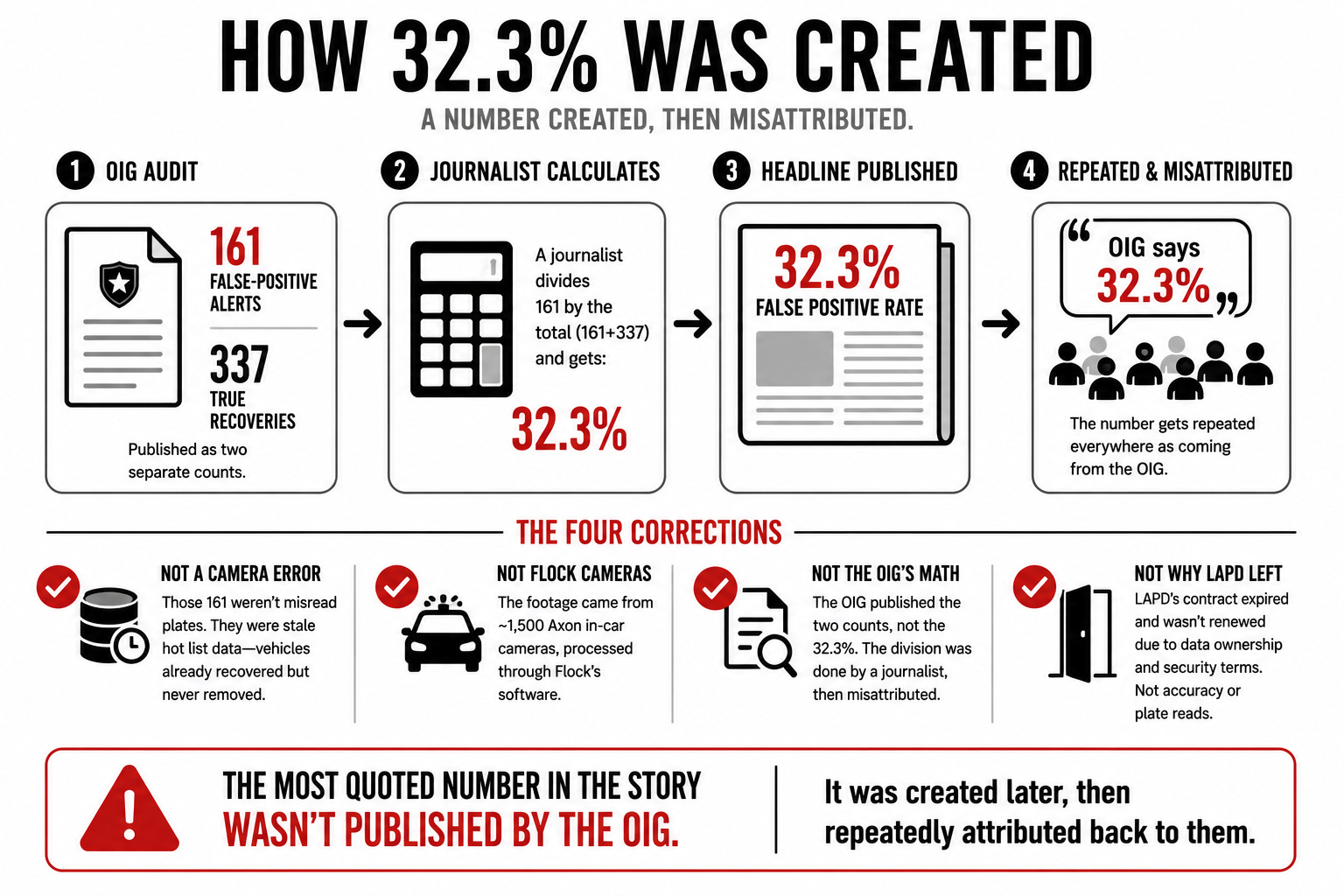
You’ve probably seen the number by now. 32.3 percent false positive rate on Flock’s license plate cameras, straight from LAPD’s own audit, repeated everywhere like it’s settled.
So I went and read the audit. The number isn’t in it. Not on one page.
What’s actually in there is two counts. 161 alerts where the plate read correctly but the car turned out not to be stolen. 337 where it was. A journalist at Futurism divided one by the sum of both and landed on 32.3 percent. The LA Police Commission’s Inspector General never built that math themselves. They published the two counts and left it there.
Follow the number back further and it falls apart three more ways.
Those 161 errors weren’t misread plates. LAPD’s own audit attributes them to stale hot list data, cars that had already been recovered but never got pulled off the flagged list. That’s a stale database, not a camera getting something wrong.
The footage wasn’t even from Flock’s cameras. It came from roughly 1,500 Axon in-car cameras, run through Flock’s software. Flock was the middle layer that day, not the hardware.
And LAPD didn’t walk away over accuracy anyway. Their contract expired, and the department’s CIO pointed at data ownership and security terms. Not the plate reads.
So the most quoted number in the entire Flock story has the wrong source, the wrong camera, and the wrong reason attached to it. Four mistakes stacked into one stat, and it’s still the headline.
Honestly, that’s the real story here. Not whether Flock’s plate reader is any good. Whether we’re all arguing about the wrong layer of the product.
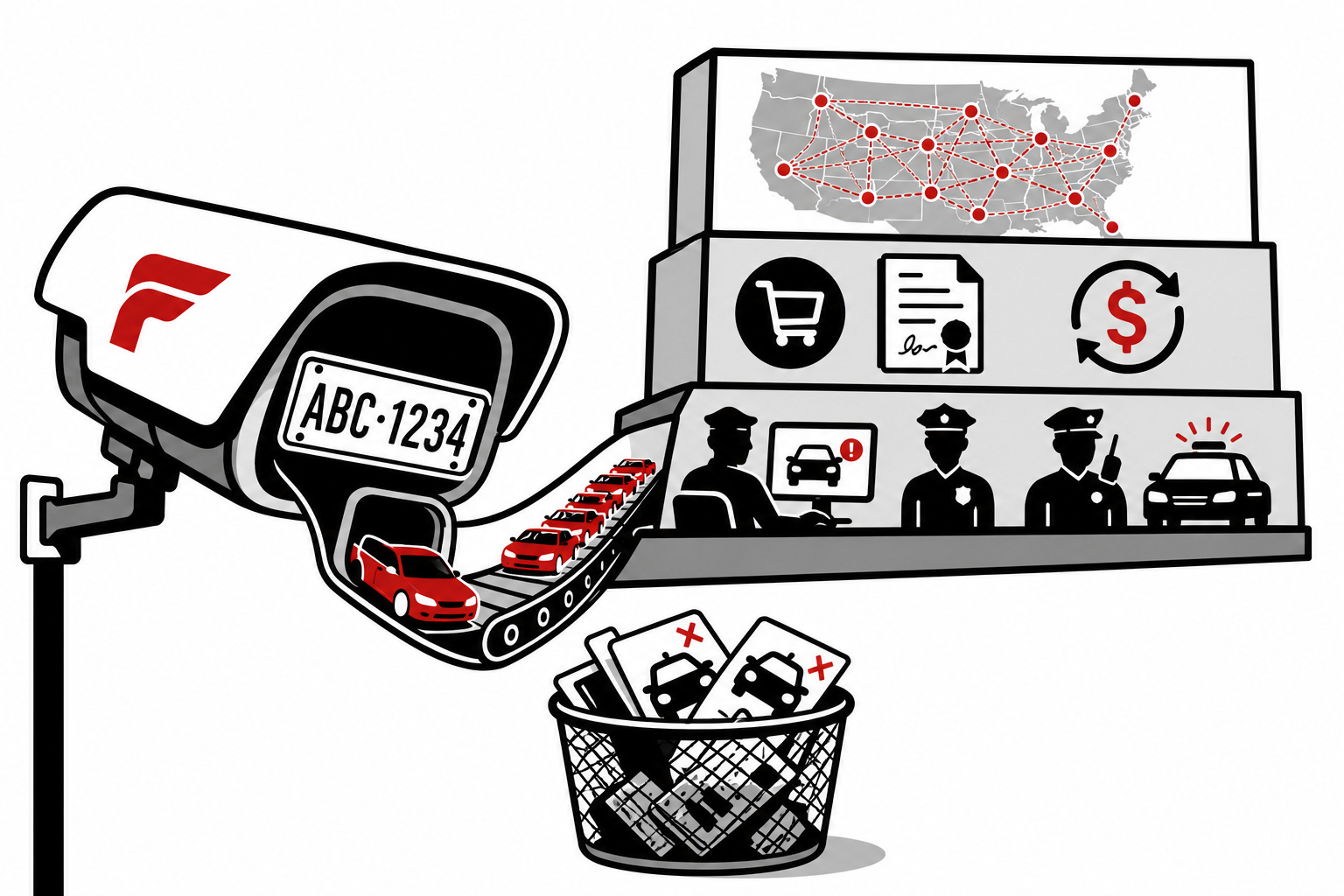
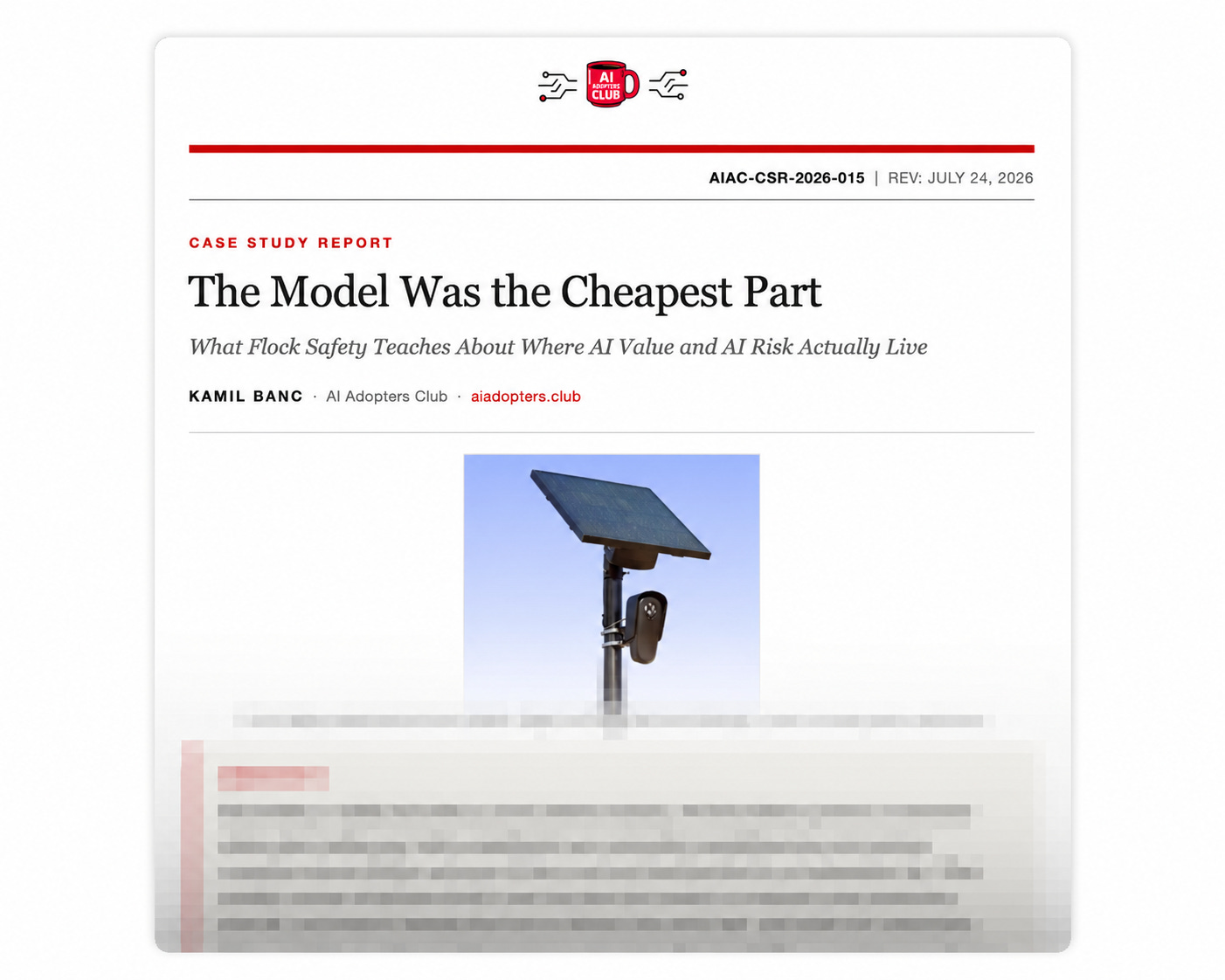
A Flock deployment isn’t one AI doing one job. It’s a chain. A camera captures the plate. A model reads the characters and guesses the car’s make and color, and that part can genuinely be wrong, an actual computer vision error. Then it hits a hot list, which is just a database lookup, a string match, nothing intelligent happening there at all. Then a person decides whether to act on it. Three very different things can go wrong in that chain, and only one of them is the model. The 32.3 percent story blamed the AI for an error that happened two steps later, sitting in a database nobody had gotten around to cleaning.
None of this means the tool doesn’t work, to be fair to it. That same LAPD audit, over two months, recorded 337 stolen cars recovered off Flock alerts. The plate reader does what it says on the label. The question was never whether it works. It’s what you’re actually paying for when you buy it.
I live inside AI tools for a living. Most of my job is figuring out what people are actually buying versus what they think they bought, and the pattern in the Flock story is one I run into constantly. Just turned up loud here.
Reading a plate off a photo isn’t hard anymore. Every serious competitor in this category does it, Axon, Rekor, Motorola. Flock’s own page comparing itself to Axon doesn’t even argue it reads plates better. It argues on network scale, on pricing, on how fast you can deploy it. That’s the company itself telling you where the value sits.
The model is the cheapest part of what you’re buying. It’s table stakes.
What you’re actually buying is everything wired around it.
A network of cameras spanning the whole country, where one department can search footage another department captured. Hardware sold as a subscription, roughly $3,000 a camera a year, all in, on multi-year terms that renew themselves unless someone remembers to cancel. Purchasing contracts that let any city or county buy in without running its own competitive bid, sometimes riding inside a solicitation written for something else entirely. One of Flock’s cooperative-purchasing deals started life as a weapons-detection contract and quietly became the vehicle for its whole camera catalog. And a workflow that plugs straight into how police already operate: alerts, hot lists, human review, action.
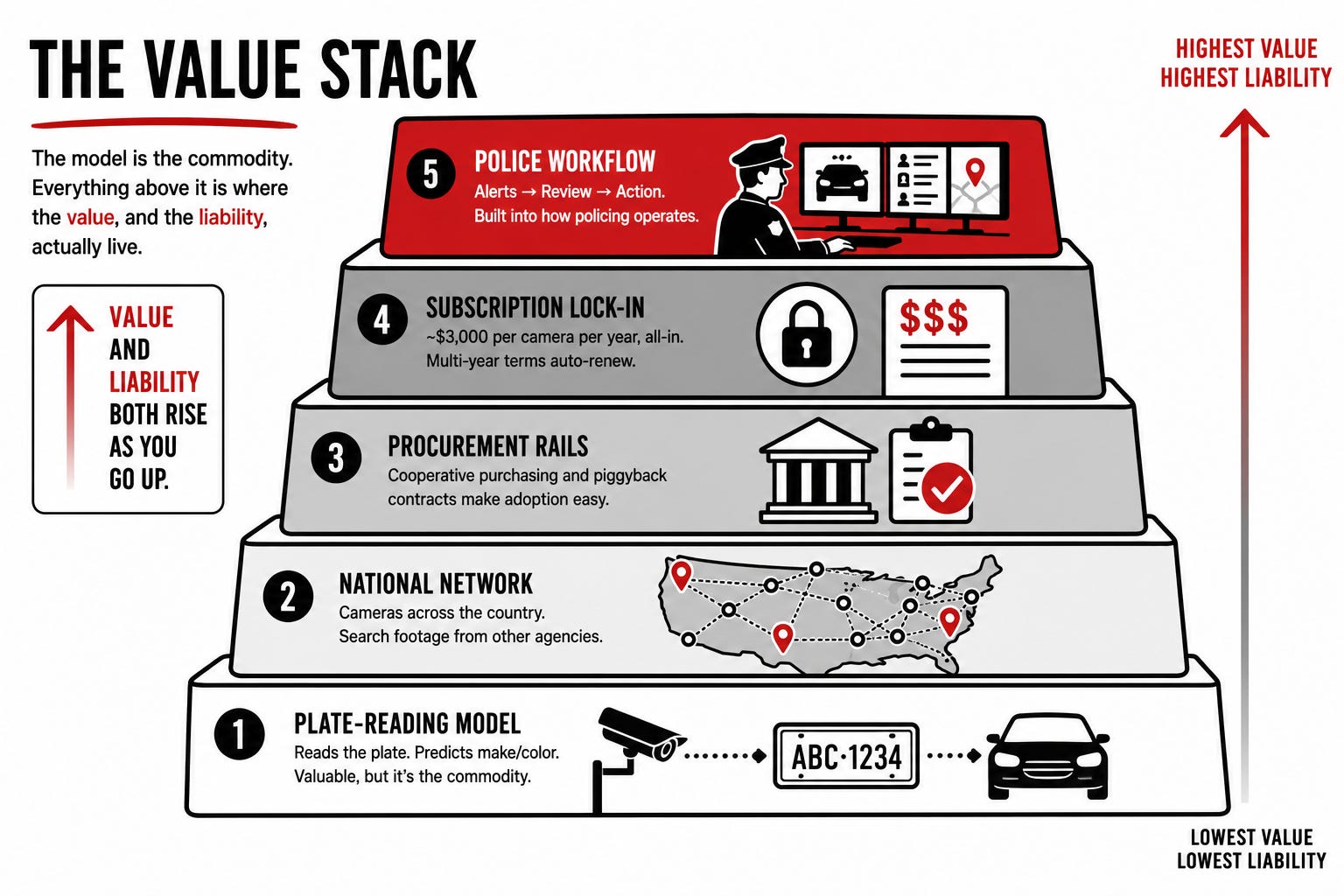
That’s the product. The camera is just what gets you in the door.
This is where it gets useful for anyone thinking about AI moats more broadly, not just cameras. That same network, the thing that makes Flock worth billions, is the exact thing cities name when they cancel.
Denver dropped Flock this year and moved to Axon, on the same poles, cameras cut from 110 down to 50. Asked why a direct competitor couldn’t just slot into the gap, Denver’s mayor said Axon doesn’t maintain a national cross jurisdiction database the way Flock does. Douglas County made the same swap, and their sheriff put it simpler: trust was lost. Syracuse pulled its readers after an eight-month fight that started with a single officer’s error, one login that connected the city to Flock’s national network for nearly a year. Federal immigration agents reportedly ran more than 2,000 searches touching Syracuse drivers before the city caught it, according to local reporting.
None of those departments are complaining that the camera misreads a plate. They’re leaving because the network reaches further than they’re comfortable with, and because who gets to search it turned out to be hard to control once it was built.
How far it can actually reach is the part that tends to get people’s attention. According to a congressional letter citing search logs, one sheriff’s office in Texas reportedly ran a search whose stated reason was logged as “had an abortion, search for female.” That single query is reported to have touched more than 6,800 separate Flock networks and over 83,000 cameras, reaching into Illinois and Washington state along the way. Nobody in either state signed off on it. The network didn’t stop them, because letting one agency reach into another is exactly what it’s built to do.
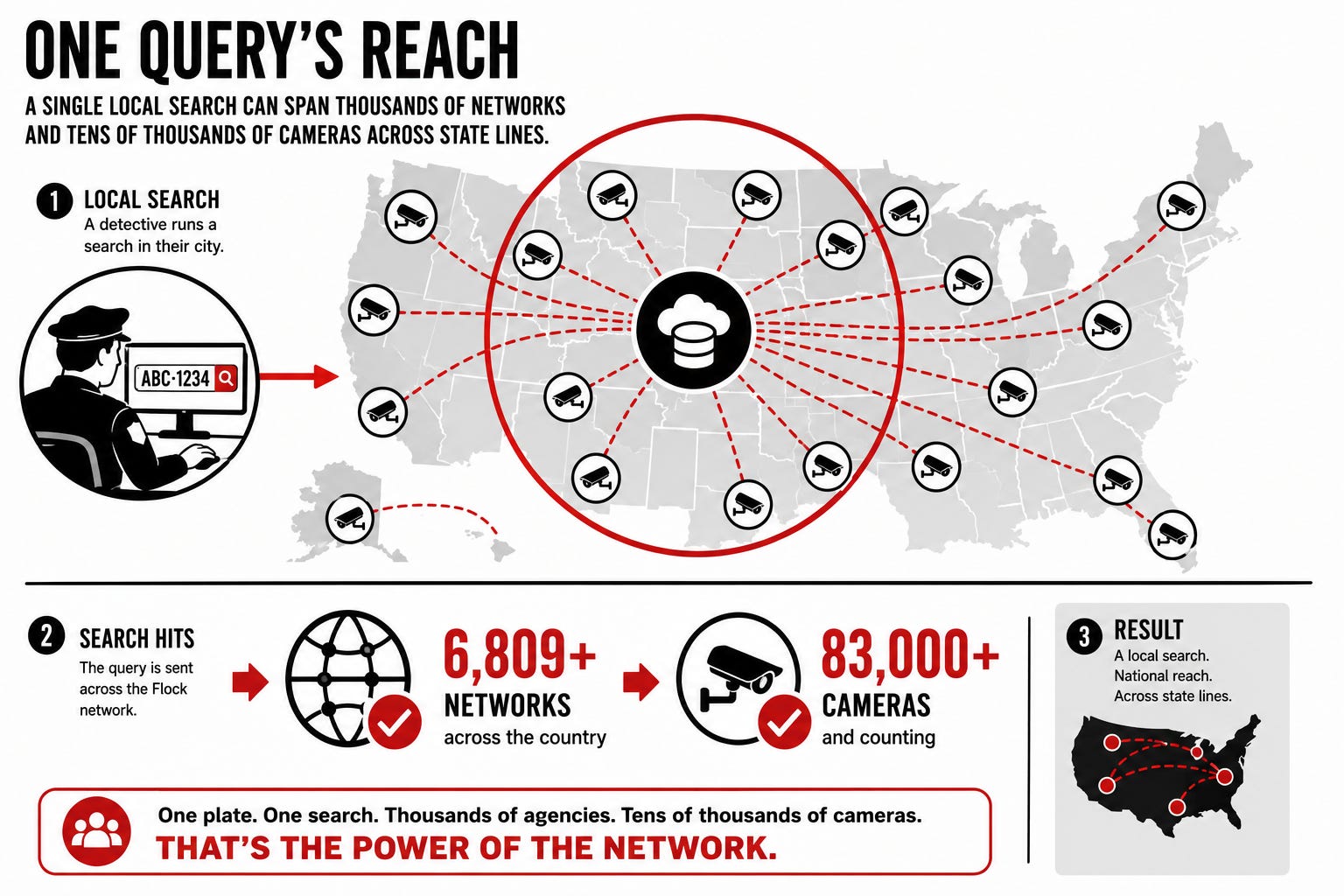
So the moat and the liability are the same asset, looked at from two different angles. The thing a competitor can’t copy is also the thing that gets you canceled.
One more piece, and I want to hold this one carefully because it’s genuinely unresolved, not a gotcha. Flock holds a patent, granted in 2022, whose written description covers classifying people by sex, race, and clothing, and matching faces across footage. Flock’s own public pages say flatly, “Flock does not use facial recognition technology” and “It cannot recognize people.” Both are real statements, about two different documents. Nobody’s independently audited the running software to say which one describes what actually ships today. That gap, between what a company is legally allowed to build and what it says it currently runs, is worth watching in any AI vendor. Not just this one. A patent isn’t a product. It’s also not nothing.
If you’re the one deciding whether to buy an AI tool, or build one, this is what actually carries over.
Stop grading the model first. That’s the part everyone pokes at, because it’s the easiest thing to argue about: accuracy, false positives, benchmarks. It’s also usually the least defensible part of the whole business, the part any competitor can match inside a year.
Look instead at what’s built around it. The data it accumulates, and who else can reach it. The contract terms, and what it actually costs to leave. The workflow it’s wired into, and how hard that would be to rip out once it’s in. That’s where the real value sits. It’s also where the real risk sits, in the same place, because most of the time they turn out to be the same thing wearing two names.
If you’re the one building the AI product instead of buying it, the same lesson just runs in reverse. Your trained model probably isn’t your moat either. Anyone with similar data and enough compute can get close to it in a year, the way Axon got close enough to Flock’s plate reading to walk right in behind it. What’s actually expensive to copy is everything you built around the model: the workflow your customers get stuck inside, the data you’re the only one holding, the distribution that gets you in the door without a fight.
Next AI pitch you sit through, on either side of the table, don’t just ask what the model can do. Ask what it’s plugged into, and who else gets to touch it once you say yes.
Companion Case Study
The Model Was the Cheapest Part
AIAC-CSR-2026-015 · AI Adopters Club
Read the full case study
Adapt and Create,
Kamil
Sources
Los Angeles Police Commission Office of Inspector General, “Review of the Department’s ALPR System and Use in the Field,” BPC #26-184, July 10, 2026.
Futurism, July 2026 (the 32.3 percent calculation).
TechCrunch, July 13, 2026 (LAPD’s non-renewal, CIO cites data ownership and security terms).
The Denver Post, February 24, 2026 (Denver’s mayor on the Axon switch).
Axios, July 23, 2026 (Douglas County sheriff on “trust was lost”).
Central Current, July 20, 2026 (Syracuse’s removal of Flock readers).
US Patent 11,416,545 B1, Garrett Langley, granted August 16, 2022. https://patents.google.com/patent/US11416545B1/en
Flock Safety, “What Is Flock” and “Trust and Safeguards” pages, accessed July 23, 2026. https://www.flocksafety.com/what-is-flock
Flock Safety, Flock vs. Axon comparison page, accessed July 24, 2026. https://www.flocksafety.com/vs/axon