


Hi Adopter,
Hilton runs 7,500 properties in 138 countries. Staff shortages, rising costs, and guests who expect frictionless digital service created a sharp set of constraints. The CEO confirmed 41 distinct AI use cases now active across the business. Not pilots. Live systems.
Three produced measurable returns fast: AI-powered marketing campaigns delivered double-digit incremental revenue growth. Food waste dropped over 60% in 200 hotels using Winnow’s AI kitchen scales. Customer service chatbots cut query resolution times by 50% with 90% positive feedback.
Core lesson: Hilton did not chase AI novelty. The company modernised its reservation and data systems first, then identified specific high-cost problems, then matched each problem to a partner with proven tools.
The playbook that turned pilots into profit
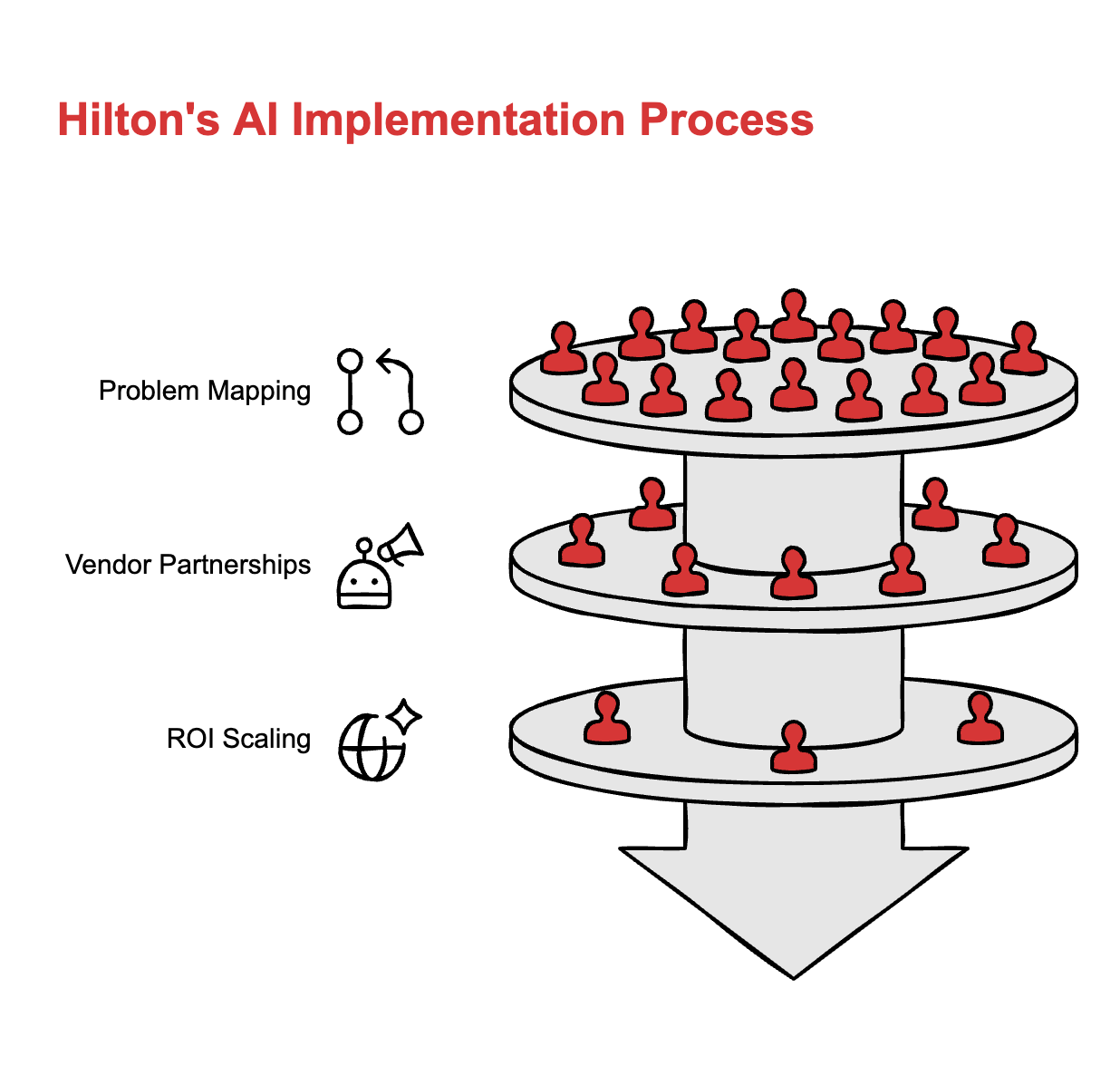
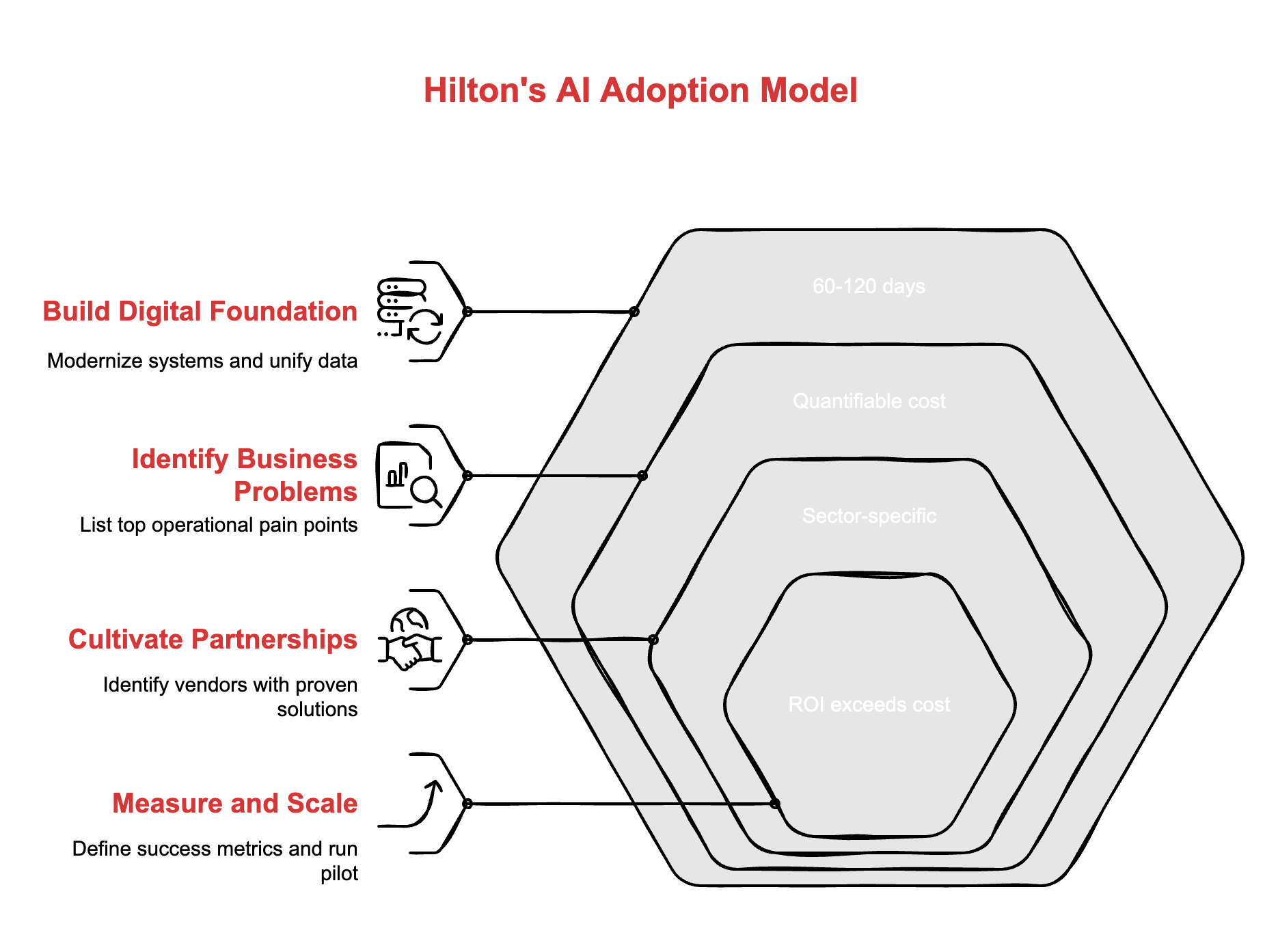
Hilton’s approach split into four phases: cloud migration to break data silos, problem mapping across operations, selective vendor partnerships, and scaling only what showed ROI. The franchised structure forced discipline. Franchisees pay fees based on occupancy and revenue, so underperforming tools would not survive.
The “enablement not replacement” philosophy kept staff onside. AI coaches train employees on service recovery. Predictive maintenance reduces breakdowns before guests notice. Marketing teams use AI to automate low-value tasks like selecting photos for 1.3 million rooms, freeing time for strategy.
Download today’s full 20-page PDF for the stack, timelines, and measured impact
Four-phase adoption framework Hilton applied to scale from pilot to 200 properties
Vendor shortlist with selection criteria for waste management, marketing automation, and staff training platforms
Data prerequisites: what Hilton fixed before any AI tool went live
30-60-90 implementation plan mapped to SMB resources and team sizes
KPI tree showing baseline metrics, targets, and variance tracking at 30-day intervals
What SMBs can do this week
Map your three highest-cost operational problems with numbers attached. Hilton identified food waste costing millions annually and slow room turnover cutting occupancy. Start with verifiable pain, not with exploring AI use cases. Check whether your CRM, POS, or inventory system has an API. Integration capacity matters more than feature lists.
Minimum data you need in place
Hilton moved its reservation system to the cloud and built a unified property management layer before deploying AI. You need clean, accessible customer or transaction data in one place. Siloed spreadsheets kill AI performance. If three teams maintain separate customer records, consolidation comes before automation.
Common vendor traps to avoid
Winnow charged upfront for hardware but billed on waste reduction. Google’s ad tools scaled with spend. SweetRush built custom training on Hilton’s service model. Avoid vendors selling generic AI without sector expertise or measurable outcomes. Long-term platform lock-in contracts before proof of ROI signal weak product-market fit.

Download the full report for the stack, timelines, and measured impact.

Framework: from pilot to steady state
Hilton’s four-phase AI adoption model emerged from observing what succeeded and what stalled. Phase one addressed the unsexy foundation work that most organisations skip.
Phase 1: Build the digital foundation
Hilton spent years modernising its Central Reservation System and migrating to cloud infrastructure before AI tools went live. The Property Engagement Platform unified data from franchised properties into a single accessible layer. AI systems need clean, consolidated data. Siloed systems deliver garbage predictions.
For SMBs: audit your data infrastructure. Can you pull a single customer record showing purchase history, support tickets, and preferences without manual reconciliation? If not, fix that before buying AI tools. This typically takes 60 to 120 days depending on legacy system complexity.
Phase 2: Identify high-impact business problems
Hilton did not ask “what can AI do for us?” The company identified costly problems first. Food waste ran into millions annually. Marketing to younger demographics underperformed. Staff training at scale lacked consistency. Each problem had a quantifiable cost attached.
For SMBs: list your top three to five operational pain points with dollar values or time costs. Examples: customer support backlog costing X hours weekly, inventory waste at Y percent of COGS, proposal generation taking Z days per deal. If you cannot attach a number to the problem, it is not a priority.
Phase 3: Cultivate strategic partnerships
Hilton partnered with Google for advertising automation, Winnow for kitchen waste management, SweetRush for generative AI training tools, and Be My Eyes for accessibility. Each vendor brought domain expertise Hilton could not build internally. The company stayed focused on hospitality while specialists handled AI implementation.
For SMBs: do not attempt to build custom AI. Identify vendors with sector-specific solutions and proven case studies in businesses similar to yours. Request pilot terms that tie payment to measurable outcomes. Winnow charged based on waste reduction, not upfront licensing fees. That risk-sharing model filters weak vendors fast.
Phase 4: Measure relentlessly and scale methodically
Every Hilton AI initiative tied to hard KPIs. Marketing AI measured on incremental revenue. Waste reduction tracked dollars saved. Chatbots monitored resolution time and satisfaction scores. Pilots with weak results died. Winning projects scaled from a handful of properties to hundreds.
For SMBs: define success metrics before deployment. Establish baseline measurements. Run a 30 to 90-day pilot with a subset of customers, transactions, or locations. Scale only when ROI exceeds internal cost of capital. This disciplined approach prevents budget bleed on underperforming tools.
Vendor shortlist and selection notes
For food waste and kitchen optimisation:
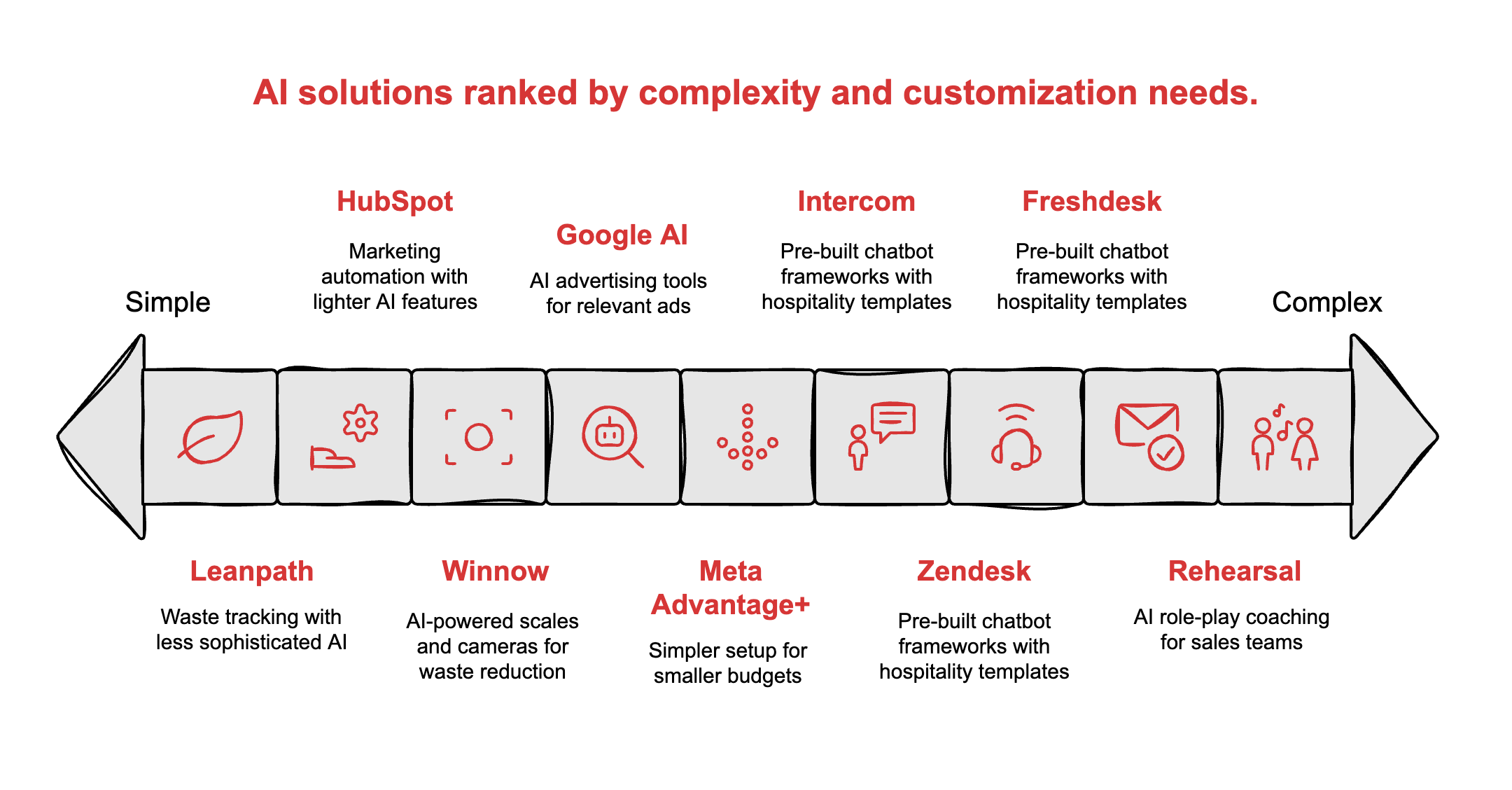
Winnow deploys AI-powered scales and cameras in commercial kitchens. Chefs see waste reports broken down by ingredient and meal period. Hilton reduced waste over 60% in participating properties. Hardware costs approximately $3,000 to $5,000 per location with ongoing fees tied to savings.
Alternative: Leanpath offers similar waste tracking with less sophisticated AI but lower upfront costs. Suitable for operations under 100 meals daily.
Selection criteria: integration with existing kitchen workflows, reporting granularity, staff training requirements, contract structure linking fees to verified savings.
For marketing automation and ad targeting:
Google’s AI advertising tools, including Video Reach campaigns and Smart Bidding, analyse user signals in real time to serve relevant ads. Hilton credited these tools with double-digit revenue growth. Costs scale with ad spend. Best for organisations spending $10,000+ monthly on digital advertising.
Alternative: Meta’s Advantage+ campaigns offer simpler setup for smaller budgets. HubSpot provides marketing automation with lighter AI features for inbound-focused SMBs.
Selection criteria: existing ad spend levels, in-house marketing expertise, integration with CRM and booking systems, transparent reporting on incremental lift versus baseline.
For staff training and coaching:
SweetRush built Hilton a custom VR and WebXR platform with generative AI coaching for soft skills. Team members practice handling guest complaints in realistic scenarios. An LLM fine-tuned on Hilton’s service standards provides instant feedback. Scales training to 400,000+ employees.
This solution required significant custom development investment suitable only for large enterprises. SMBs should explore off-the-shelf alternatives.
Alternative: Rehearsal provides AI role-play coaching for sales and support teams at $50 to $100 per user monthly. Interplay Learning offers VR training for technical skills. Both require minimal customisation.
Selection criteria: ease of content updates, device compatibility, pricing model (per-user versus enterprise), measurable impact on performance metrics.
For customer service automation:
Hilton deployed AI chatbots across digital channels achieving 90% positive feedback and 50% faster query resolution. The chatbots handle routine questions about amenities, check-in times, and local attractions, freeing front-desk staff for complex guest needs.
Platforms: Intercom, Zendesk, and Freshdesk offer pre-built chatbot frameworks with hospitality templates. Pricing ranges from $50 to $200 per agent seat monthly depending on message volume.
Selection criteria: natural language processing accuracy in your sector, escalation pathways to human agents, multilingual support, CRM integration depth, training data requirements.
Risk controls and contract negotiation
Data privacy and compliance:
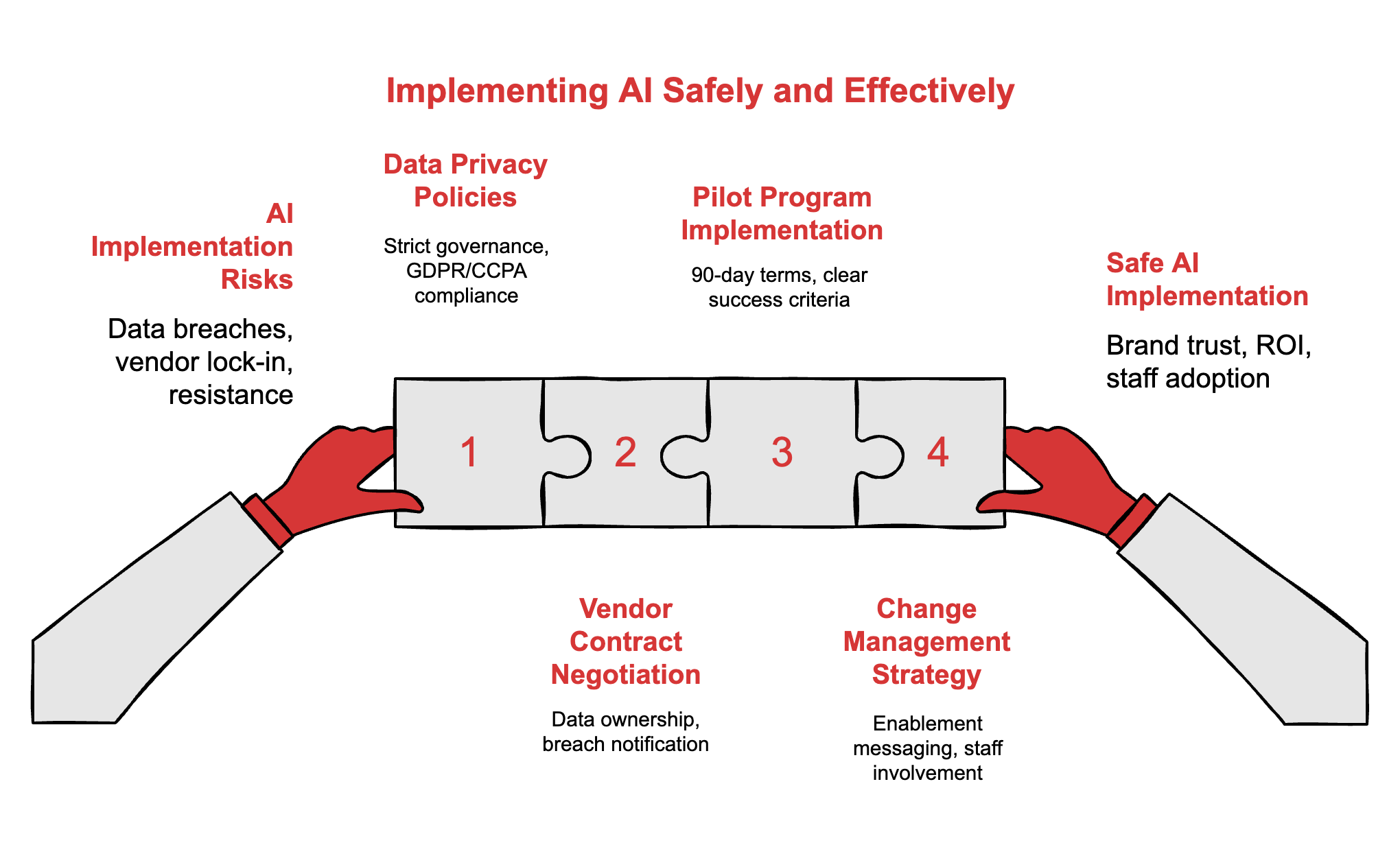
Hilton processes guest data from 235 million Honors members. Any breach would be catastrophic for brand trust. The company maintains strict data governance policies and vendor contracts requiring compliance with GDPR, CCPA, and sector-specific regulations.
For SMBs: ensure vendor contracts specify data ownership, processing locations, breach notification timelines, and liability caps. Run vendor security audits before deploying customer-facing AI. Budget for annual penetration testing if handling payment or health data.
Vendor lock-in and exit clauses:
Avoid multi-year platform commitments before proof of ROI. Negotiate 90-day pilot terms with clear success criteria and easy termination rights. Request data export capabilities in standard formats. Hilton’s partnerships with Google and Winnow scaled over time after initial proof of concept phases.
For SMBs: pilot contracts should include baseline metrics, target improvements, measurement methodology, and mutual exit clauses if targets miss by more than 15%. Long-term deals come after 12 months of verified performance.
Change management and staff resistance:
Hilton’s “enablement not replacement” messaging reduced fear. The generative AI coach improved service skills rather than automating jobs away. Food waste systems empowered chefs with better data rather than dictating menus.
For SMBs: involve frontline staff in tool selection and pilot design. Frame AI as removing tedious work to create time for higher-value tasks. Track and publicise quick wins. One team’s success story accelerates adoption across other departments.
30-60-90 plan
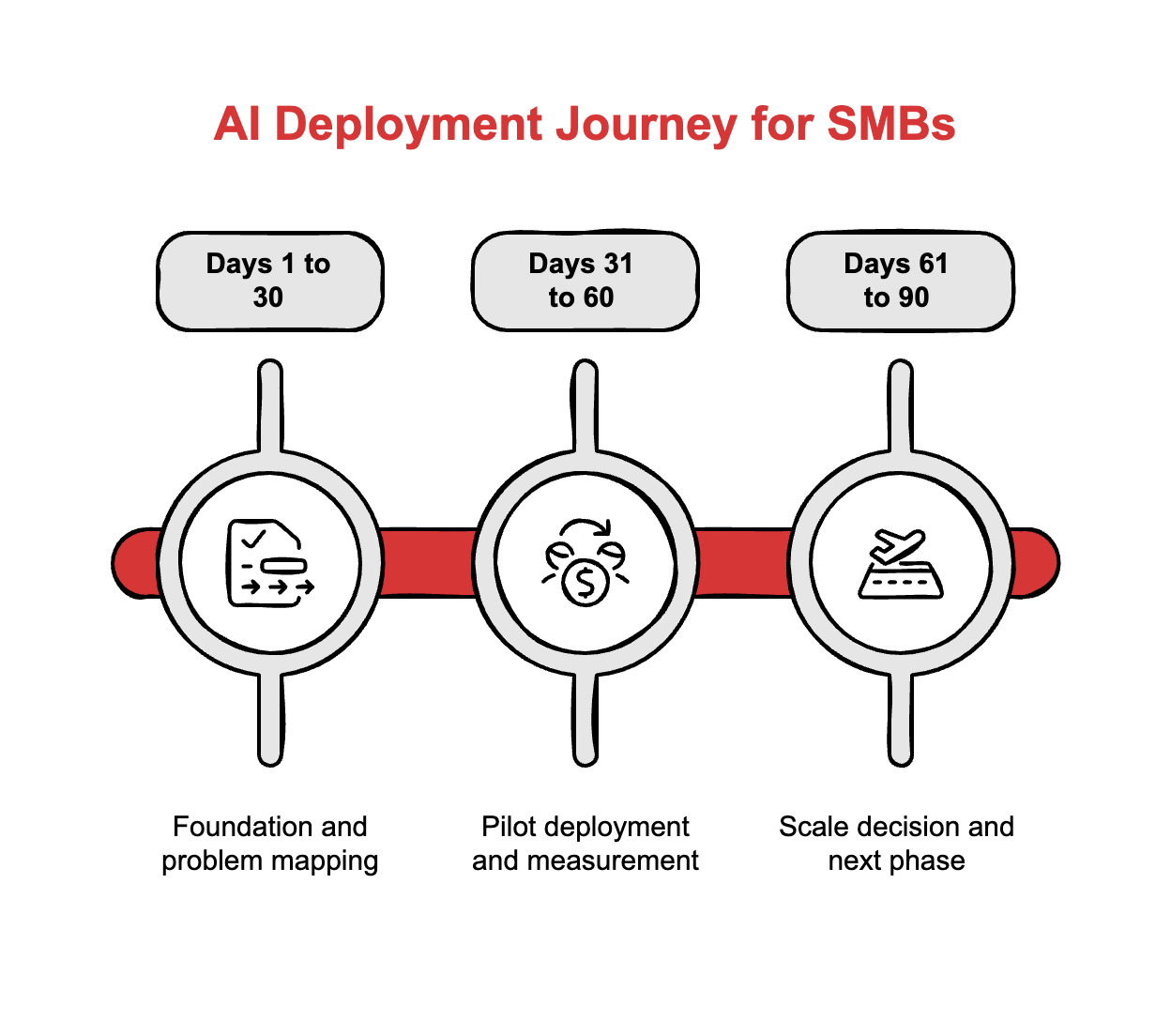
This timeline assumes an SMB with 20 to 100 employees, consolidated customer data in a CRM or ERP, and $5,000 to $25,000 budget for initial AI deployment.
Days 1 to 30: Foundation and problem mapping
Week 1: audit current data infrastructure. Identify where customer, transaction, or operational data lives. Document integration points and API availability.
Week 2: map top three operational pain points with quantified costs. Examples: support backlog costing 40 hours weekly, proposal generation taking 5 days per deal, inventory shrinkage at 8% of COGS.
Week 3: research vendors with proven case studies in similar businesses. Request pilot terms, pricing models, and reference customers. Schedule demos with shortlist of two to three vendors per problem area.
Week 4: select one high-impact problem for initial pilot. Define baseline metrics, target improvement, measurement methodology, and decision criteria for scaling or terminating.
Days 31 to 60: Pilot deployment and measurement
Week 5: negotiate pilot contract with clear success metrics and exit clauses. Complete vendor onboarding and data integration. Assign internal owner for project management.
Week 6 to 8: deploy pilot with subset of customers, transactions, or team members. Hilton typically ran pilots in 5 to 10 properties before scaling. Collect quantitative data on target metrics and qualitative feedback from users.
Week 9: conduct mid-pilot review. Compare results to baseline. Adjust configuration based on early learnings. Document unexpected benefits or friction points.
Days 61 to 90: Scale decision and next phase
Week 10: analyse full pilot results against success criteria. Calculate ROI including implementation time, vendor costs, and internal resource allocation.
Week 11: make scale decision. If ROI positive and user feedback strong, plan rollout to broader organisation. If results mixed, identify specific improvements needed or terminate and test alternative vendor.
Week 12: if scaling, negotiate long-term contract with volume pricing. Plan change management communications. If exploring additional use cases, apply learnings to next problem area and repeat cycle.
Week 13: document lessons learned, vendor performance notes, and process improvements for next AI deployment. Share results with leadership and frontline teams to build momentum.
KPI tree and targets
Marketing automation KPIs
Baseline metric: customer acquisition cost, ad spend efficiency (ROAS), campaign launch time
30-day target: 10% improvement in ROAS, 20% reduction in campaign setup time
60-day target: 15% improvement in ROAS, 30% reduction in campaign setup time
90-day target: 20%+ improvement in ROAS (Hilton achieved double-digit revenue growth), 40% reduction in campaign setup time
Measurement: compare AI-optimised campaigns to control group using identical budget and audience size
Leading indicators: click-through rate improvements, conversion rate lift, cost per acquisition decline
Food waste reduction KPIs
Baseline metric: food waste as percentage of total food purchased, waste disposal costs monthly
30-day target: 15% waste reduction (measurement period may show volatility as staff adjust to new system)
60-day target: 35% waste reduction
90-day target: 50%+ waste reduction (Hilton properties achieved 60%+ with Winnow)
Measurement: compare pre-deployment waste measurements to post-deployment using Winnow scale data
Leading indicators: staff engagement with waste reports, menu adjustments based on data, portion control improvements
Customer service automation KPIs
Baseline metric: average query resolution time, customer satisfaction score (CSAT), agent workload hours
30-day target: 20% faster resolution for routine queries, maintain or improve CSAT
60-day target: 35% faster resolution, agent workload reduced by 15%, CSAT maintained or improved
90-day target: 50% faster resolution (Hilton achieved this with 90% positive feedback), agent capacity freed for complex queries
Measurement: track resolution time by query type, CSAT surveys post-interaction, agent time allocation analysis
Leading indicators: chatbot deflection rate, escalation rate to human agents, first-contact resolution improvements
General AI adoption KPIs
User adoption rate: percentage of target users actively engaging with AI tool weekly
Time to value: days from deployment to first measurable business impact
ROI calculation: (financial benefit minus costs) divided by costs, expressed as percentage or payback period in months
Staff satisfaction: survey scores on tool usefulness, ease of use, impact on workload
Track variance every 30 days. If any KPI misses target by more than 15%, investigate root cause. Common issues: inadequate training, poor data quality feeding AI system, workflow integration friction, or vendor tool limitations.
What to do next
Audit your current data infrastructure this week. Book two hours to map where customer, transaction, or operational data lives and whether systems have API access.
Quantify your top three operational pain points. Attach dollar costs or time costs to each problem. If a problem lacks a measurable cost, deprioritise it.
Research two to three vendors with proven case studies in businesses similar to yours. Request pilot terms that tie payment to measurable outcomes rather than upfront licensing fees.
Define baseline metrics and success criteria before any deployment. Hilton scaled only what showed clear ROI. Apply that discipline to your pilots.
Thanks for reading.
Now Adapt & Create
Kamil
References and Source Notes
Hilton Business Model, Business Model Analyst, accessed October 30, 2025. Explains Hilton’s asset-light franchise model and how technology investments support franchisee success. https://businessmodelanalyst.com/hilton-business-model/
Hilton Worldwide Holdings Inc., Robins School of Business, accessed October 30, 2025. Academic analysis of Hilton’s strategic positioning and growth approach. https://robins.richmond.edu/files/Robins-Case-Network/Hilton.pdf
How Hilton’s Growth Strategy Is Delivering Strong Results, Nasdaq, November 29, 2019. Details on Hilton Honors driving 60%+ occupancy through direct bookings. https://www.nasdaq.com/articles/how-hiltons-growth-strategy-is-delivering-strong-results-2019-11-29
Outlook 2025: Key Hospitality Industry Trends & Insights, HUB International, accessed October 30, 2025. Sector analysis of labor shortages and operational cost pressures in hospitality. https://www.hubinternational.com/insights/outlook/2025/hospitality/
13 Common Challenges in the Hospitality Industry in 2025, NetSuite, accessed October 30, 2025. Documents rising costs, staff shortages, and guest expectation shifts driving technology adoption. https://www.netsuite.com/portal/resource/articles/erp/hospitality-industry-challenges.shtml
Hilton CEO Chris Nassetta on AI impact on labor force, YouTube, accessed October 30, 2025. CEO articulates “enablement not replacement” philosophy for AI deployment.
Hilton CEO: We have 41 use cases of AI across the business, The Caterer, accessed October 30, 2025. Confirms 41 distinct AI use cases active across Hilton’s operations. https://www.thecaterer.com/news/hilton-ceo-we-have-41-use-cases-of-ai-across-the-business
Hilton’s AI-powered YouTube strategy, Think with Google, accessed October 30, 2025. Details AI-driven advertising partnership delivering double-digit incremental revenue growth. https://www.thinkwithgoogle.com/marketing-strategies/automation/hilton-hotels-ai-powered-strategy/
Hilton is Reducing Hotel Food Waste With Creative Cooking and AI, TriplePundit, 2025. Documents 60%+ food waste reduction in 200 hotels using Winnow AI kitchen scales. https://triplepundit.com/2025/hilton-hotel-food-waste-ai/
How Hilton Hotels Increased Direct Bookings by 50% with AI Chatbots, Sendgun, accessed October 30, 2025. Reports 50% faster query resolution and 90% positive feedback from AI chatbot deployment. https://sendgun.in/how-hilton-hotels-increased-direct-bookings-by-50-with-ai-chatbots/
Hospitality Statistics: Industry Trends and Data for 2025, Escoffier, accessed October 30, 2025. Data on guest preferences for contactless services and digital key adoption. https://www.escoffier.edu/blog/world-food-drink/hospitality-industry-trends-and-statistics/
Top Hospitality Technology Trends to Embrace in 2025, Acropolium, accessed October 30, 2025. Industry analysis showing 41% reduction in room turnover time using AI housekeeping scheduling. https://acropolium.com/blog/top-hospitality-technology-trends/
Top 10 Hospitality Trends: What Shaped 2024 and What To Expect in 2025, HospitalityNet, accessed October 30, 2025. Consumer expectations for sustainability and personalization driving AI investment. https://www.hospitalitynet.org/opinion/4125874.html
Top Trends Shaping the Hospitality Industry in 2025, drvn, accessed October 30, 2025. Guest demand for frictionless digital experiences and mobile-first services. https://www.drvn.com/travel-trends/top-trends-hospitality-industry
Six trends shaping new business models in tourism and hospitality, McKinsey, accessed October 30, 2025. Analysis of how digital transformation enables new revenue models in hospitality. https://www.mckinsey.com/industries/travel/our-insights/six-trends-shaping-new-business-models-in-tourism-and-hospitality
Hilton Worldwide, Wikipedia, accessed October 30, 2025. Company overview showing 7,500 properties across 138 countries. https://en.wikipedia.org/wiki/Hilton_Worldwide
Hilton Hotels Segmentation, Targeting and Positioning, Research Methodology, accessed October 30, 2025. Details on Hilton’s 22 distinct brands serving different market segments. https://research-methodology.net/hilton-hotels-segmentation/
Hilton Brands, Hilton Corporate, accessed October 30, 2025. Official brand portfolio information from luxury to focused-service properties. https://www.hilton.com/en/corporate/
Investor Presentation, Hilton Investor Relations, May 2024. Details on franchise model, 235 million Honors members, and network effect economics. https://ir.hilton.com/~/media/Files/H/Hilton-Worldwide-IR-V3/presentations/hlt-investor-presentation-may-2024.pdf
Hilton Worldwide: AI Use Cases 2024, PitchGrade, accessed October 30, 2025. Overview of facial recognition experiments and other exploratory AI applications. https://pitchgrade.com/companies/hilton-worldwide-ai-use-cases
How Hilton Is Using AI to Transform Hospitality, Purple Square AI, accessed October 30, 2025. Analysis of AI applications in predictive maintenance, energy optimization, and personalization. https://purplesquareai.com/how-hilton-is-using-ai-to-transform-hospitality/
Our Approach, Travel with Purpose, Hilton, accessed October 30, 2025. ESG strategy and sustainability commitments driving food waste reduction initiatives. https://travelwithpurpose.hilton.com/our-approach/
Travel with Purpose, Hilton, accessed October 30, 2025. Overview of environmental and social responsibility programs including AI-enabled sustainability efforts.
https://travelwithpurpose.hilton.com/
Hilton’s AI-powered YouTube strategy, Google Business, accessed October 30, 2025. Technical details on Video Reach campaigns and Smart Bidding for hotel marketing. https://business.google.com/us/think/ai-excellence/hilton-hotels-ai-powered-strategy/
How Hilton and Wendy’s Are Using AI to Improve Customer Interactions, What’s Next Is Everything, September 28, 2024. Case study on AI automating photo selection for 1.3 million hotel rooms. https://www.whatsnextiseverything.com/blog/2024/9/28/how-hilton-and-wendys-are-using-ai-to-improve-customer-interactions
AI in Hospitality Industry: Uses and Benefits of AI in Hotels, eSelf, accessed October 30, 2025. Industry overview of AI applications in hotel operations and guest services. https://www.eself.ai/blog/ai-in-hospitality-industry-uses-and-benefits-of-ai-in-hotels/
Hilton hotel digital marketing strategy, uploaded research, accessed October 30, 2025. Academic analysis of digital transformation and marketing technology investments. https://irp.cdn-website.com/83938aac/files/uploaded/862407.pdf
Hilton Worldwide Holdings Inc – Digital Transformation Strategies, GlobalData, accessed October 30, 2025. Enterprise technology analysis and digital maturity assessment. https://www.globaldata.com/store/report/hilton-worldwide-holdings-inc-enterprise-tech-analysis/
Hilton and Be My Eyes Launch Industry‑First Partnership, Stories From Hilton, accessed October 30, 2025. Announcement of accessibility-focused AI partnership for blind and low-vision guests. https://stories.hilton.com/releases/hilton-and-be-my-eyes-launch-industry-first-partnership
Be My Eyes and Hilton Sign Industry-First Partnership, ADA Southeast, accessed October 30, 2025. Details on custom-trained AI model providing virtual assistance for accessible hotel stays. https://adasoutheast.org/be-my-eyes-and-hilton-sign-industry-first-partnership-to-create-a-more-accessible-hotel-stay/
Soft Skills, High Tech: How Hilton And SweetRush Created A Generative AI Coaching Experience, eLearning Industry, accessed October 30, 2025. In-depth case study of VR and WebXR platform with LLM-powered coaching for 400,000 employees. https://elearningindustry.com/soft-skills-high-tech-how-hilton-and-sweetrush-created-a-generative-ai-coaching-experience-for-guest-service-training
Hilton Global Privacy Statement, Hilton, accessed October 30, 2025. Data governance policies and compliance framework for guest data processing. https://www.hilton.com/en/p/global-privacy-statement/
AI Hotel Lending and Voice Agents, Hotel Tech Insider, accessed October 30, 2025. Industry analysis of voice AI and automation trends in hospitality operations.
https://hoteltechinsider.com/p/ai-hotel-lending-and-voice-agents
Future Hospitality Trends: Hilton Building The Hotel of the Future, Digital Travel Summit, accessed October 30, 2025. Strategic vision for technology-enabled guest experiences and operational efficiency. https://digitaltravel.wbresearch.com/blog/hilton-virtual-reality-sustainable-tech-hotel-future-strategy-research
How Hilton’s Tech Innovations Deliver Frictionless Travel, Stories From Hilton, accessed October 30, 2025. Overview of consumer-centric technology investments reducing travel friction points. https://stories.hilton.com/innovation/hiltons-consumer-centric-tech-innovations-delivering-frictionless-travel-experience
Hilton uses digital transformation to engage employees, Credera, accessed October 30, 2025. Case study on cloud migration and Property Engagement Platform deployment. https://www.credera.com/en-us/case-studies/hilton-digital-transformation
Connectivity & Personalization, 2024 Trends Report, Stories From Hilton, accessed October 30, 2025. Guest expectations research driving personalization and connectivity investments. https://stories.hilton.com/2024trends-connectivity-personalization
Hilton Rolling Out Technology Platform to Help Reduce the Friction of Travel, Hilton, accessed October 30, 2025. Announcement of HotelKey partnership for integrated property management systems. https://stories.hilton.com/releases/hotel-key-partnership
Hilton Debuts Industry Leading Tech Enhancements, Stories From Hilton, accessed October 30, 2025. Product announcements for mobile key, digital check-in, and connected room features. https://stories.hilton.com/releases/hilton-debuts-industry-leading-tech-enhancements
Hilton CMO: Human Connection > AI in Hospitality’s Future, Data Insights Market, accessed October 30, 2025. Leadership perspective on balancing technology with human service delivery. https://www.datainsightsmarket.com/news/article/hilton-cmo-human-connection-ai-in-hospitalitys-future-59193
Hilton vs. Marriott on AI: Guest-Facing Tech vs. Front Desk Automation, Websrefresh, accessed October 30, 2025. Comparative analysis showing Hilton’s balanced approach versus Marriott’s back-office focus. https://websrefresh.com/hilton-vs-marriott-on-ai-guest-facing-vs-front-desk-automation/
Marriott Advances Tech with AI Integration & Strong Cybersecurity, All Top Hotels, September 10, 2025. Competitor analysis of Marriott’s operational efficiency and systems modernization strategy. https://www.alltophotels.com/2025/09/10/marriott-advances-tech-with-ai-integration-and-strong-cybersecurity/
HM on Location: How hotel companies are deploying AI today, Hotel Management, accessed October 30, 2025. Industry roundup of AI deployment strategies across major hospitality brands. https://www.hotelmanagement.net/tech/how-hotel-companies-are-deploying-ai-today
HRDA Frankly Speaking: Hyatt’s Warning on AI’s Equity Trap, HR Daily Advisor, October 27, 2025. Competitor analysis showing Hyatt’s focus on AI equity and workforce fairness. https://hrdailyadvisor.com/2025/10/27/hrda-frankly-speaking-hyatts-warning-on-ais-equity-trap/
Expedia and Accor CEOs: AI to Reinvent the Future of Travel, PYMNTS, 2025. Competitor perspective on Accor’s aggressive 90% AI-driven journey vision. https://www.pymnts.com/news/artificial-intelligence/2025/expedia-accor-ceos-ai-reinvent-future-travel/