



Hey Adopter,
Google spent two hours on stage telling you the work will get done while you do something else. Gemini Spark runs on its own cloud machine, around the clock, chewing through email, monitoring, research and project tasks under your direction. The search box got its biggest change in 25 years. New audio glasses you talk to. A quicker default model in Gemini 3.5 Flash. And a fresh $100 a month plan that slots in beneath the old top tier, which dropped from $250 to $200.
Big day. Here is the bit the keynote skipped.
Why the demo works and your week breaks
Every announcement pointed the same way. AI that reasons, acts in the background, and strings tools together without you babysitting each step. The same agent logic now sits across Search, Workspace and YouTube, with persistent agents that monitor things for you and a search box that builds its own interactive widgets. The Verge’s roundup of the biggest announcements walks through the lot. Google says Spark handles long-running jobs on its own, plugged into Gmail, Docs and outside apps through MCP, which you can read in 9to5Google’s breakdown of the Gemini app changes.
On stage, the task is clean. The inbox is tidy. The goal fits in one sentence. Your real work is messier than that.
The agent does not fall over because the model is weak. Gemini 3.5 Flash is fast and sharp, and a stronger Pro lands in June. It falls over because the job you handed it was never defined. A thin brief produces thin output, and now that output arrives at 3am while you sleep.
That points at a skill no keynote sells.
Delegation is the real skill here
Most people are bad at handing work to a human assistant. The brief is half a sentence. The constraints live in your head. Nobody said what done looks like. You correct it after the fact and call that managing.
An agent makes the habit expensive. A person senses a half-baked instruction and asks a question. An agent takes the half-baked instruction and runs with it, on a schedule, with confidence. Feed it a fuzzy task and it returns a tidy pile of wrong work overnight.
The people who pull value from Spark are the ones who already write tight briefs. If you cannot tell a new hire what good looks like in plain words, a cloud machine acting on your behalf will not save you. It will scale your vagueness and bill you monthly for it.
So before you pay for the agent, earn the right to use it.
What to run this week
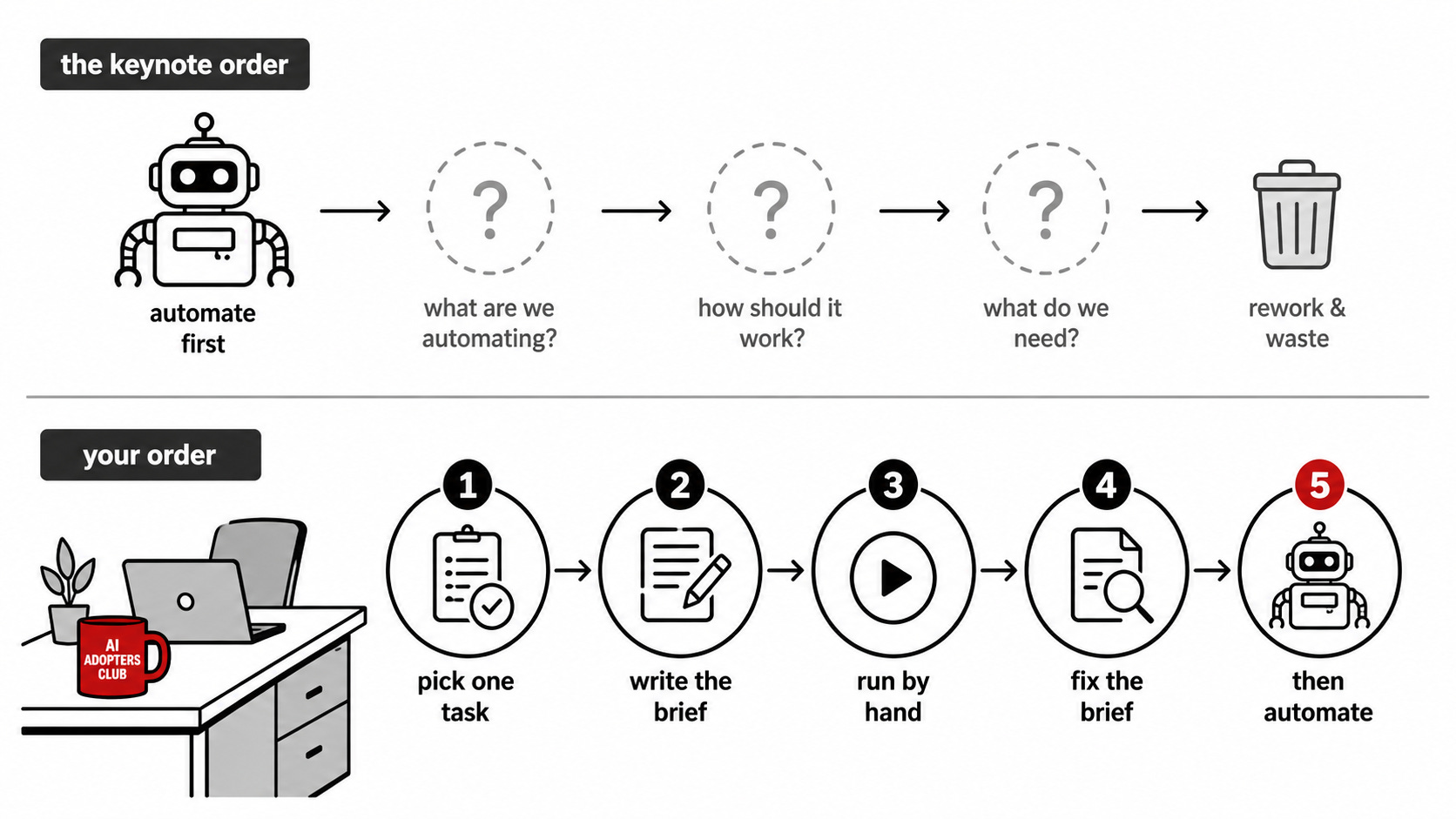
Pick one task you repeat every week. Weekly report, inbox triage, meeting prep, status update. One.
Write the brief as though onboarding a person on their first morning. Name the inputs. List the steps in order. Show the exact shape of the output you want. Write the single line that tells you the job is finished.
Run it as an ordinary prompt first, inside the Gemini app or whatever sits on your desk. No automation yet. Watch where it guesses wrong.
Fix the brief, not the tool. Tighten the step it fumbled. Run it again. Repeat until it produces something you would sign your name to without edits.
Only once it works by hand do you let anything run it on a schedule. Google showed the automation first and the definition never. You do it the other way round.
Get that order right and the next part stops being frightening.
Read the price tag before you reach for it
Google moved the money around too. A new Ultra plan at $100 a month, and the old $250 tier trimmed to $200. The full list of what dropped sits at the bottom of this email if you want the receipts. The pitch writes itself. Pay more, get an employee who never clocks off.
The question for you is not which tier. It is whether a background agent on a pricier plan beats a sharper prompt on the plan you already pay for. For most weekly tasks, it does not. Buy the capability after a defined job demands it, not because a keynote made it look effortless.
The permission problem nobody put on a slide
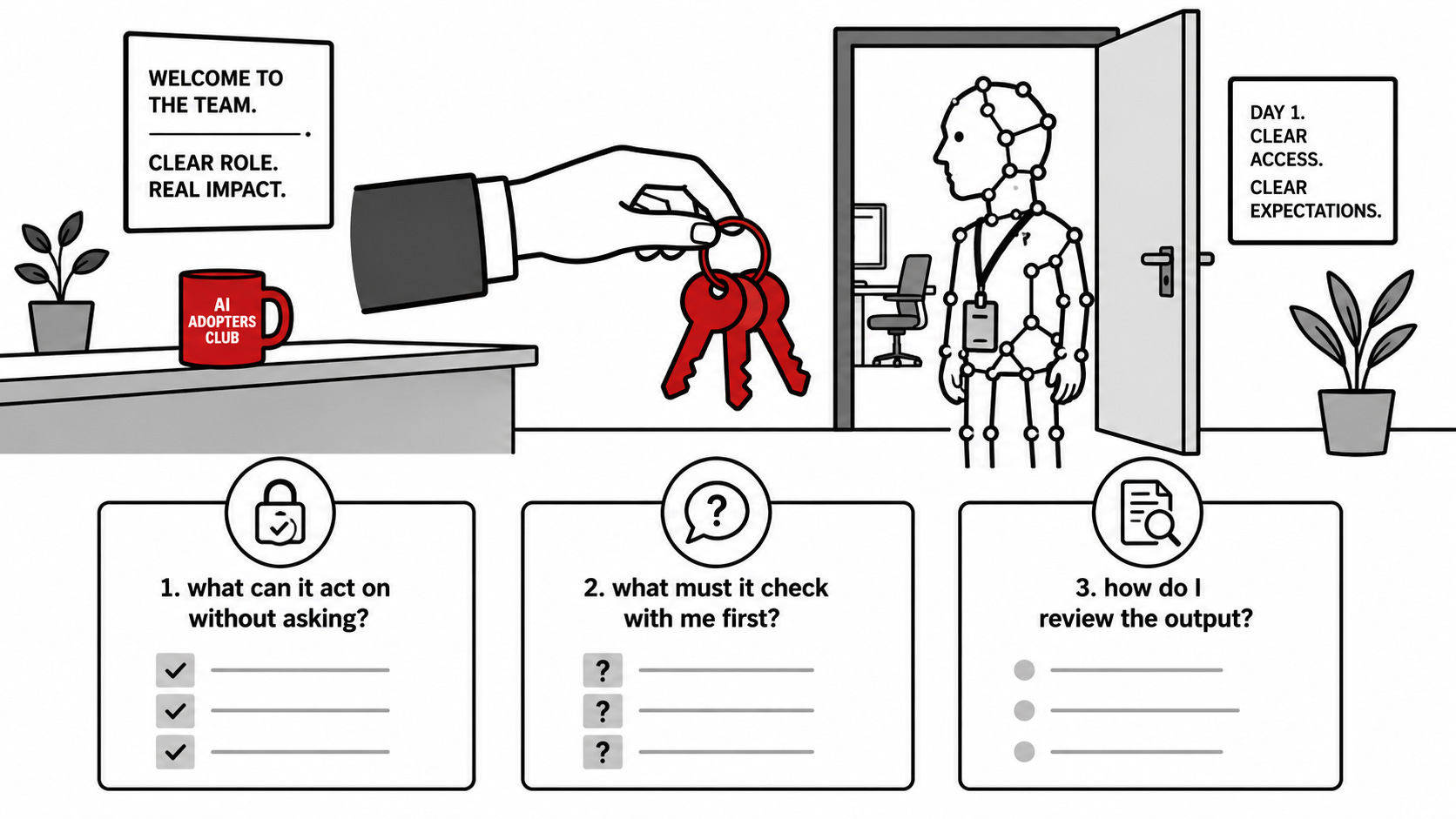
A background agent needs standing access to your mail, your documents, your calendar and third-party tools. That is a different animal from a chatbot you paste text into. The keynote spent its energy on what the agent can do, almost none on what it can touch.
Before you grant that access, settle three things. What it may act on without asking. What it must bring to you before doing. How you check its output before it leaves the building. Treat it like a junior with keys to the office, not a faster search bar.
None of this needs a $100 plan to begin. The thinking is free. The tool is the easy part.
If a colleague is about to pay for an agent before they have defined a single task for it, forward this. You will save them a month of confident nonsense and one awkward chat with their boss.
This is the work I am building a room for. Professionals and executives putting these tools into live workflows, not only reading about them. We pressure-test each other’s briefs, swap what runs and what flops, and build the systems together instead of guessing alone. Pull up a chair at skool.com/aiac.
The agents are coming whether your work is defined or not. Define it, and they finally earn their keep.
Adapt & Create, Kamil
The full I/O 2026 rundown if you want it
Everything worth knowing from the keynote, in one place. Skim it, click what matters to you.
Gemini 3.5 Flash, the new default. Faster output, frontier reasoning, and agent skills built in. A stronger Pro version lands in June. 9to5Google’s live news hub
Gemini Spark, the 24/7 agent, plus new pricing. A persistent agent on a dedicated cloud machine, wired into Gmail, Docs and Workspace. New Ultra plan at $100 a month, top tier cut from $250 to $200. WIRED’s full announcement list
Antigravity 2.0, the agent builder. A desktop app, CLI, SDK and multi-agent orchestration for developers shipping agents. Google’s developer highlights
Gemini Omni, multimodal creation. Reasoning fused with video generation and conversational editing, with better physics and motion. 9to5Google on Gemini Omni
Search, rebuilt. Its biggest change in 25 years. Persistent monitoring agents, generative interfaces, and a Universal Cart spanning Search, Gemini, YouTube and Gmail. Tom’s Guide live coverage
Audio glasses on Android XR. Voice-first eyewear with Samsung, Warby Parker and Gentle Monster, aimed at a fall 2026 launch. Google’s Android XR post
Productivity odds and ends. Docs Live voice dictation, Ask YouTube video search, a Daily Brief agent, and wider content provenance through SynthID and C2PA. CNET’s recap
The real move here is Google trying to move from owning the system of record to owning the system of action. Traditional SaaS stores the work: docs, emails, tickets, CRM notes. Agents start executing the work: follow-ups, summaries, routing, drafting, checking.
Once a company teaches Gemini its recurring workflows, permissions, context, handoff rules, and weird exception logic, switching vendors is no longer just “export the data.” It becomes “rebuild how the company operates.”