


Hey Adopter,
The Walt Disney Company is having an identity crisis.
Bob Iger calls AI "the most powerful technology that our company has ever seen" whilst simultaneously leading a high-profile copyright lawsuit against AI firm Midjourney. They're exploring partnerships with OpenAI whilst publicly stating their goal is "not to replace people."
This isn't just corporate doublespeak. It's a century-old entertainment giant grappling with the innovator's dilemma in real time.
The physical AI advantage nobody talks about
Most companies are fighting the same battle: building better recommendation engines, smarter chatbots, faster content creation tools. Disney is playing a different game entirely.
Their secret weapon isn't digital. It's physical.
The MagicBand ecosystem generates data that Netflix can only dream of. When you tap your MagicBand to buy a Dole Whip, take a photo with Mickey Mouse, or board Space Mountain, Disney's AI learns not just what you watch, but how you move through the world.
This "Physical AI" moat is their most defensible competitive advantage. Digital-first competitors can copy recommendation algorithms, but they can't replicate autonomous animatronics performing aerial stunts or free-roaming droids that recognise your face in Galaxy's Edge.
The numbers prove it works. Disney's AI-driven crowd management systems reportedly increased park capacity by 30% whilst reducing wait times.

Where the magic breaks down
But Disney's AI story has a dark side.
Their biggest failure wasn't technical, it was cultural. The Secret Invasion opening credits debacle showed what happens when you deploy generative AI without considering the human cost. The AI-generated visuals were widely panned, but the real damage was reputational. Disney looked like a corporate giant replacing artists with algorithms.
The streaming numbers tell another story. Disney+ has 124.6 million subscribers, but their 6-month retention rate sits at 62% for standalone subscribers. Netflix? 72%. That 10-point gap represents millions in lost revenue and suggests Disney's personalisation AI isn't as sophisticated as it needs to be.
Their organisational structure makes this worse. Marvel, Pixar, Lucasfilm, and Parks operate as separate kingdoms. Data silos prevent the cross-platform personalisation that could make Disney+ sticky. You might love Star Wars at the theme park, but Disney+ doesn't know that when you're browsing at home.

The billion-dollar question
Here's where Disney's story gets interesting. They're not just fighting competitors, they're fighting themselves.
The company that created Mickey Mouse is now facing a choice that will define entertainment for the next decade. Do they embrace generative AI as a creative tool, or do they position themselves as the human-first alternative?
This tension came to a head when shareholders filed proposals demanding transparency on Disney's AI use. The SEC denied Disney's request to omit these from proxy statements, forcing a public vote.
But the real test isn't happening in boardrooms. It's happening in the Office of Technology Enablement, Disney's new AI coordination unit led by CTO Jamie Voris. This group has one job: break down the silos and create a unified AI strategy.
The pressure is mounting. Disney's streaming segment achieved profitability with $321 million in operating profit, but competitors are moving faster. Netflix's recommendation engine drives over 80% of content watched. Disney needs to catch up, fast.

Want to see how Disney can fix this mess? Our full case study reveals the three strategic moves that could turn Disney's AI confusion into competitive advantage:
The integrated data flywheel that could make Disney+ unbeatable •
The "Disney Standard" for ethical AI that turns legal battles into revenue streams
The physical AI roadmap that creates experiences no competitor can replicate
Specific KPIs Disney should track to measure AI success across all segments
The talent retention strategy that keeps creators happy whilst cutting costs
Download the complete Disney AI case study here 👇

The three moves that could save Disney's AI strategy
Disney's path forward isn't about choosing between human creativity and AI efficiency. It's about creating a new category where both thrive.
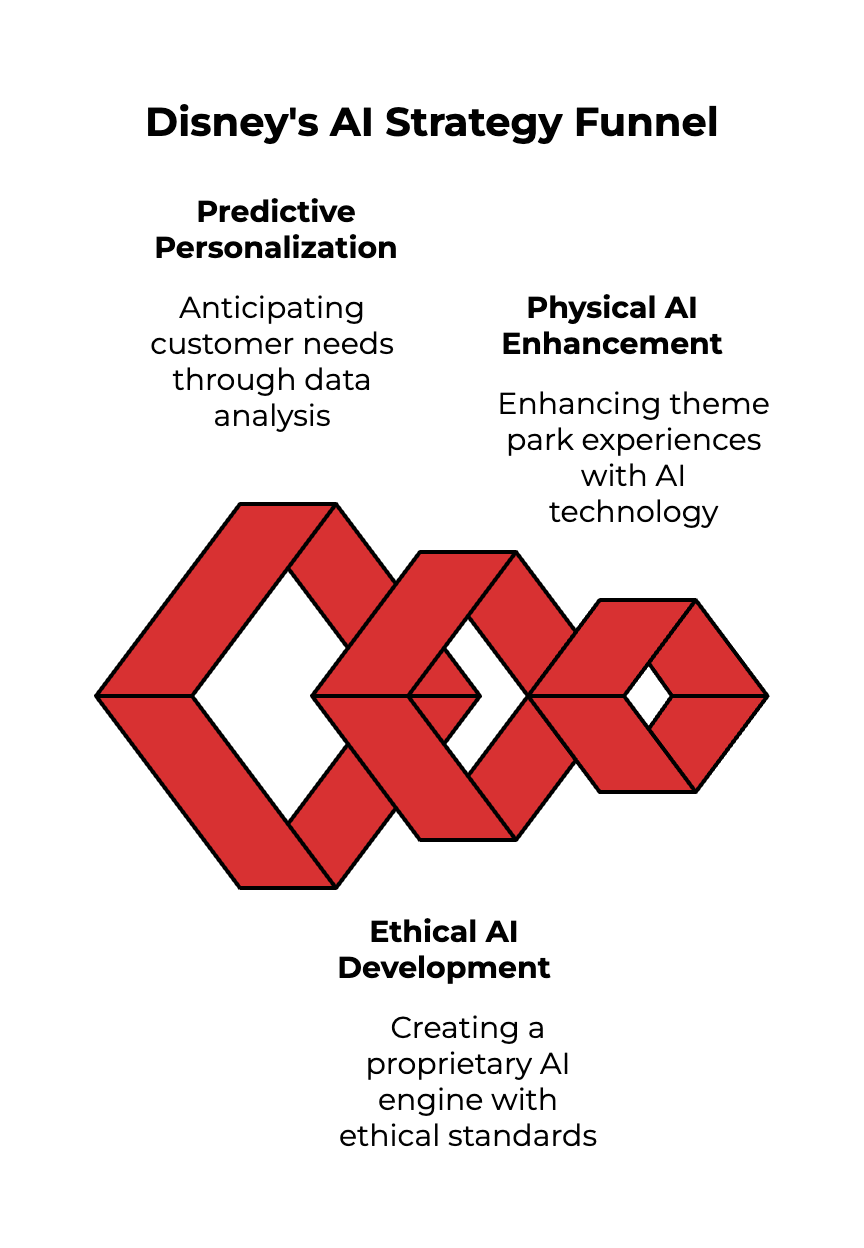
Move 1: Unify the magic across segments
Disney's most valuable asset isn't its IP library. It's the customer data that spans physical and digital touchpoints. But this data is trapped in silos.
The solution is a unified Customer Data Platform that connects park visits, streaming behaviour, and merchandise purchases. Imagine: you ride Guardians of the Galaxy three times at EPCOT, then Disney+ immediately surfaces the entire Marvel catalogue when you get home. You binge-watch Star Wars series, then receive a targeted lightsaber offer in the Disney Store app.
This isn't just personalisation. It's predictive magic. Disney can anticipate what you want before you know it yourself.
The Office of Technology Enablement must be given executive authority to break down divisional resistance. The technical infrastructure exists. The organisational will doesn't.
Move 2: Lead the ethical frontier
Disney's defensive legal strategy is necessary but insufficient. Suing Midjourney protects existing IP but doesn't create new revenue streams.
The breakthrough move is building a proprietary "Disney Generative Engine" trained exclusively on licensed content. This isn't just about avoiding copyright issues. It's about creating a new business model.
Target market: advertising agencies, entertainment companies, and independent creators willing to pay premium prices for "safe" AI. Position this as the ethical alternative to Wild West AI models.
Partner with creative guilds to develop frameworks for consent, credit, and compensation. Turn Disney from an adversary in AI labour disputes into a collaborative partner shaping the future of creative work.
Move 3: Double down on physical AI
Netflix can build better recommendation engines. Amazon can create smarter voice assistants. But nobody can replicate Disney's physical AI ecosystem.
The "theme park metaverse" is Disney's most defensible competitive advantage. Accelerate investment in Imagineering's robotics division. Make autonomous characters ubiquitous across all parks. Create dynamic, personalised interactions that feel magical, not mechanical.
Expand the MagicBand ecosystem to capture even more behavioural data. Use AR and mixed reality to create persistent experiences that begin before you arrive and continue after you leave.
This isn't about replacing human performers. It's about creating experiences that blend the best of human creativity with AI capability.
What to do next
If you're leading AI adoption at a traditional company, Disney's struggles offer three crucial lessons:
Don't let perfect be the enemy of good. Disney's ethical concerns about generative AI are valid, but paralysis helps nobody. Set clear guidelines and start experimenting in controlled environments.
Data integration beats data accumulation. Disney has more customer data than most companies could dream of, but it's fragmented. Focus on connecting your data streams before investing in fancier AI models.
Culture trumps technology. Disney's biggest AI failures weren't technical. They were cultural. Bring your creative teams into the AI conversation from day one. Make them partners, not casualties.
The companies that win the AI race won't be the ones with the most sophisticated algorithms. They'll be the ones that best integrate AI into their existing strengths whilst maintaining the human elements that make them special.
Disney's story isn't over. But the next chapter will determine whether they remain the happiest place on earth or become another cautionary tale about digital transformation gone wrong.
Adapt & Create, Kamil
Sources
Disney CEO Bob Iger Highlights "Invaluable" AI Entertainment Technology
Disney bets big on AI: CEO Bob Iger hails new tech as 'most powerful' ever seen
Disney CEO on AI: "Don't Fixate on Its Ability to Be Disruptive"
How the Disney-Midjourney Suit Could Reshape AI Copyright Law
Disney And NBCUniversal File First Major Studio Lawsuit Against AI Firm
Disney and Apple Set to Address AI Transparency Following AFL-CIO Push
Disney Finds Its Groove With Streaming And Theme Park Revival