


Hi Adopter,
I keep getting the same question. Someone watches the AI job listings pile up, month after month, and asks me which one is actually worth chasing. And honestly, most of them aren’t. Prompt engineer is already fading. “AI specialist” means basically nothing to a hiring manager, it’s a shrug with a salary attached.
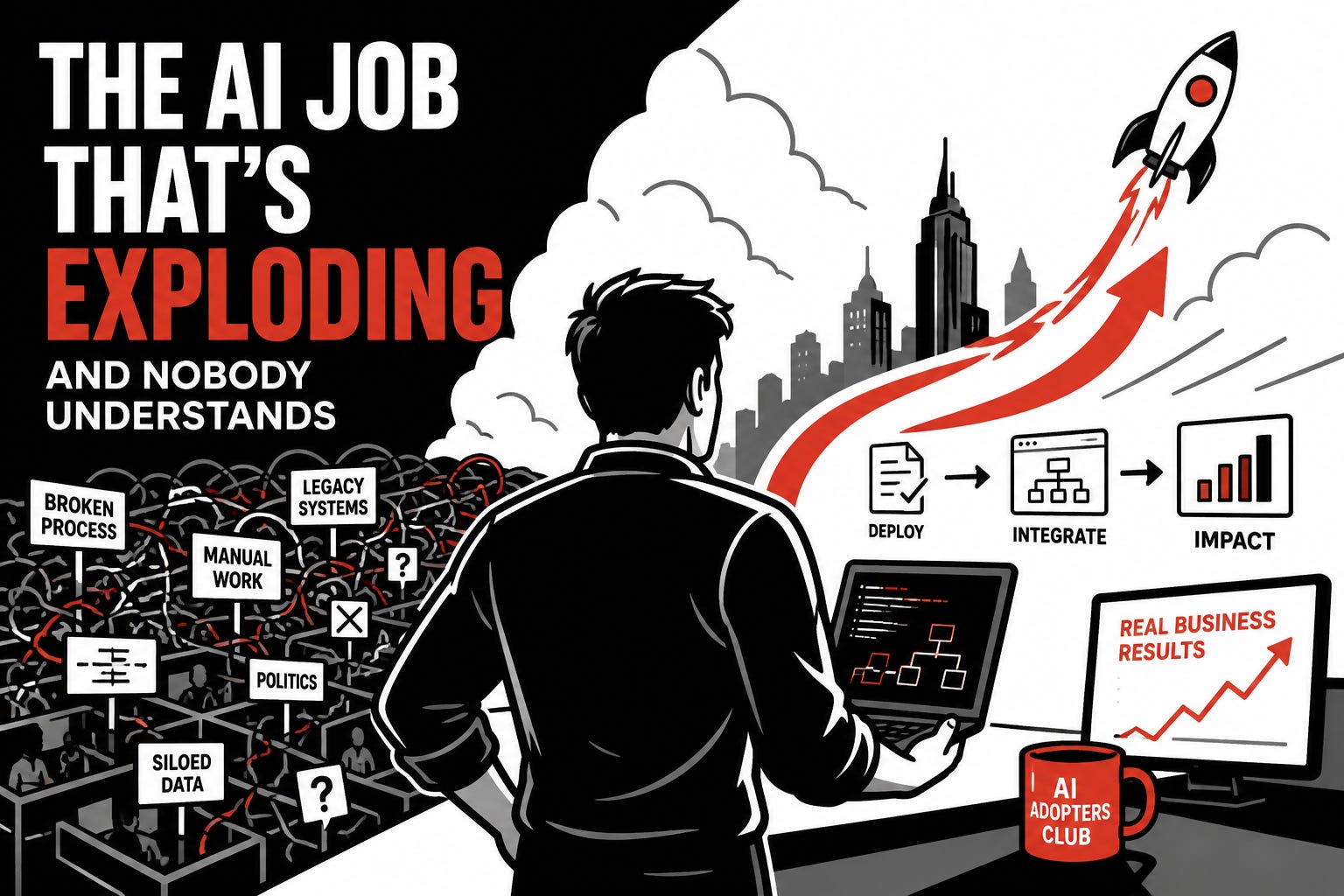
But there’s one role hiring like crazy that hardly anyone can explain to me properly, sometimes not even the people applying for it. Forward deployed engineer. I do a version of this for a living, walking into companies and working out where AI actually earns its keep versus where it just looks clever in a demo, so this one keeps landing in my inbox.
The job is deployment, not intelligence
What changed is that the model stopped being the hard part. Every company can buy the same one now, OpenAI, Anthropic, whoever, so the intelligence itself is more or less a commodity. What almost nobody has is the person who can take that model and get it running inside one company’s actual mess. The process nobody ever wrote down. The data sitting in one guy’s head. The security team that trusts none of it. And then, on top of all that, show it moved a number the CFO actually cares about.
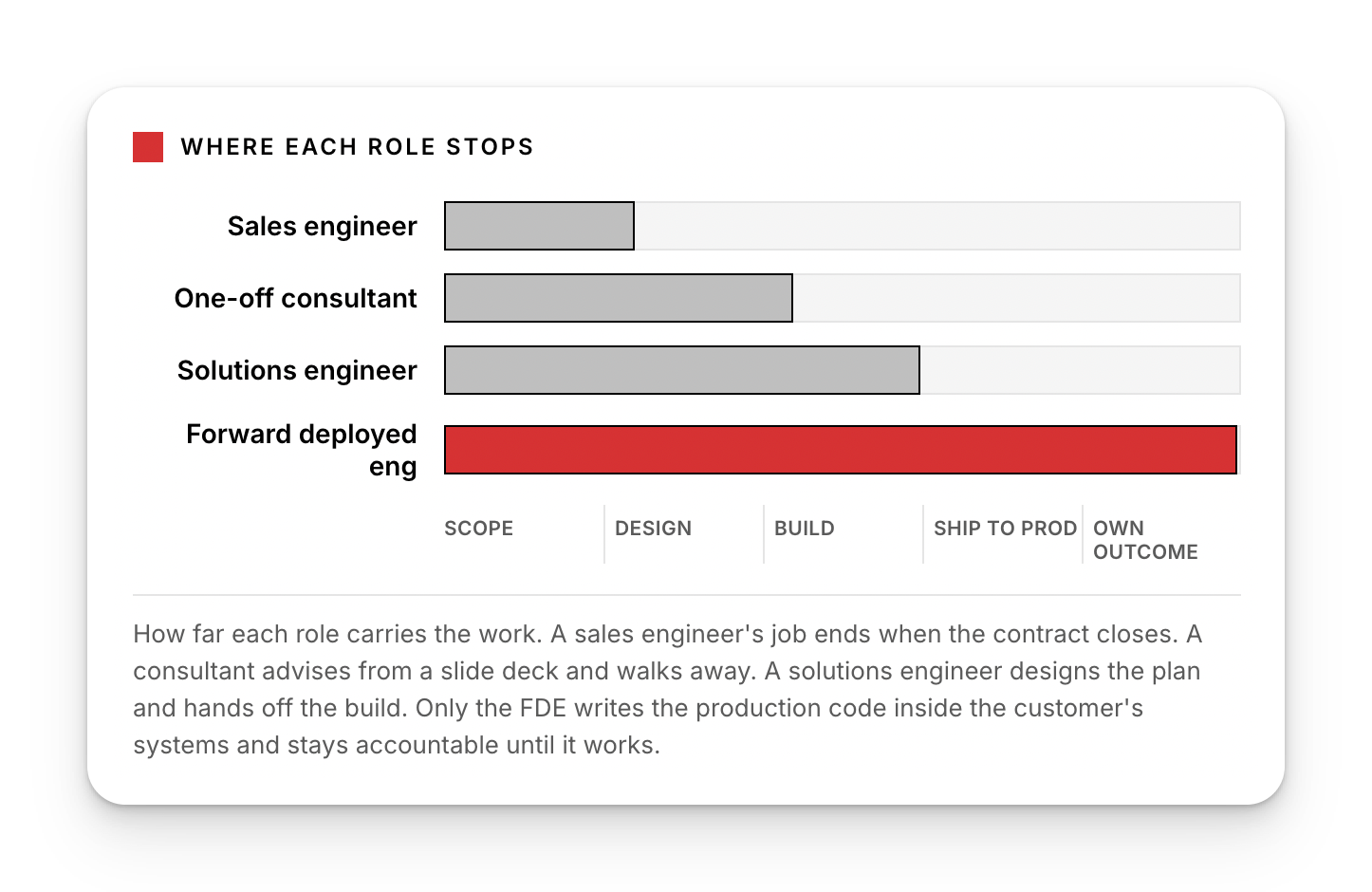
So that’s the role, roughly. Part engineer, part consultant, and the person on the hook for whether the thing works in the end. That last part is where most people quietly fall out.
Why it’s exploding right now
The money tells this better than I can. OpenAI spun up a whole subsidiary for it, the Deployment Company, put more than four billion behind it, and the first thing they did was buy an applied-AI consulting shop just to get roughly 150 of these engineers on staff overnight. Anthropic ran its own version, Ode, worth north of a billion and a half, with Blackstone and Goldman Sachs in on it, built to embed engineers inside mid-market and private-equity companies and rebuild how they actually work.
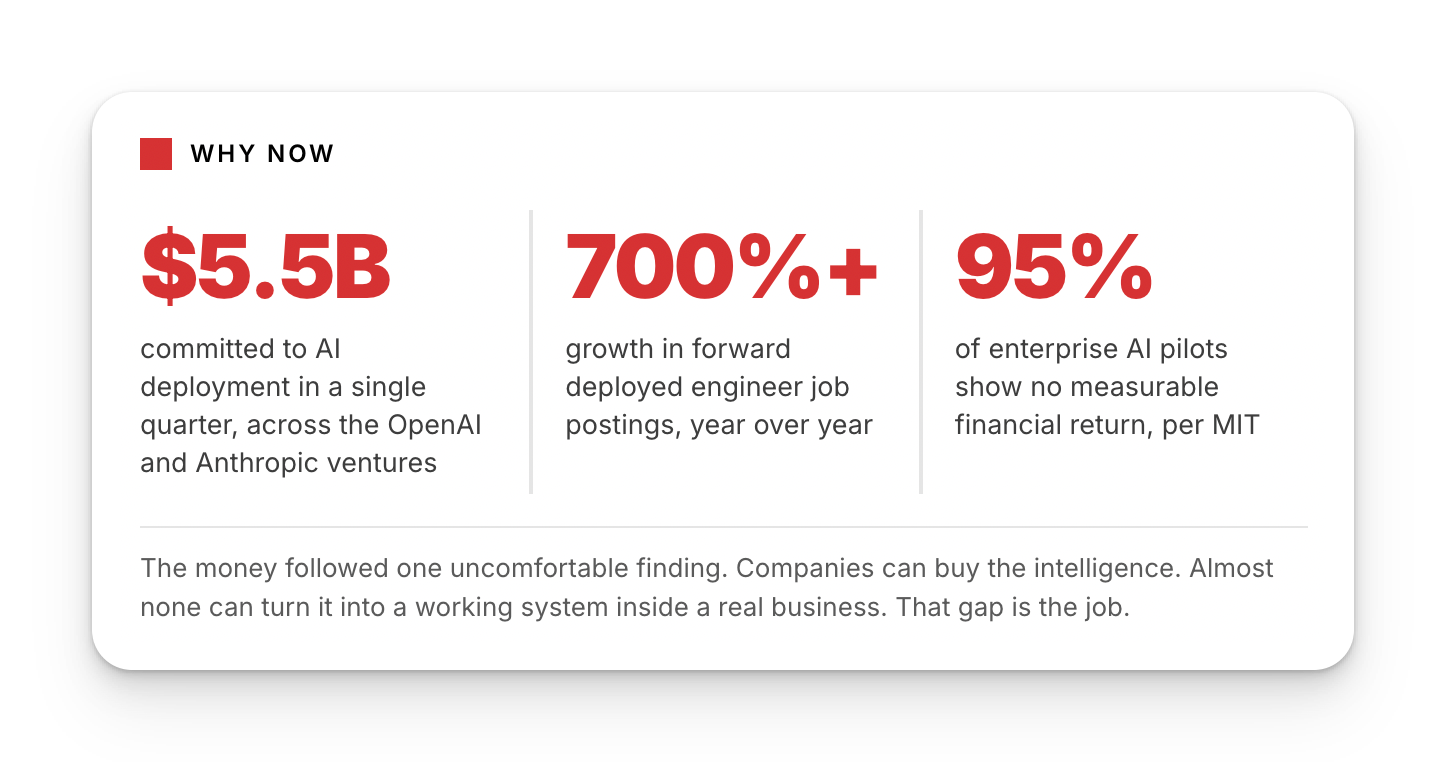
And the reason all that money moved is kind of grim, if you think about it. MIT went and looked at enterprise AI projects and found something like 95% of them produce no measurable return. Not because the models are weak. Because getting a model to actually work inside a real, messy company is genuinely hard, and most places have nobody who can do it. That's the whole opening, right there.
What it pays, honestly
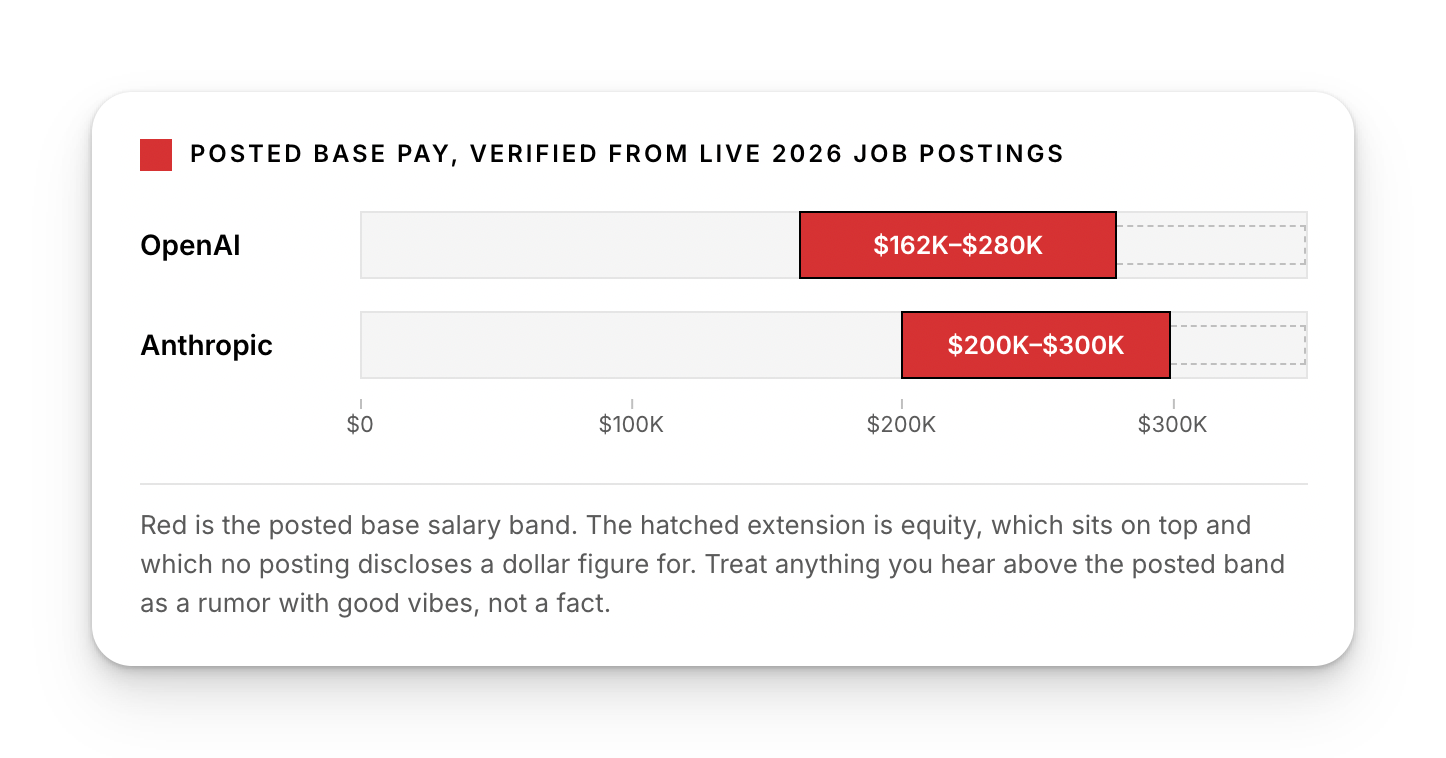
On money, I’ll only tell you what’s actually posted, because everything past that is rumour. OpenAI’s listings put base pay somewhere between $162,000 and $280,000, plus equity. Anthropic sits around $200,000 to $300,000. You’ll hear people throw around “a million dollars,” and sure, that exists, but it’s the top of the ladder for senior folks whose equity has already paid off, not the thing you walk into. I’d plan around the base and treat the rest as upside.
Where you fit
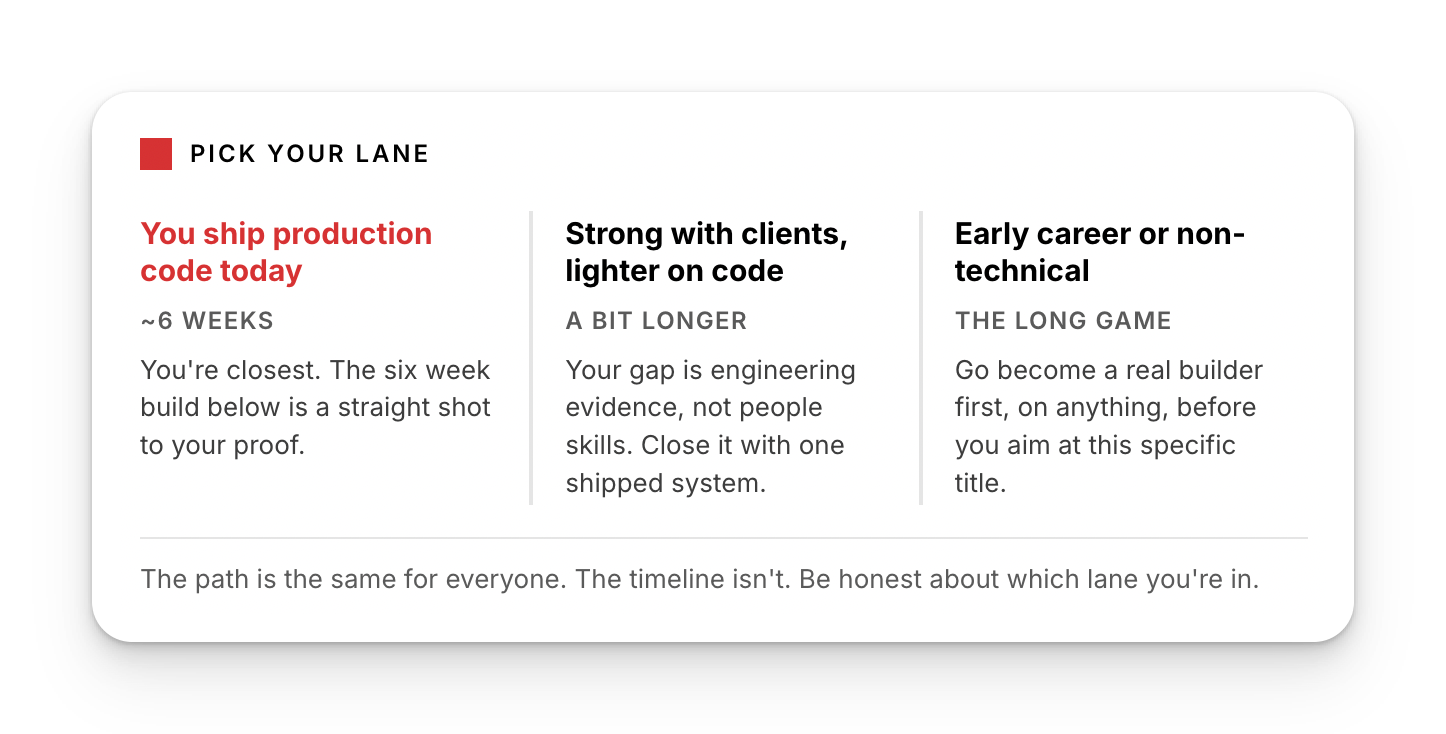
Where you land in all this mostly comes down to where you’re starting from. And the uncomfortable bit nobody running a bootcamp will tell you is that you don’t study your way into this one. You build your way in. So do the work first, then go looking for the title, not the other way around.
The one move that beats a course
Forget applying for a second. The thing that actually gets you in the door is one real system you built, start to finish, that you can walk somebody through. Roughly like this.
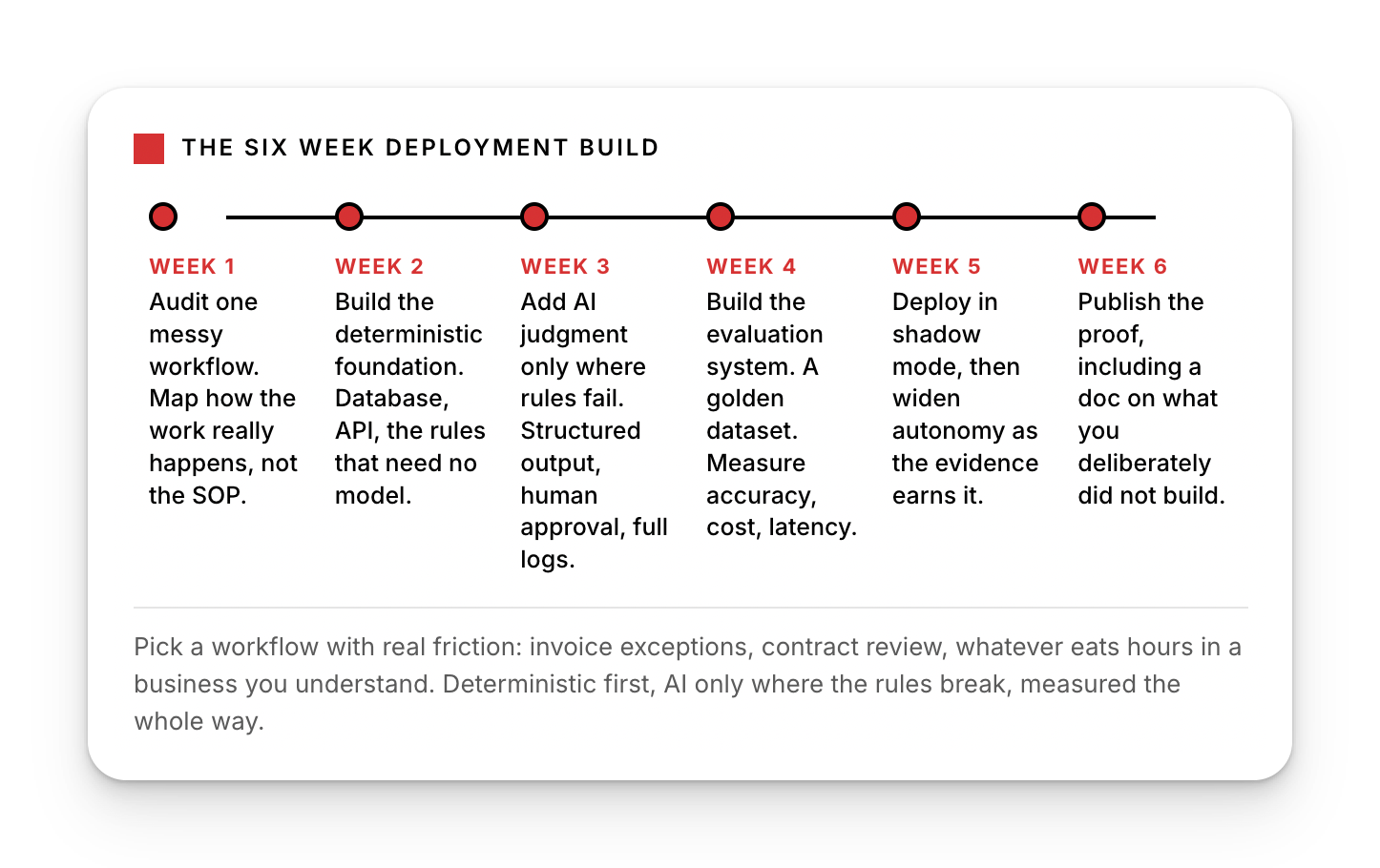
There’s a simple gut-check for whether you’ve earned the title. Can you show evidence for each of those steps, or can you only describe them? If it’s describe, you’re an AI implementation lead for now, and there’s no shame in that. The most convincing piece isn’t even the code, weirdly. It’s the short doc where you explain what you deliberately chose not to build. That’s the thing that makes a hiring manager exhale.
The honest part
I’m not going to pretend this is a soft gig. The real listings want 25 to 50% travel. A lot of the time you’re the only technical person in a room full of people who don’t trust you yet, untangling politics nobody warned you about. And you have to actually ship into production, not demo something slick and disappear.
If your idea of a good day is headphones on, no meetings, just you and the code, this one will grind you down fast. But if you like walking into a mess and owning how it turns out, it’s honestly one of the best-paid, fastest-growing corners of this whole thing right now. Both of those can be true about the same job.
Your move
You don’t have to quit anything or sign up for anything. Just pick one real problem and finish it. Right now the market’s moving fast enough that a working thing beats a polished resume, and that window won’t stay open forever.
Since where you’re starting from changes the whole plan, I put together a prompt that builds a version of this for your own background. Paste it into whatever AI you use, answer a few honest questions, and you’ll get your own six-week build instead of mine.
Your personal roadmap
Copy the prompt, paste it into your AI of choice, and answer the questions. You’ll get an honest, specific plan built on everything above, tuned to your background.
You are a Forward Deployed Engineer (FDE) career strategist. Turn my background into an honest, specific, and actionable roadmap to become an FDE, or the closest role I can realistically win, based on how the role actually works in 2026.

The premise you operate from:
- Intelligence is now a commodity. Any company can buy a frontier model. The scarce, expensive skill is DEPLOYING that intelligence into one company’s messy real workflows and proving measurable business impact.
- An FDE is a consultant who can actually engineer and build, embedded with a customer, owning the outcome end to end.
- The winning move is “do the job before you have the title.” The proof is one real, production-style system you built and measured, not a certificate or a course.
- Be honest, not flattering. If I am far from ready, tell me plainly. Never promise a salary or a specific company.

STEP 1 - Ask me these questions in one numbered message. If I have already answered some, use those and only ask for what is missing. Then wait for my answers.
  1. Your current role and years of technical experience.
  2. Your coding depth: (a) non-technical, (b) AI-assisted builder / vibe-coder, (c) I ship small production systems, (d) senior full-stack or infrastructure engineer.
  3. Customer-facing experience: discovery with stakeholders, presenting to execs, or leading a delivery? One or two lines.
  4. Your domain or industry expertise. This is where we anchor your project, so be specific.
  5. Hours per week you can commit, and your target start date.
  6. Travel and on-site tolerance, your location, remote-only?
  7. Your goal: independent paid engagements, a full-time role, or both? Any dream companies?
  8. Honest self-test, yes/no with one line each: (a) shipped something real users depend on? (b) turned a vague business problem into a scoped MVP with real stakeholders? (c) measured a system’s cost, latency, or business impact? (d) handled a production failure?

STEP 2 - Classify my starting point and state it plainly, with a realistic timeline:
  - Builder-ready (ship production code): fastest, a six-week deployment sprint produces your proof.
  - Customer-facing-ready (strong discovery/exec/delivery, lighter coding): ~6-10 weeks, gap is production engineering evidence.
  - Early-career / some coding: longer; often win a software or solutions role first, then transition.
  - Non-technical switcher: the long game; become a real builder first.
  Name my single biggest gap in one blunt sentence.

STEP 3 - Produce my roadmap in exactly this structure:
  1. WHERE YOU STAND - archetype, realistic timeline, biggest gap named plainly.
  2. YOUR POSITIONING - 3-5 best-fit target titles (Forward Deployed Engineer, Forward Deployed Software Engineer, Technical Deployment Lead, Forward Deployed AI Lead, AI Solutions Engineer, Customer Engineer, Deployment Strategist, Applied AI Consultant), plus one positioning line I can use, modeled on: “Forward Deployed AI Lead: I diagnose the operational bottleneck, build the first production AI workflow, and lead deployment until the system is adopted and measurable.” Say which companies to target first and which to earn toward.
  3. YOUR ONE PROJECT - a deployment sprint anchored in MY domain. Pick one messy workflow from my world, week by week (stretch the timeline honestly if I’m below builder-ready):
     Week 1: Audit. Map current state, catalogue undocumented exceptions, baseline (time, error rate), success criteria, security/access needs, explicit non-goals.
     Week 2: Deterministic foundation. Real stack (Python, FastAPI, PostgreSQL, Docker, a cloud, CI/CD). Ingestion, schema, rules-based logic, API, auth, tests. No toy CRUD.
     Week 3: Add AI judgment only where rules fail. Structured JSON, confidence score, source references, human approval for every consequential action, full trace logging, no irreversible actions.
     Week 4: Evaluation system. Golden dataset of 75-100 real cases including ugly ones. Report accuracy, false-approval/escalation rates, cost per run, median + worst-case latency, before and after each change.
     Week 5: Deploy safely. Local, private test, shadow mode, limited pilot, production with human approval. RBAC, secrets, monitoring, retries, rollback, incident runbook.
     Week 6: Turn it into proof. Demo, architecture diagram, workflow map, evaluation report, threat model, decision log, before/after metrics, one-page exec case study, README on what you deliberately did NOT build. Synthetic data for anything public.
  4. YOUR PROOF - the public artifact checklist; flag the “what I did not build” doc as the most persuasive item.
  5. YOUR READINESS TEST - 10 checkpoints, marked against my answers (have vs still need):
     mapped a workflow by observing users; found exceptions the SOP never documented; decided where AI belonged vs plain rules; built or directly contributed to the system; integrated databases, APIs, identity, existing tools; created an evaluation dataset; measured failures, latency, cost, impact; deployed in shadow mode before increasing autonomy; handled a production failure; turned a customer-specific lesson into a reusable component. Until most are true, “AI implementation lead” or “technical deployment lead” is more defensible.
  6. THIS WEEK - the single most important action in the next seven days.

CONSTRAINTS: honest over flattering; ground everything in my actual answers, domain, hours, travel tolerance; real tools and metrics only; if I lack a production track record or dislike customer interaction/travel/ambiguity, say so and suggest a better fit; do not invent compensation figures (verified 2026 base bands at frontier labs run ~160K-300K USD for 4-5+ years experience, total comp reportedly higher with equity, entry and mid-market pay less).

Start now by asking me the Step 1 questions.
Run it yourself in ten minutes. Or just reply and I’ll help you map your first build on a workflow you actually own.
Adapt and Create,
Kamil
Sources
Anthropic, “Ode with Anthropic” enterprise AI services announcement, 2026.
Exponent, “What Is a Forward Deployed Engineer? Complete 2026 Guide,” 2026.
MIT NANDA, “The GenAI Divide: State of AI in Business 2025,” 2025.
OpenAI, “Forward Deployed Engineer (FDE) - SF” job posting, accessed July 2026.
Anthropic, “Forward Deployed Engineer, Applied AI” job posting, accessed July 2026.