



Hey Adopter,
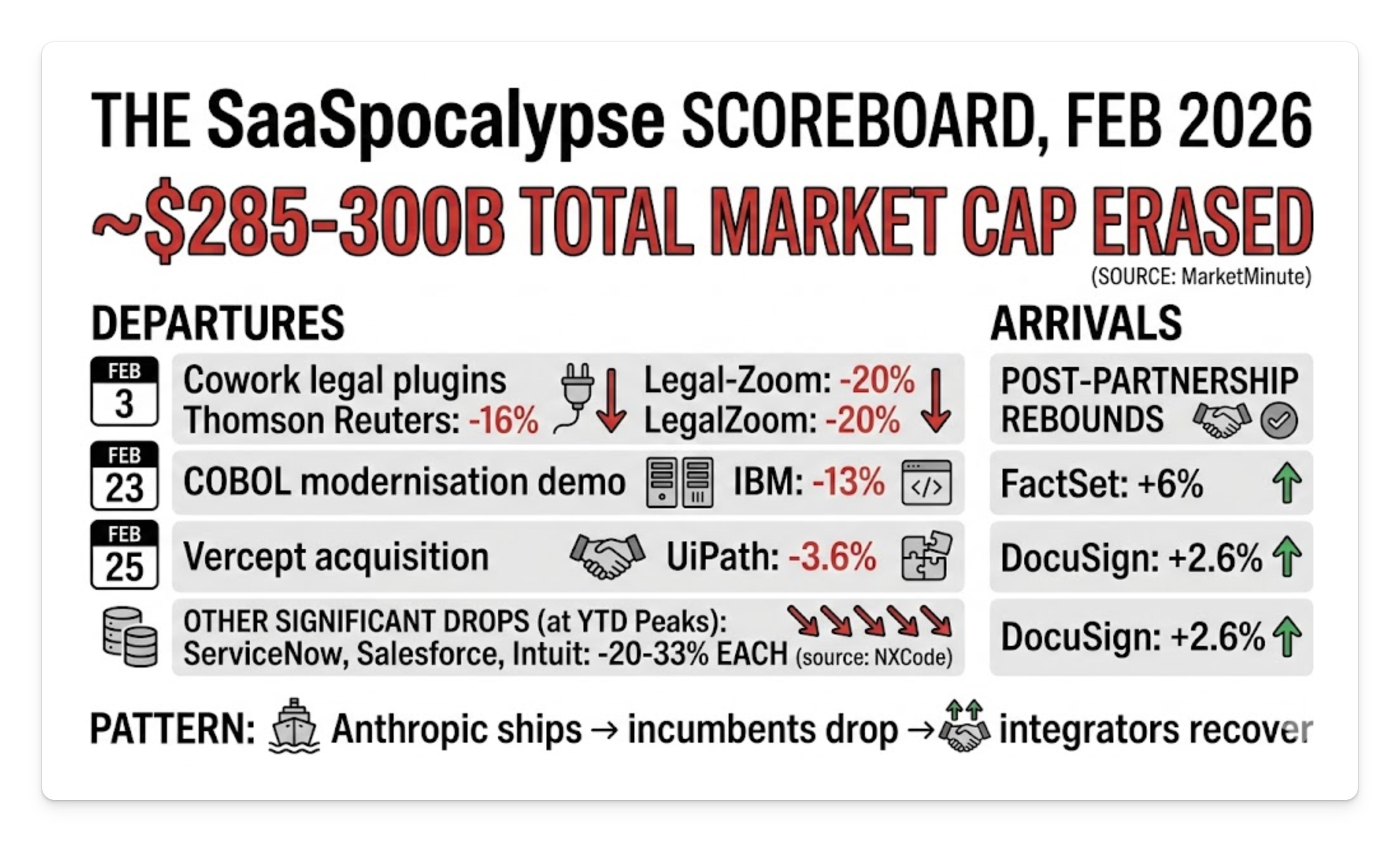
$285 billion. That’s how much SaaS market cap vanished in a single session when Anthropic launched its legal plugins earlier this month. Thomson Reuters dropped 16%. LegalZoom fell 20%. And that was just one category of software getting repriced. Between February 24 and 26, Anthropic shipped three more releases that, stacked together, turn Claude from a clever chat window into something that looks uncomfortably like a junior hire, one that works on a schedule, sees your actual screen, and takes direction from your pocket.
This piece breaks down what landed, why UiPath lost 3.6% on a single acquisition announcement, and what all of it signals about the jobs, companies, and software categories sitting in the blast radius over the next 18 months.
Three releases, one new reality
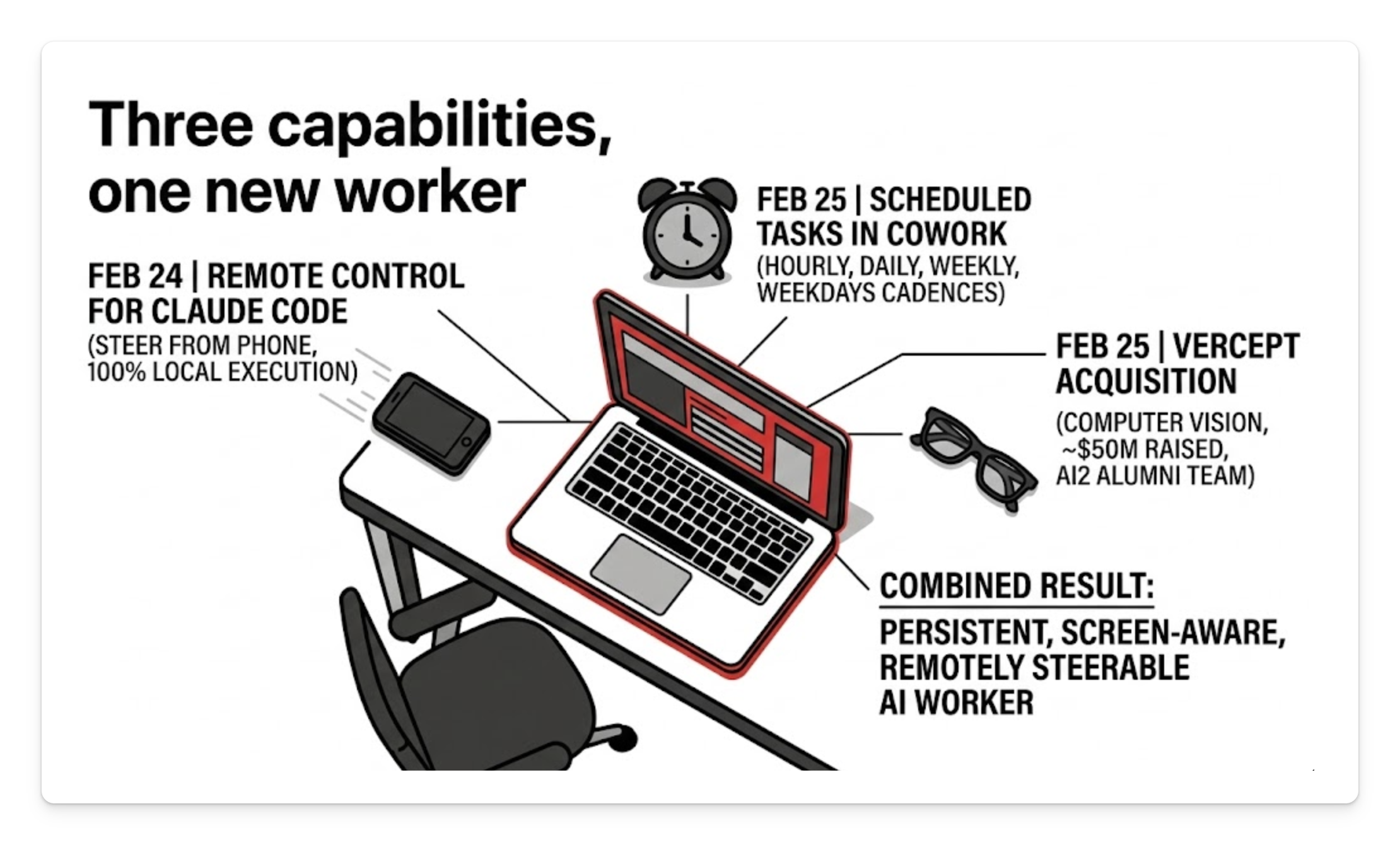
Monday, February 24. Remote control for Claude Code drops. You start a coding session at your desk, walk away, pull out your phone, and keep steering it. Everything runs locally. Nothing hits the cloud. Simon Willison tested it the same day and noted it directly kills the pitch of products like OpenClaw, which built their entire business around phone-to-desktop control.
Tuesday, February 25. Two more.
Scheduled tasks in Cowork go live for all paid plans. Describe a task once, pick hourly, daily, weekly, or weekdays. Claude runs it on repeat. Morning Slack briefings. Weekly spreadsheets. File clean-up. Stripe reports. Your computer needs to be awake and the desktop app running, but if it sleeps, the task fires on wake.
Same day, the Vercept acquisition. Anthropic absorbs a team of AI2 alumni co-founded by Kiana Ehsani, Luca Weihs, and computer-vision veteran Ross Girshick. TechCrunch confirmed $50 million raised, with angels including Eric Schmidt and Jeff Dean. Their product Vy, a cloud-based agent that operated a remote MacBook by looking at the screen, shuts down March 25.
Each alone is a product update. Together they create a new species of software.
Why seeing the screen changes everything
Desktop agents have been able to click buttons for a while. The bottleneck was never intelligence. It was eyesight. Most AI agents navigating software read the DOM, the raw code behind the interface. That works until you hit a spreadsheet with merged cells, a dropdown that renders differently across browsers, or a multi-tab web form. Real office software is messy. DOM parsing fails on mess.
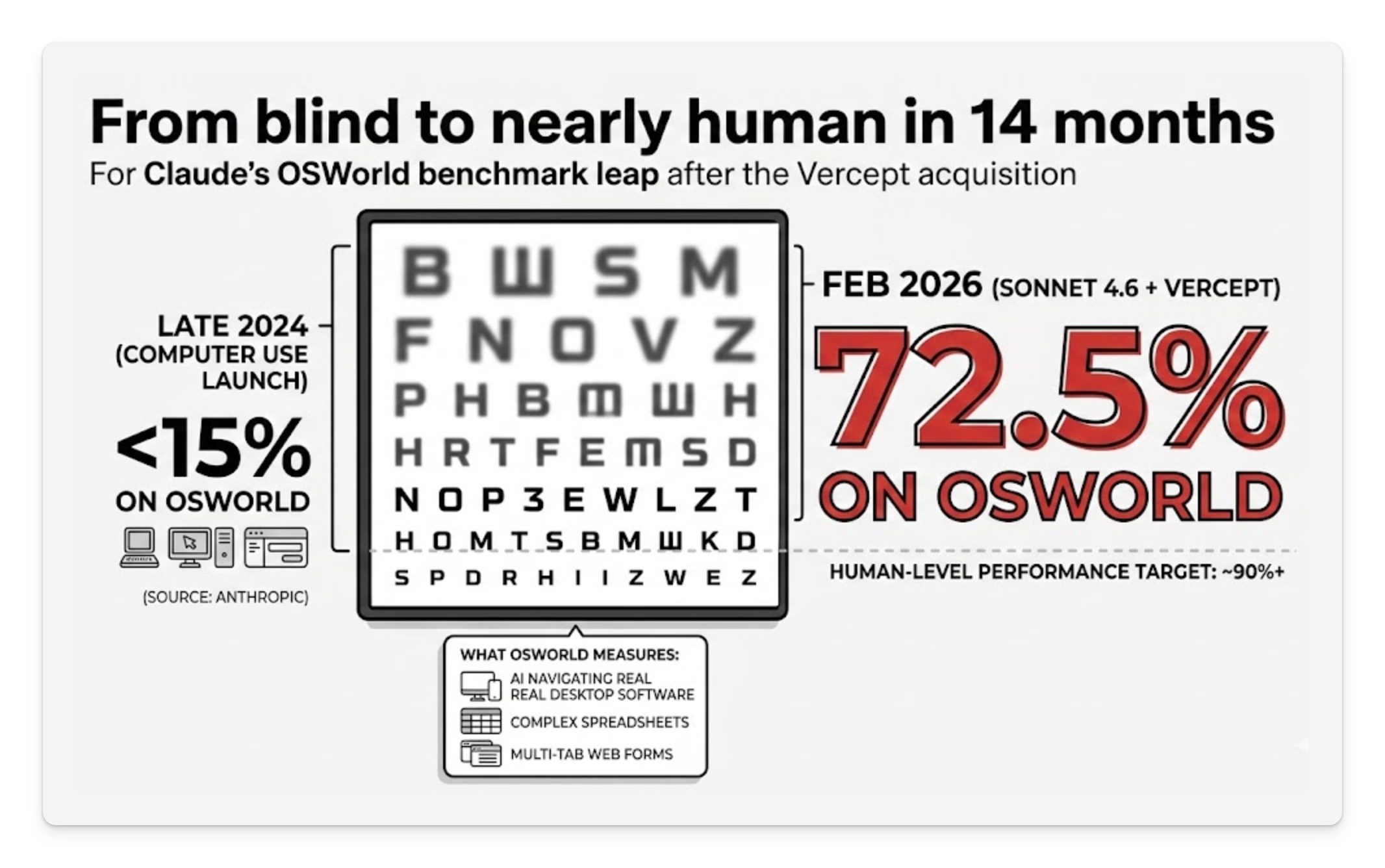
Vercept solved perception by looking at screens as pixels and layout, the way you do. The benchmark numbers tell the rest. When Anthropic first shipped computer use in late 2024, Claude scored under 15% on OSWorld, the standard evaluation for AI navigating real desktop software. Sonnet 4.6 now hits 72.5%. Anthropic describes this as “approaching human-level performance on tasks like navigating complex spreadsheets and completing web forms across browser tabs.”
Under 15% to 72.5% in fourteen months is not improvement. It’s a species change. And it forces a question that goes well beyond benchmarks.
If software can see and schedule, what happens to the companies that sell seeing and scheduling
The market answered before anyone wrote an analyst note. UiPath’s entire model is robotic process automation, software that navigates enterprise interfaces with pre-built scripts and brittle integrations. Claude now does the equivalent by looking at the screen and following natural language. No scripts. No connectors. Just a prompt and a schedule.
GeekWire reported that Vercept co-founder Oren Etzioni, an AI2 veteran and early backer, called the shutdown “sad” for a company with “so much traction,” even as he confirmed positive investor returns. His reaction captures the strange position of an entire industry right now. The technology works. The economics are brutal for incumbents.
This was not the first tremor. IBM lost 13% on a COBOL modernisation demo. ServiceNow, Salesforce, and Intuit are each down 20-33% at peaks YTD. The pattern repeats with mechanical precision: Anthropic ships, incumbent stocks bleed, then integrators selectively recover. FactSet bounced 6% after announcing plugin partnerships. DocuSign clawed back 2.6%. Software stocks rallied briefly as investors recalibrated from “Claude kills categories” to “Claude amplifies platforms.”
The dividing line is becoming clear. Companies that become substrates for agents survive. Companies that sell the manual work agents replace do not.
The economy after agents clock in
Here is where it gets uncomfortable for anyone managing a team.
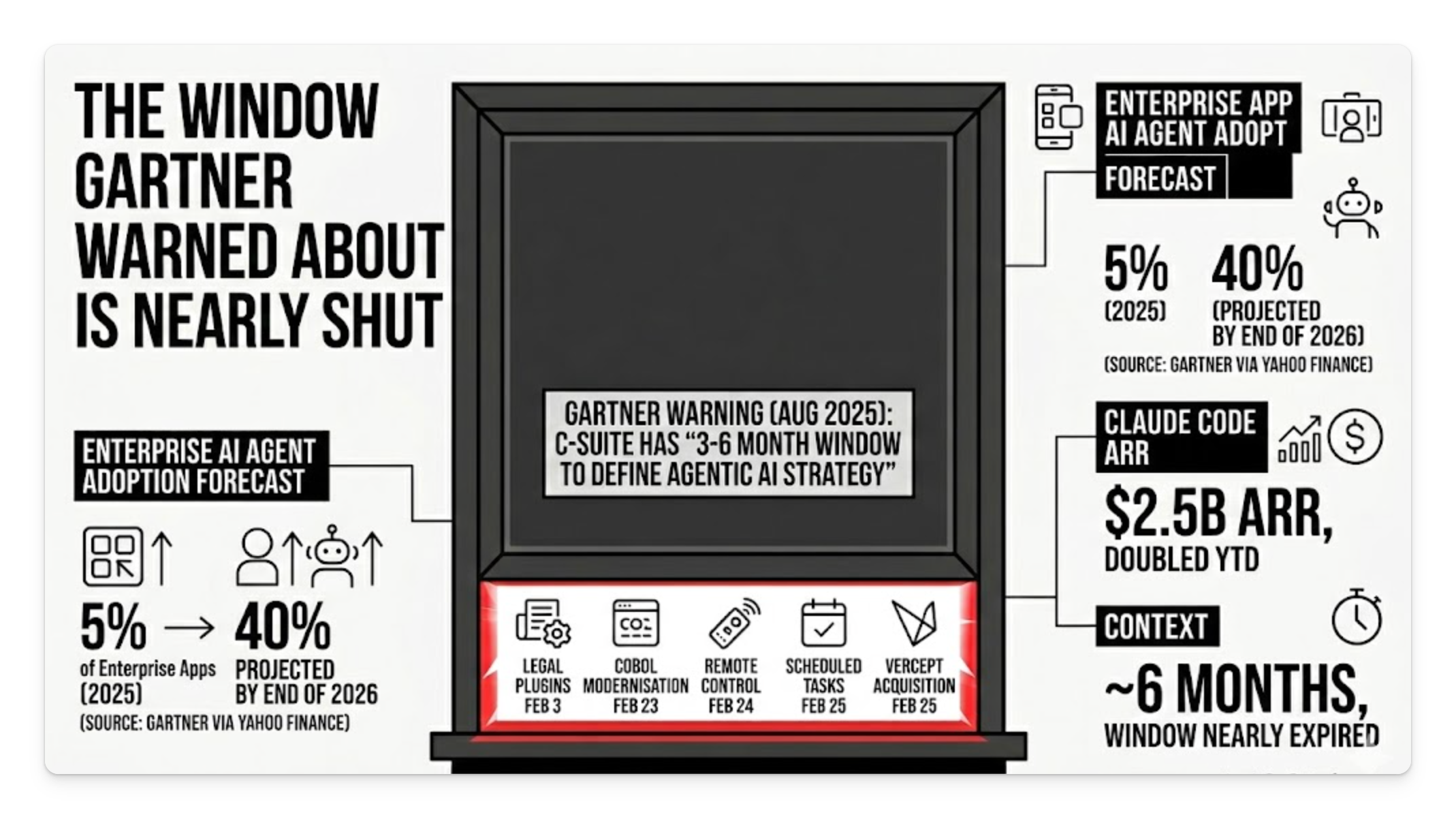
Gartner projects 40% of enterprise applications will embed task-specific AI agents by end of 2026, up from less than 5% today. An eightfold jump in twelve months. And Claude Code is already generating $2.5 billion in annual recurring revenue, doubled year to date.
Daria Cupareanu tested six scheduled workflows within 24 hours of launch, publishing copy-paste prompts for morning briefings, Stripe reports, invoice sorting, and file clean-up. No code. No APIs. Plain English.
Now extrapolate. If a $20/month subscription can produce a morning brief, sort a downloads folder, compile a weekly report, and manage recurring file operations, what happens to the 15-25 hours per week of knowledge work those tasks represent? Not in theory. Right now. The junior analyst building your Monday deck. The operations coordinator pulling numbers from three platforms. The admin scheduling reports and chasing receipts.
These roles don’t vanish overnight. But the number of people needed to fill them drops, fast. And the new role that emerges, agent orchestrator, someone who writes the prompts, reviews the outputs, and improves the workflows, looks nothing like the job it replaces.
The three-to-six-month window that closes faster than anyone planned
Gartner warns C-suite leaders at software companies they have a “three-to-six-month window to define their agentic AI product strategy” or risk falling behind peers. That warning was published in August 2025. Six months later, Anthropic has already shipped the scheduling, perception, and remote steering that make agents practical for daily use.
The window is not closing. It is mostly closed.
For operators and team leads reading this, the calculus is simpler. You are not deciding whether to use agents. You are deciding whether to learn how to direct them now, while the learning curve is gentle, or scramble later when your competitors have already automated the tasks you are still doing by hand.
Open Claude Desktop this week. Set one scheduled task. Pick the most boring recurring job on your plate, the Monday morning report pull, the inbox triage, the folder clean-up. Let Claude run it once. Review the output. That single experiment will tell you more about the next two years of your career than any strategy deck. The agents are already clocking in. The only question is whether you are directing them or competing with them.
Adapt & Create,
Kamil
