




Hi Adopter,
this article is about putting AI to work in your company and becoming the person who takes ownership of making it useful.
It’s 2026. You already know AI matters. But between agent demos and the race to name the best model, it’s easy to feel you need to follow every release before you can do anything useful. You don’t need to win that race to lead a useful project.
After three years advising companies big and small on AI, I keep coming back to the basics. Understand the work. Get the right people involved. Test an improvement and measure the whole job.
The model choice matters when it changes quality, cost, or what your workflow can do. Compare upgrades on the same cases before changing tools. Even Anthropic’s agent-building guidance recommends starting with the simplest solution and adding complexity when it earns its place.
Follow a report all the way through
Take a weekly client report assembled from a CRM, a finance export, and a spreadsheet one colleague fully understands. Ask them to walk you through the last report they finished, with the files open.
What starts the job? Which figures get copied? Where does it wait? Who decides it’s ready?
Then ask for a troublesome case. Maybe finance removed a canceled order but the CRM still showed it as open. Find out who spotted the difference and how they resolved it.
Compare what you saw with the instructions and ask the system owner about rules hidden in code. A mismatch might be an outdated document, a useful workaround, or a defect. Investigate before replacing it.
Give the owner something small to approve
Choose one recurring bottleneck with permitted inputs and someone responsible for the result.
For this report, I’d try drafting commentary from verified figures and approved account notes. The account manager checks it and sends the report.
Bring the owner a concrete proposal. Name the task, tool, permitted data, reviewer, time needed, and decision you’ll make after testing.
If you don’t know whether those notes are permitted in the AI tool, resolving that is your next step. Having a license doesn’t answer the data question.
Check whether an existing feature or spreadsheet formula would solve the bottleneck more easily.

Agree what a finished job looks like
Before testing, record completed reports, turnaround time, active preparation time, checking, corrections, and recurring cost. Keep waiting separate from active work, and record setup costs separately.
Agree acceptance checks with the recipient. I’d propose correct reporting dates, figures matching the approved source, commentary supported by account notes, and unresolved discrepancies flagged for review.
Try ten representative authorized historical cases, including missing notes and conflicting figures. Ten gives you a first look, not proof of a company-wide gain.
Measure the full job. If drafting saves 20 minutes and checking adds 25, you’ve added five minutes of work. That’s an illustration, not a forecast.
METR’s 2025 coding trial found perceived speed and measured completion time diverged. Its 2026 follow-up encountered selection and time-tracking problems. These studies don’t predict your reporting results; they reinforce the need to measure carefully.
Give each part a clear job
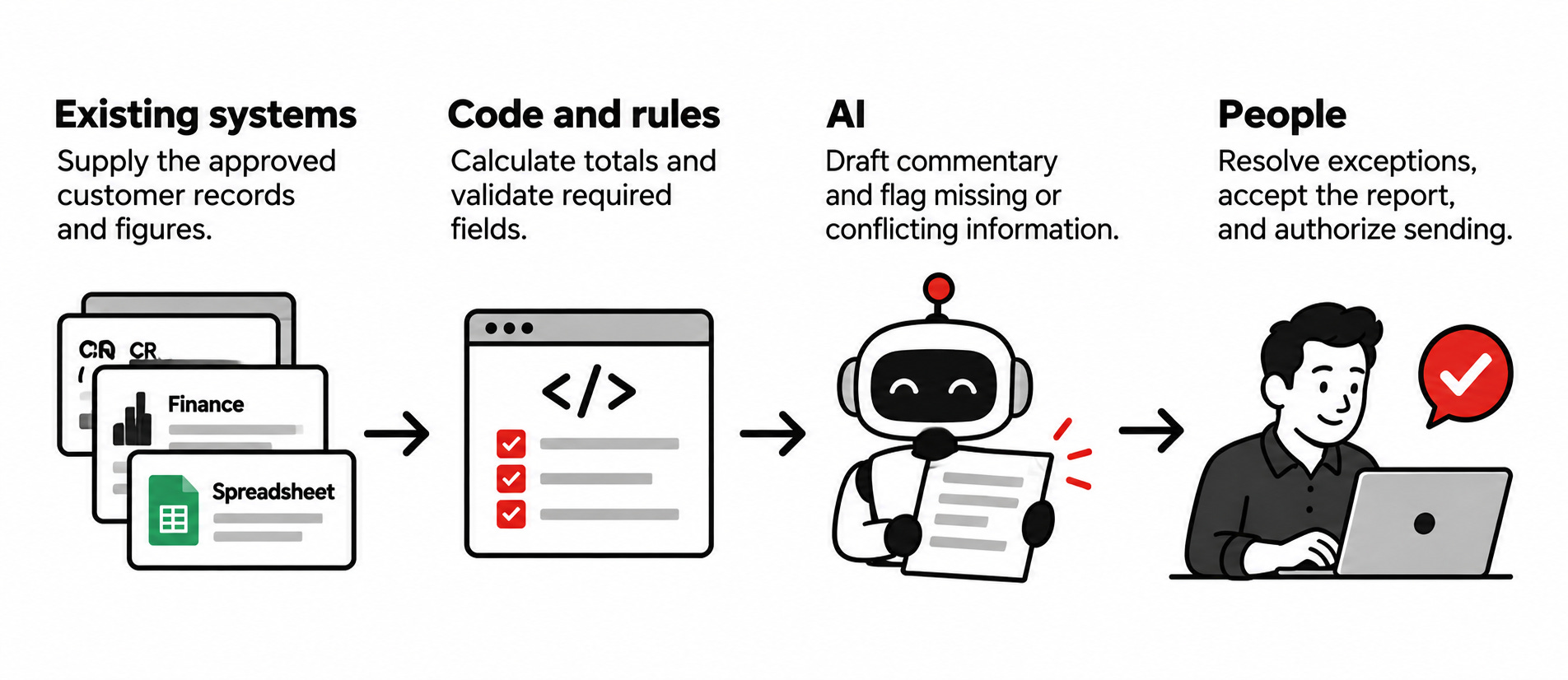
For the reporting test, I’d divide the work this way.
Existing systems: Supply the approved customer records and figures.
Code and established rules: Calculate totals and validate required fields.
AI: Draft commentary and flag missing or conflicting information.
People: Resolve exceptions, accept the report, and authorize sending.
Write down the data definitions and business rules. The AI shouldn’t decide what revenue means because two systems disagree.
Have the system owner enforce access, spending limits, and required approvals in the tools. Telling an agent to ask before sending doesn’t establish an approval control. Anthropic’s permission documentation makes that distinction explicit.
Leave your colleagues something they can run
With the owner’s agreement, let a small group try the workflow after the historical checks. Compare similar work against the same acceptance standard, including everyone’s checking and correction time.
Log failures and turn them into test cases. Agree when to stop, who handles an incident, and how to return to the existing process. Name who reviews changes to the prompt, tool, or rules, consistent with NIST’s voluntary guidance.
If the test earns its place, teach a colleague to run it and name who maintains it. Choose the next project partly by what you can reuse. Use the evidence to review handoffs and approvals.
Get support for the project you own
I’m focusing more of my time on personal, one-to-one coaching because I’ve seen companies make more progress when one person takes ownership and gets support to follow through.
If that’s you, agree the time and authority you need with your manager, and how your contribution will be recognized and rewarded in your role. This work needs room in your week.
I work with you on a real project in your business. Explore one-to-one AI coaching.
The companion Right Click Prompt asks about your role and one frustrating task, then builds a custom plan, checklist, blank scorecard, and note to your manager. If permissions are unclear, it starts with discovery work.
Book 30 minutes with the person doing the job. Ask them to show you the last case that went wrong.
Adapt and Create, Kamil