


Hi Adopter,
Here’s one way to make money with AI: help a sales team prepare for customer calls.
A rep’s customer notes are scattered across files and emails. You build a process that turns those notes into a short call brief and a follow-up draft the rep can check.
You charge for understanding the team’s needs, setting up the process, testing the output and teaching people to use it.
This article walks you through the first offer. You’ll build a sample to show a sales manager, scope a paid pilot and work out your fee. Premium subscribers also get the build instructions, client message and printable Pilot Checklist to put the offer into practice.
Anthropic’s sales plugin is the starting point. The plugin is free; using it in Claude requires a paid plan.
The companies, prices and results below are fictional. The sample brief was written by hand, and the plugin test has not yet run successfully.
Start with one job
Acme Industrial Supply sells packaging equipment to food manufacturers. Its three reps search notes and emails before calls, then write follow-ups and update the CRM afterward.
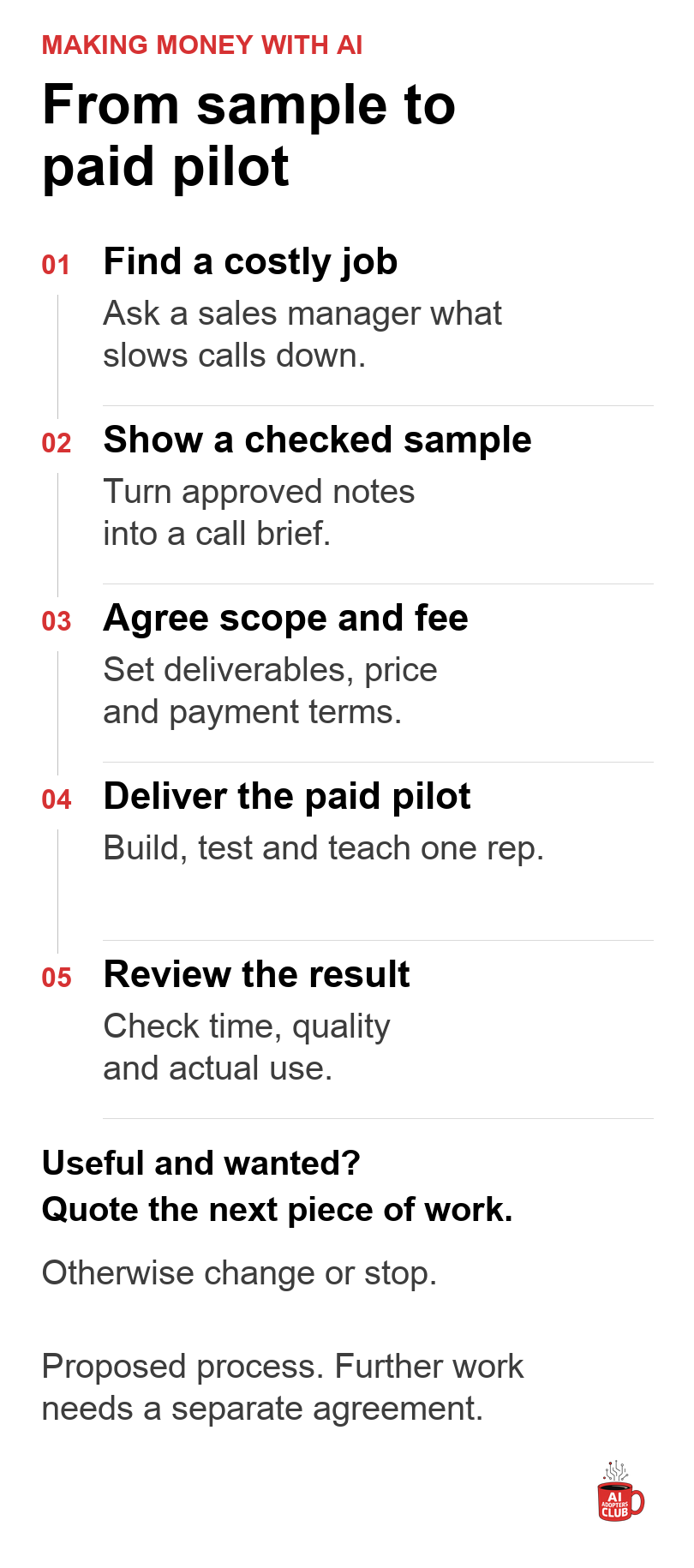
You offer a two-week pilot with one rep and up to ten calls:
Turn approved customer notes into a one-page call brief. Include the customer history, open promises, useful questions, and missing information. After the call, draft a follow-up for the rep to check and send.
Keep the first version limited to approved files. Leave the CRM connection and automatic sending out of the pilot.
Find the problem
Ask the sales manager to walk you through the last customer call.
Where did the rep find the notes?
What was missing?
How long did preparation and follow-up take?
What would a useful brief include?
Would one rep test it for two weeks?
Ask to see a good brief, a poor set of notes, and a useful follow-up. Use fictional or redacted material until the client approves real customer information for the test.
If the team doesn’t have this problem, move on.
Show a useful sample
Start with fictional notes:
October 20: Harbor Foods has two packaging lines and wants shorter changeovers. Operations director Maya Chen asked for a demo.
October 27: Rep Elena promised to check whether the equipment fits the current line width and send demo dates.
Neither note gives a budget or purchase date.
Show the manager what a brief should look like:
Harbor Foods call brief
Reason for the call: Discuss the requested equipment demo. [October 20 notes]
What we know: Harbor has two packaging lines and wants shorter changeovers. [October 20 notes]
Open promise: Elena needs to confirm equipment fit and send demo dates. [October 27 notes]
Questions: What is the current line width? How are changeovers handled today? Who should attend the demo?
Unknown: Budget and purchase date.
Suggested next step: Verify the line width, confirm equipment fit, and offer demo dates.
Every fact leads back to a note. Suggestions are labeled. Missing information stays missing.
Ask the manager whether this would help their rep prepare.
Price a small pilot
Keep the offer clear:
We’ll test this with one rep on up to ten calls over two weeks. We’ll check every brief and compare the time and quality with your current process. Then we’ll decide whether to continue.
For this example, charge $750 for a kickoff, setup, up to ten reviewed test cases, a results meeting, and a handoff. The client pays for Claude and other software separately. Custom software, CRM migration, automatic sending, and unlimited revisions are outside the price.
The $750 is an example, not a market rate.
Check whether it pays for your time. If delivery costs $50, you have $700 left before taxes and overhead. At 12 hours of work, that’s about $58 an hour. At 24 hours, it’s about $29.
Track your hours. Use them to price the next pilot.
The pilot fee pays for this first piece of work. If it helps, agree a separate price for training more reps, adding another call type or providing defined support. Base any ongoing fee on work the client needs and you can deliver.

Premium subscribers get the build instructions below and the Pilot Checklist PDF: discovery questions, a scope to adapt, pricing checks, output tests, a measurement sheet and a handoff checklist.
Use the checklist to prepare your first client conversation and keep track of the work through delivery.